Alternate Spellings of Surname: Petre, Petri, Petrie
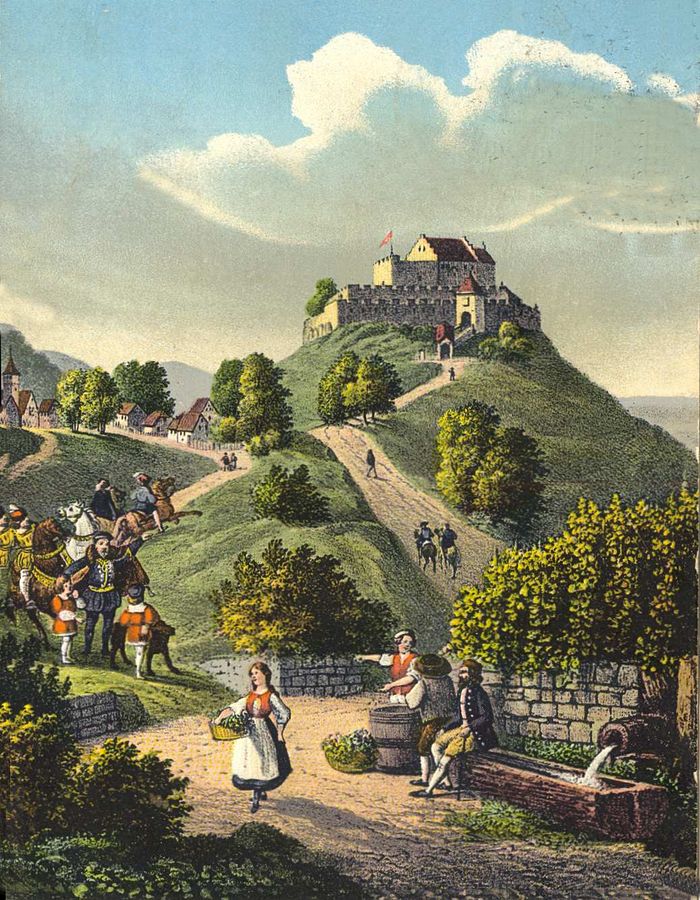
Württemberg Castle, circa 18th Century (Jakob Heinrich Renz, public domain).
Jacob Petre was one of multiple German immigrants who fought to preserve America’s Union as a member of the 47th Pennsylvania Volunteer Infantry during the American Civil War, but unlike many of his fellow 47th Pennsylvanians, he did not join that fight until later in the war when he was either drafted or became one of the new recruits that regimental officers hoped would fill the void left by members of the regiment who had been felled by disease or had been killed in combat.
Despite that late start, he would go on to fight valiantly as a member of the history-making 47th Pennsylvania, serving beside his brothers in blue until the regiment’s final muster out on Christmas Day in 1865.
Formative Years
Born in Baden-Württemberg, Germany in 1831 (alternate birth year: 1834), Jacob Petre emigrated from Germany in 1850, and settled in Northampton County, Pennsylvania in the United States that same year. He had also married in 1850; researchers have not yet determined whether or not that wedding took place before or after he left Germany, but surmised that it may have occurred before his emigration because his wife, Magdalena, was a fellow native of Baden-Württemberg, Germany.
Researchers have, however, been able to determine with certainty that he and his wife, Magdalena, began to welcome children to their home in Northampton County during the 1850s. Their daughter Catharine was born circa 1857, followed by son Anthony, circa 1859. His wife, who was shown on various census records as Magdalena or Margaret, was known to family and friends as “Lena.”
Still employed as a laborer during the early 1860s, Jacob Petre continued to reside with his family in Easton.
American Civil War
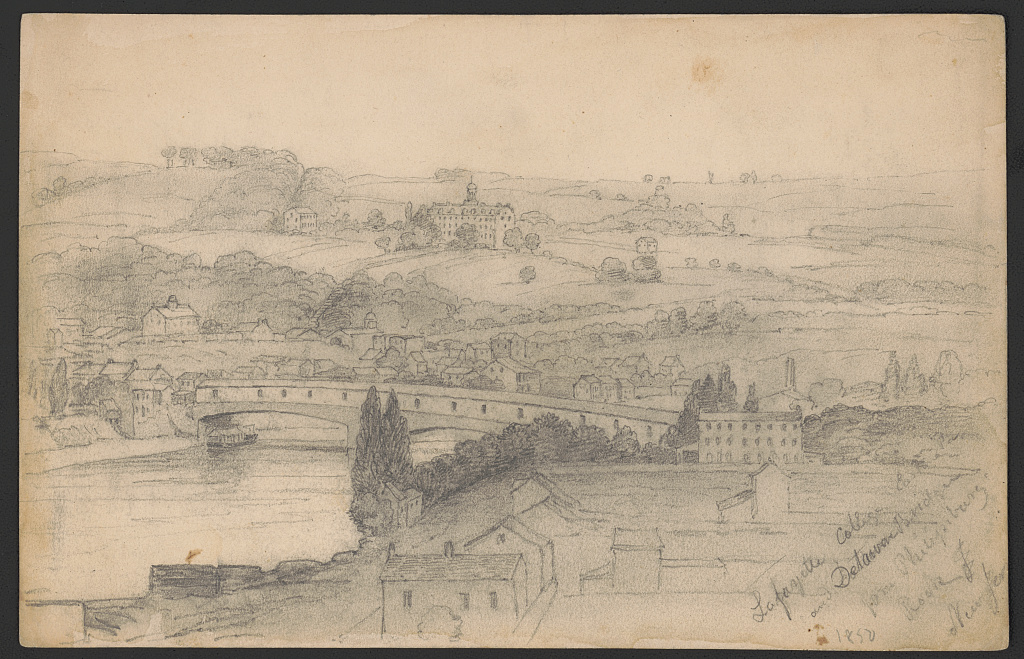
Easton, Pennsylvania viewed from the opposite bank of the Delaware River, circa 1850 (James Fuller Queen, U.S. Library of Congress, public domain).
At the age of thirty-one, Jacob Petre decided that he could no longer sit on the sidelines as his adopted homeland was torn by disunion and civil war and enrolled for military service in Easton, Northampton County, Pennsylvania on 21 November 1863. He then officially mustered in for duty at Camp Curtin in Harrisburg, Dauphin County as a private with Company I of the 47th Regiment, Pennsylvania Volunteer Infantry on 24 November of that same year, but did not connect with his regiment until 18 September 1864—the day before the Battle of Opequan, Virginia.
Military records at the time described him as being five feet, nine inches tall with sandy hair, blue eyes and a fair complexion.
* Note: The delay between Jacob Petre’s muster and connection with his regiment may have been related to his wife’s pregnancy. Their third child, George Petre, was born circa 1864.
Sheridan’s 1864 Shenandoah Valley Campaign
Researchers for 47th Pennsylvania Volunteers: One Civil War Regiment’s Story have not yet determined whether or not Private Jacob Petre fought in the Battle of Opequan on 19 September 1864, but theorize that he most likely did not because he had only connected with his regiment from a recruiting depot the day before that battle unfolded and his commanding officers would likely not have had enough time to assess his readiness for combat. They also theorize that he likely did not participate in the Battle of Fisher’s Hill from 21-22 September for this same reason.

Alfred Waud’s 1864 sketch, “Surprise at Cedar Creek,” captured the flanking attack on the rear of Union Brigadier-General William Emory’s 19th Corps by Lieutenant-General Jubal Early’s Confederate army, and the subsequent resistance by Emory’s troops from their Union rifle-pit positions, 19 October 1864 (public domain).
What is known with relative certainty is that he most likely did participate in his regiment’s subsequent pursuit through Virginia’s Shenandoah Valley of the Confederate States Army troops commanded by Lieutenant-General Jubal Early over the next several weeks and in the Battle of Cedar Creek, Virginia on 19 October 1864.
From a military standpoint, 19 October 1864 turned out to be an impressive, but heartrending day. During that morning, Confederate troops launched a surprise attack directly on the Union Army of the Shenandoah, which was encamped near Cedar Creek, Virginia and was commanded by legendary Major-General Philip H. Sheridan. Early’s men succeeded in capturing Union weapons while freeing a number of Confederates who had been taken prisoner during previous battles — all while pushing seven Union divisions back. According to Samuel P. Bates, author of History of Pennsylvania Volunteers, 1861-5:
When the Army of West Virginia, under Crook, was surprised and driven from its works, the Second Brigade, with the Forty-seventh on the right, was thrown into the breach to arrest the retreat…. Scarcely was it in position before the enemy came suddenly upon it, under the cover of fog. The right of the regiment was thrown back until it was almost a semi-circle. The brigade, only fifteen hundred strong, was contending against Gordon’s entire division, and was forced to retire, but, in comparative good order, exposed, as it was, to raking fire. Repeatedly forming, as it was pushed back, and making a stand at every available point, it finally succeeded in checking the enemy’s onset, when General Sheridan suddenly appeared upon the field, who ‘met his crest-fallen, shattered battalions, without a word of reproach, but joyously swinging his cap, shouted to the stragglers, as he road rapidly past them—“Face the other way, boys! We are going back to our camp! We are going to lick them out of their boots!’

Sheridan Rallying His Troops, Battle of Cedar Creek, Virginia, 19 October 1864 (U.S. Library of Congress, public domain).
The Union’s counterattack ultimately punched Early’s forces into submission to win the day; afterward, the 47th Pennsylvania Volunteers were commended for their heroism by General Stephen Thomas who, in 1892, was awarded the Medal of Honor for his own “distinguished conduct in a desperate hand-to-hand encounter, in which the advance of the enemy was checked” that day.
Following that engagement, Private Jacob Petre and his fellow 47th Pennsylvania Volunteers rested and recuperated. Quartered at Camp Russell near Winchester from November through most of December, the 47th Pennsylvanians were subsequently ordered to relocate to Camp Fairview in Charlestown, West Virginia. Five days before Christmas, they began the thirty-five-mile march to their new home in a driving snowstorm.
According to an 1870 edition of The Lehigh Register, the 47th Pennsylvania Volunteers made their way through Winchester, during that march, and followed the Charlestown and Winchester Railroad line “until two o’clock the following morning” when they were forced to sleep on their arms “until daylight, the guide having lost his way.”

Charlestown West Virginia, circa 1863 (public domain).
Initially using Camp Fairview as a place to hunker down for the winter, the 47th Pennsylvania Volunteers were soon “on constant active duty, guarding the railroad and constructing works for defense against the incursions of guerrillas. The regiment participated in a number of reconnoissances [sic] and skirmishes during the winter” — as the old year of 1864 became the New Year of 1865.
* Note: Private Jacob Petre was wounded in action sometime during Sheridan’s 1864 Shenandoah Valley Campaign — either during the Battle of Cedar Creek or during an encounter with Confederate guerrillas during the campaign’s “mop-up” operations following the battle. According to post-war records created by the federal government, the little finger of his right hand had been “shot off.”
1865 – 1866
By early 1865, according to historians at the Pennsylvania State Archives, the 47th Pennsylvania Volunteers “were employed building blockhouses at all the railroad ‘posts’ (meaning loading stations).” By February, they were assigned to the Provisional Division of the 2nd Brigade of the Army of the Shenandoah. Then, as the end of March approached, according to The Lehigh Register, “The command was ordered to proceed up the valley to intercept the enemy’s troops, should any succeed in making their escape in that direction.”
By 4 April 1865, they were headed for Winchester and Kernstown. Five days later, they received word that General Robert E. Lee had surrendered the Confederate Army of Northern Virginia to Union General Ulysses S. Grant at Appomattox on 9 April 1865. The long war appeared to be over.
In a letter penned to the Sunbury American on 12 April, 47th Pennsylvanian Henry Wharton described the celebration that took place following Lee’s surrender while also explaining to residents of his hometown that Union Army operations in Virginia were still continuing in order to ensure that the Confederate surrender would hold:
Letter from the Sunbury Guards.
CAMP NEAR SUMMIT POINT, Va.,
April 12, 1865Since yesterday a week we have been on the move, going as far as three miles beyond Winchester. There we halted for three days, waiting for the return or news from Torbett’s cavalry who had gone on a reconnoisance [sic] up to the valley. They returned, reporting they were as far up as Mt. Jackson, some sixty miles, and found nary an armed reb. The reason of our move was to be ready in case Lee moved against us, or to march on Lynchburg, if Lee reached that point, so that we could aid in surrounding him and [his] army, and with Sheridan and Mead capture the whole party. Grant’s gallant boys saved us that march and bagged the whole crowd. Last Sunday night our camp was aroused by the loud road of artillery. Hearing so much good news of late, I stuck to my blanket, not caring to get up, for I suspected a salute, which it really was for the ‘unconditional surrender of Lee.’ The boys got wild over the news, shouting till they were hoarse, the loud huzzas [sic] echoing through the Valley, songs of ‘rally round the flag,’ &c., were sung, and above the noise of the ‘cannons opening roar,’ and confusion of camp, could be heard ‘Hail Columbia’ and Yankee Doodle played by our band. Other bands took it up and soon the whole army let loose, making ‘confusion worse confounded.’
The next morning we packed up, struck tents, marched away, and now we are within a short distance of our old quarters. – The war is about played out, and peace is clearly seen through the bright cloud that has taken the place of those that darkened the sky for the last four years. The question now with us is whether the veterans after Old Abe has matters fixed to his satisfaction, will have to stay ‘till the expiration of the three years, or be discharged as per agreement, at the ‘end of the war.’ If we are not discharged when hostilities cease, great injustice will be done.
The members of Co. ‘C,’ wishing to do honor to Lieut. C. S. Beard, and show their appreciation of him as an officer and gentleman, presented him with a splendid sword, sash and belt. Lieut. Beard rose from the ranks, and as one of their number, the boys gave him this token of esteem.
A few nights ago, an aid [sic] on Gen. Torbett’s staff, with two more officers, attempted to pass a safe guard stationed at a house near Winchester. The guard halted the party, they rushed on, paying no attention to the challenge, when the sentinel charged bayonet, running the sharp steel through the abdomen of the aid [sic], wounding him so severely that he died in an hour. The guard did his duty as he was there for the protection of the inmates and their property, with instruction to let no one enter.
The boys are all well, and jubilant over the victories of Grant, and their own little Sheridan, and feel as though they would soon return to meet the loved ones at home, and receive a kind greeting from old friends, and do you believe me to be
Yours Fraternally,
H. D. W.

Spectators gather for the Grand Review of the Armies, 23-24 May 1865, beside the crepe-draped U.S. Capitol, flag at half-staff after the assassination of President Abraham Lincoln (Matthew Brady, U.S. Library of Congress, public domain).
Two days later, that fragile peace was shattered when a Confederate loyalist fired the bullet that ended the life of President Abraham Lincoln. By 19 April 1864, they were responsible for helping to ensure that the nation’s capital was safe in the wake of a presidential assassination that threatened to reignite the civil war they had just helped to end. Making camp near Fort Stevens, they were issued new uniforms and additional ammunition.
Letters sent to friends and family back home during this period and newspaper interviews that were conducted, post-war, with survivors of the 47th Pennsylvania confirm that at least one 47th Pennsylvania Volunteer was given the high honor of guarding President Lincoln’s funeral train while others may have guarded the key Lincoln assassination conspirators during the early days of their imprisonment and trial, which began on 9 May 1865. During this phase of service, the regiment was headquartered at Camp Brightwood.
Attached to Dwight’s Division of the 2nd Brigade, Department of Washington’s 22nd Corps, the 47th Pennsylvania Volunteer Infantry also participated in the Union’s Grand Review of the National Armies on 23 May.
Reconstruction
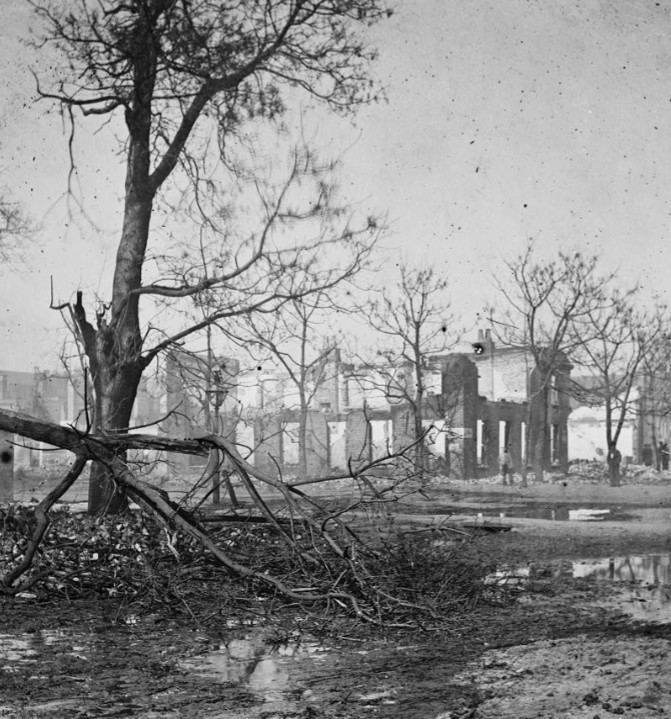
War-damaged houses in Savannah, Georgia, 1865 (Sam Cooley, U.S. Army, U.S. Library of Congress, public domain).
During the final months of their service to the nation, Private Jacob Petre and his fellow 47th Pennsylvania Volunteers were ordered to head for America’s Deep South, where they were directed to take up Reconstruction-related duties in Savannah, Georgia from in early June. Attached again to Dwight’s Division, this time, they were assigned to the 3rd Brigade, U.S. Department of the South.
Relieving the 165th New York in July, they were subsequently housed in a mansion formerly owned by the Confederate Secretary of the Treasury in Charleston, South Carolina, where they assumed provost-related responsibilities related to local government operations.
Finally, on Christmas Day, 1865, the 47th Pennsylvania Volunteers were honorably mustered out for the final time in Charleston, South Carolina — a process that continued through early January 1866. Following a stormy voyage north, they disembarked in New York City, and were then transported to Philadelphia by train, where the regiment was officially honorably discharged at Camp Cadwalader on 9 January 1866.
Return to Civilian Life
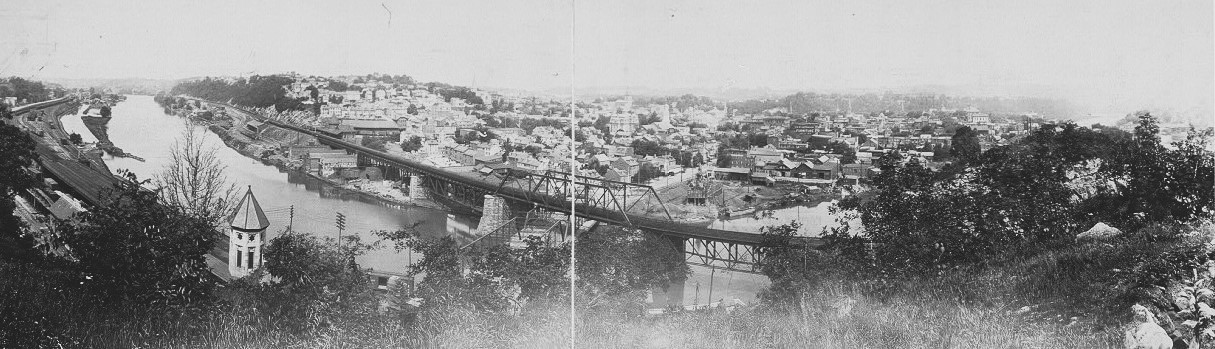
Easton, Pennsylvania, circa 1896 (U.S. Library of Congress, public domain; click to enlarge).
Following his honorable discharge from the military, Jacob Petre returned home to Northampton County, Pennsylvania, where he tried to begin life anew. A blue-collar laborer, he was a member of the Protestant faith throughout his post-war life.
On 30 August 1867, Jacob Petre and his wife, Magdalena, welcomed the birth of son Peter Philipp Petre. His son was later baptized on 4 June 1868. By 1870, their South Easton household included children Catharine (aged thirteen), Anthony (aged eleven), George (aged six), and Philipp (aged three). That year’s federal census enumerator had noted that those children had all been born in Pennsylvania, except for George, who had been born in New Jersey — a birth that occurred while Jacob Petre had been serving with the 47th Pennsylvania during the American Civil War.
Residents of Easton’s Sixth Ward in 1880, the Petre household included Jacob and his wife, “Lena,” and their children Andrew, a twenty-year-old cigar maker; “Charles,’ who was shown on the prior census as “George,” and was now a sixteen-year-old laborer in a stone quarry; and Peter Philip, who was twelve years old, but was not documented as currently being in school.
On 3 February 1883, Jacob Petre filed for, and was awarded, a U.S. Civil War Pension in recognition of the health problems he had developed during his service with the Union Army. The next year, a city directory documented that he was a laborer who resided at 30 North Herster Street in Easton.
By 1890, he was residing in Easton’s Fourth Ward. That year’s special veterans’ census confirmed that the little finger on his right hand had been “shot off” during his military service.
Illness, Death and Interment
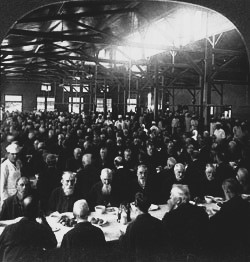
Union Army veterans ate together in the dining hall at the U.S. National Home for Disabled Volunteer Soldiers in Dayton, Ohio, circa 1890s (U.S. National Park Service, public domain).
Suffering from a hernia and heart disease, Jacob Petre was admitted, discharged from, and readmitted to various hospitals that were part of the network of U.S. National Homes for Disabled Volunteer Soldiers throughout his later life.
On 29 August 1893, Jacob Petre was admitted to the U.S. National Home for Disabled Volunteer Soldiers in Dayton, Ohio, where he remained under the care of physicians, receiving treatment for his hernia, until 12 April 1894, when he checked himself out of the hospital. His pension rate was documented in that hospital’s admissions ledger as six dollars per month; his discharge paperwork was sent to Easton, Pennsylvania in care of George H. Young.
On 6 July 1896, Jacob Petre was readmitted to the U.S. National Home for Disabled Volunteer Soldiers system — but this time, he was admitted to the Soldiers’ Home in Hampton, Virginia. Once again, he checked himself out of the hospital, this time on 31 December 1896. Admissions records for that same Soldiers’ Home documented that he was readmitted there on 1 April 1899, but did not document his date of discharge. In August of that same year, his pension rate was increased from six to eight dollars per month.
Researchers theorize that his repeated pattern of admissions and discharges may have been due to the fact that he needed the medical care that a soldiers’ home could provide him, but quickly tired of the regimented life that was typical of those soldiers’ care facilities. According to historians at the U.S. National Park Service, “The veterans living at the National Home branches were subject to the Articles of War, which dictated how soldiers should conduct themselves,” and “were organized into companies of 150 men, commanded by a captain.”
Every morning, one captain designated as “Officer of the Day” inspected the buildings and grounds to ensure that all regulations were observed. A branch governor, normally a Civil War veteran as well, managed each National Home branch. A deputy governor, secretary, and treasurer supported the discharge paperwork was sent to Easton, Pennsylvania in care of George H. Younghismanager. Later the National Home branches added additional managerial positions including a quartermaster, surgeon, and chaplain.
The veterans who were admitted were also “required to wear uniforms.”
The United States Army had a surplus of uniforms following the Civil War, so the National Home for Disabled Volunteer Soldiers adopted the uniform of the Army as its uniform. Once the surplus ran out, the National Home for Disabled Volunteer Soldiers continued to have uniforms made.
At the Dayton, Ohio branch, where Jacob Petre was first admitted, church services and prayer meetings were conducted on a weekly basis while “daily court” sessions were held “to deal with infractions of members who did not follow the rules.”
Examples of infractions included bringing liquor onto campus or disorderly conduct. Punishments ranged from detention in the guard house to a fine or being deprived of pay for labor, to the extreme of expulsion from the National Home system. In general, the punishments were applied sparingly; The goal was to provide structure but not have too heavy a hand.
A typical schedule was patterened after what soldiers had experienced during the war with reveille sounded at 5 a.m., breakfast at 5:45 a.m., dinner at noon, supper at 5:30 p.m., fatigue duty at 7:30 p.m., sick call at 7:45 p.m., tattoo at 9 p.m., and taps at 9:30 p.m., when veterans bedded down for the night in their respective assigned barracks. Meals typically followed a routine with breakfast consisting of eggs, meat hash, or fish, plus bread, butter and coffee. Their noon meals were generally the largest each day, and consisted of some form of boiled, corned, or roast beef, mutton or veal, plus potatoes, vegetables, bread, and coffee or tea. Supper, a lighter evening meal, was often simply just a dish of apple sauce or prunes, or a small plate of cheese and crackers. Tea was their evening beverage, presumably to reduce their caffeine intake, enabling them to sleep soundly.
Their free time was often filled with trips to the campus library or theatre, where they had the opportunity to attend concerts, lectures or plays.
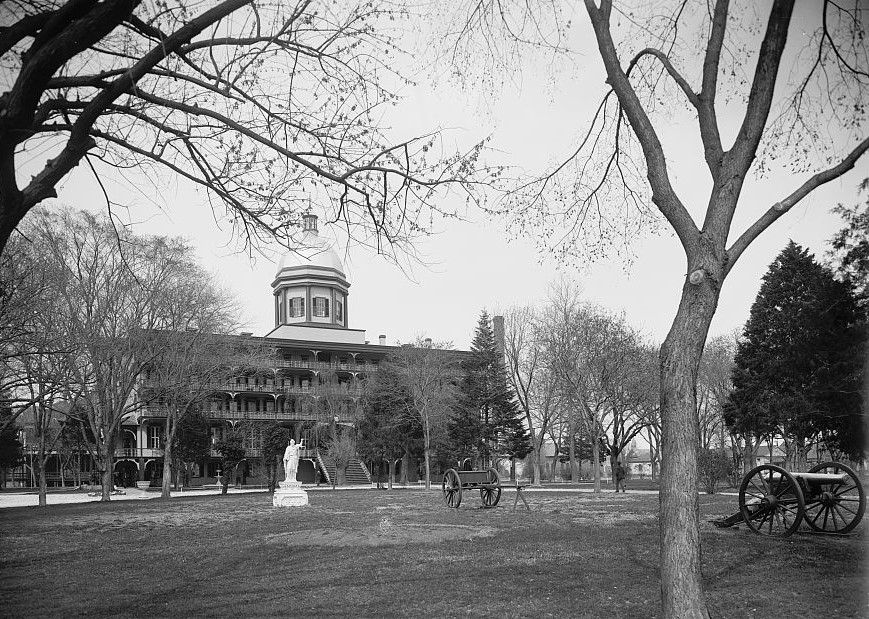
Main Building, National Home for Disabled Volunteer Soldiers, Hampton, Virginia, circa 1902 (U.S. Library of Congress, public domain).
By June of 1900, Jacob Petre was documented by a federal census enumerator as one of the residents of the Northern Branch of the U.S. National Homes for Disabled Volunteer Soldiers in Elizabeth City, Virginia, who noted that he had been born in 1831 and had been married for fifty years, indicating that he had emigrated from Germany in 1850 and had been married roughly around that same time, but that he had never chosen to become a naturalized citizen of the United States.
Readmitted to the National Soldiers’ Home in Hampton, Virginia sometime after that, he was reportedly dropped from that hospital’s admissions records on 14 September 1905 for being “AWOL” (absent without leave). Readmitted on 11 April 1906, he appears to have continued to live out his remaining years there.
Diagnosed with mitral insufficiency, he died there on 28 January 1908 and was subsequently laid to rest at the Hampton National Cemetery. His hospital admissions record noted that his final effects were valued at seventy-seven dollars, but did not document whether or not those effects were distributed to any surviving family members.
Sources:
- Bates, Samuel P. History of Pennsylvania Volunteers, 1861-5, vol. 1. Harrisburg, Pennsylvania: B. Singerly, State Printer, 1869.
- “Camp Russell.” The Historical Marker Database, retrieved online December 27, 2023.
- “Civil War, 1861-1865.” Stephens City, Virginia: Newtown History Center, retrieved online December 27, 2023.
- “Daily Life at the National Home for Disabled Volunteer Soldiers.” Washington, D.C.: U.S. National Park Service, retrieved online 4 May 2024.
- Diaries of Jeremiah Siders (Company H. 47th Pennsylvania Volunteer Infantry), in “Pennsylvania Military Museum Collections, 1856-1970” (MG 272). Harrisburg, Pennsylvania: Pennsylvania State Archives.
- Dyer, Frederick H. A Compendium of the War of the Rebellion, p. 1589. Des Moines, Iowa: The Dyer Publishing Company, 1908.
- “Late Pensions.” Allentown, Pennsylvania: The Allentown Democrat, 9 August 1899.
- Noyalas, Jonathan. “The Fight at Cedar Creek Was Over. So Why Couldn’t Union Troops Let Their Guard Down?” Arlington, Virginia: HistoryNet, 27 February 2023.
- Peter, Jacob, in “Registers of Pennsylvania Volunteers, 1861-1865: 47th Regiment, Co. I,” in Records of the Department of Military and Veterans’ Affairs. Harrisburg, Pennsylvania: Pennsylvania State Archives.
- Petre, Jacob, in Civil War Muster Rolls (Co. I, 47th Pennsylvania Infantry). Harrisburg, Pennsylvania: Pennsylvania State Archives.
- Petre, Jacob, in Civil War Veterans’ Card File (Co. I, 47th Pennsylvania Volunteer Infantry). Harrisburg, Pennsylvania: Pennsylvania State Archives.
- Petre, Jacob, in U.S. Census (Special Schedule.—Surviving Soldiers, Sailors, and Marines, and Widows, etc.: Easton, Fourth Ward, Northampton County, Pennsylvania, 1890). Washington, D.C.: U.S. National Archives and Records Administration.
- Petre Jacob, in U.S. Census (Northern Branch, National Soldiers’ Home for Disabled Union Soldiers, Elizabeth City, Virginia, 1900). Washington, D.C.: U.S. National Archives and Records Administration.
- Petre, Jacob, in U.S. Civil War Pension General Index Cards (application no.: 471561, certificate no.: 729756; filed by the veteran, an invalid, from Pennsylvania, 3 February 1883). Washington, D.C.: U.S. National Archives and Records Administration.
- Petre, Jacob, in U.S. National Cemetery Interment Control Forms (Hampton National Cemetery, Hampton, Virginia, 1908). Washington, D.C.: U.S. National Archives and Records Administration.
- Petre, Admissions Records (U.S. National Homes for Disabled Volunteer Soldiers, Dayton, Ohio, 29 August 1893-12 April 1894; and Hampton, Virginia, multiple admissions between 1896 and 1908), Washington, D.C.: U.S. National Archives and Records Administration.
- Petre, Jacob, Margaret, Catharine, Anthony, George, and Phillip, in U.S. Census (Easton, West Ward, Northampton County, Pennsylvania, 1870). Washington, D.C.: U.S. National Archives and Records Administration.
- Petre, Jacob, Lena, Anthony, Charles, and Peter Philip, in U.S. Census (Easton, Sixth Ward, Northampton County, Pennsylvania, 1880). Washington, D.C.: U.S. National Archives and Records Administration.
- Petri [sic], Jacob (father), Magdalena (mother), and Peter Philipp, in Birth and Baptismal Records (St. John’s Lutheran Church, Easton, Pennsylvania, 1867-1868). Easton, Pennsylvania: St. John’s Lutheran Church.
- Petry [sic], Jacob, in Easton, South Easton, Phillipsburg, Bethlehem, and South Bethlehem Directory for 1884-5, p. 112. Easton, Pennsylvania: J. H. Lant, 1884.
- Schmidt, Lewis. A Civil War History of the 47th Regiment of Pennsylvania Veteran Volunteers.” Allentown, Pennsylvania: Self-published, 1986.
- “The History of the Forty-Seventh Regt. P. V.” Allentown, Pennsylvania: The Lehigh Register, 20 July 1870.
- Wharton, Henry D. Letters from the Sunbury Guards, 1861-1868. Sunbury, Pennsylvania: Sunbury American.
 47th Pennsylvania Volunteers
You must be logged in to post a comment.