
A beautiful garden tribute to Private Benjamin Missmer, 47th Pennsylvania Volunteers was created by his descendant, Sylvia Matis De Luca (photo used with permission of Sylvia Matis De Luca).
Alternate Spellings of Surnames: Messamer, Messmer, Messimer, Missmer, Missimer
One hundred and sixty years after one young man enlisted with the Union Army during the American Civil War, the story of his great sacrifice continues to resonate with children and adults who have come to know him through efforts by his present-day descendants to keep his memory alive.
That young man, who made his mark in history by marching off to war in place of another Pennsylvanian, was Benjamin Missmer.
Formative Years
Born in Lehigh County, Pennsylvania circa 1844, Benjamin Missmer was a son of Samuel Missimer (1802-1887), who was a native of the Electorate of Bavaria (now part of Germany), and Lehigh County, Keystone State native Catharine (Hartman) Missimer (1803-1880). He was raised in the bucolic Lehigh Valley with his siblings: Angelina Missimer (1828-1914), who was born in Pennsylvania on 2 July 1828 and later wed Edmund W. Kreider (1829-1904); Willoughby H. Missimer (1832-1891), who was born in Lower Macungie Township, Lehigh County on 12 September 1832 and later wed Carolina A. Krause (1835-1910) on 27 August 1854; Henry John Missmer (1837-1922), who was born in Lower Milford Township, Lehigh County on 21 March 1837 and later wed Lavina L. Simons (1839-1913) in 1861; Samuel Missmer (1839-1917), who was born in Macungie, Lehigh County on 19 March 1839 and later wed Anna Treichler (1846-1925); Fianna Missmer (1841-1913), who was born in Upper Macungie Township, Lehigh County on 4 June 1841 and later wed Tilghman Reuben Laubach (1842-1917); and Anna Amelia Missmer (1846-1926), who was born in Upper Macungie Township on 1 March 1846, was known to family and friends as “Amelia,” and later wed Henry W. Ehrie (1835-1876).
The family’s patriarch, Samuel Missimer, was the first cigarmaker to set up shop in their community. He also helped to found the Emanuel Evangelical Church, according to Allentown’s Morning Call newspaper.
* Note: A newspaper account of the family’s early life noted that the Missimer family’s home was situated on land that would later be occupied by the home of Ammon H. Bachman, head of the Star Electric Company in 1926.
Sometime during the late 1840s or early in 1850, Benjamin’s older sister, Angelina Missimer, married and began making a life with Edmund Kreider. They welcomed the birth of a son, Milton Charles Kreider (1854-1921), on 22 March 1854. Around that same time, Benjamin’s older brother, Willoughby Missimer, also left the family home to begin his own new life. Following Willoughby’s marriage to Carolina Krause on 27 August 1854, he and his wife welcomed the birth of a daughter, Ella Missimer (1855-1920), on New Year’s Eve in 1855.
By August of 1850, Benjamin Missmer was living in Upper Macungie Township, Lehigh County with his parents and siblings Henry, Fianna and Amelia. Their father supported them on the wages of a laborer and was documented by that year’s federal census enumerator as the owner of real estate that was valued at three hundred dollars (the equivalent of roughly twelve thousand dollars in 2024). The enumerator also noted that Henry, Fianna and Benjamin had all attended school during the previous academic year.
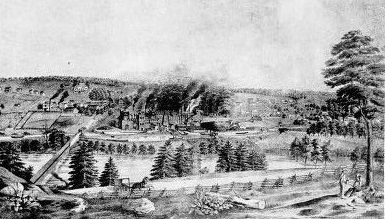
Catasauqua, Lehigh County, Pennsylvania (circa 1852, public domain).
By 25 June 1860, the Missimer family was residing in Catasauqua, Lehigh County, where family patriarch Samuel was employed as a cigarmaker whose real estate and personal property were valued by that year’s federal census enumerator at two thousand one hundred and fifty dollars (the equivalent of roughly sixty-one thousand dollars in 2024). Residing with Samuel and his wife were their teenaged son, Benjamin, and his siblings: Henry, a twenty-three-year-old laborer; Samuel, a twenty-year-old blacksmith; and daughters Fianna, Amelia, and Mary, who had been born circa 1854. Both Benjamin and Amelia had attended school during the recent academc year.
* Note: According to Missmer family historian Sylvia Matis De Luca, at least one member of the Missimer/Missmer family had ties to the wealthy and prominent Fuller family of Catasauqua: Maria Simons. Maria was a sister-in-law of Benjamin Missmer’s brother, Henry J. Missmer, and was employed as a servant by the family of James W. Fuller, Sr., a Mayflower descendant who became a powerful, internationally respected business executive. Following her death in 1923, she was reportedly interred in the Fuller family’s plot at the Fairview Cemetery in recognition of her longtime service to the family.
Researchers for 47th Pennsylvania Volunteers: One Civil War Regiment’s Story have been able to confirm that a sixteen-year-old servant named Maria Simons did indeed work for the Fuller family in 1860. Employed by James W. Fuller, Sr. and his wife, Clarissa, she was documented by that year’s federal census enumerator on 25 June 1860 as having attended school during that academic year.
Of perhaps even greater interest, though, is the name of another young woman who was also listed as a servant of James and Clarissa Fuller at this same time–Fianna Missmer, who was Benjamin Missmer’s nineteen-year-old sister.
The known ties between the Fuller and Missimer/Missmer families become even more intriguing when placed in context with the documented history of the American Civil War and historical documents associated with the life of Benjamin Missmer.
American Civil War
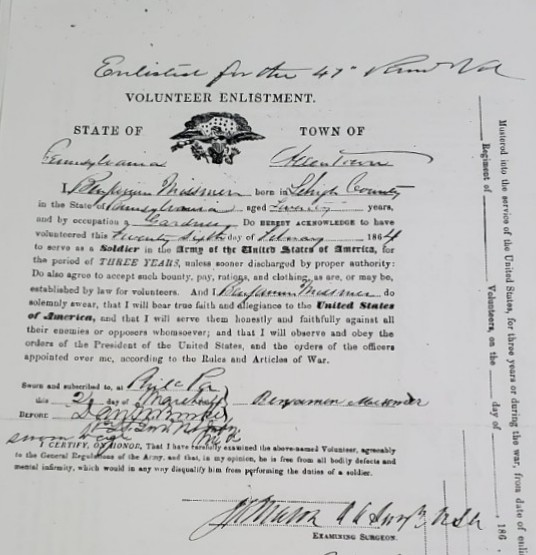
Excerpt: Enlistment paperwork, Private Benjamin Missmer, 47th Pennsylvania Volunteers (used with permission, courtesy of Sylvia Matis De Luca; click to enlarge).
On 1 February 1864, President Abraham Lincoln issued a call for five hundred thousand men to enlist with the Army of the United States and serve for three years, or for the duration of the war, if need be.
Just over three weeks later, twenty-year-old Benjamin Missmer responded to that call by enlisting for military service in Allentown, Lehigh County on 26 February 1864. He then officially mustered in for duty in Philadelphia on 2 March 1864 as a private with Company H of the 47th Pennsylvania Volunteer Infantry.
But he did so as a substitute for another Lehigh County resident who was choosing not to answer the president’s call–for a reason that has still not been determined more than one hundred and sixty years after that fateful month.
* Note: According to Missimer/Missmer family historian Sylvia Matis De Luca, Benjamin Missmer was employed as a gardener for a wealthy family in Catasauqua–quite possibly the family of James W. Fuller, Sr., who had already been employing Benjamin’s sister, Fianna, and the sister-in-law of Benjamin’s brother, Henry J. Missmer. This oral history is likely accurate because there were two sons of James W. Fuller, Sr. who would have been plausible candidates to have sought out Benjamin Missmer’s service as a substitute: James Wheeler Fuller, Jr. and Orange Miller Fuller. Both were of age and eligible for the federal government’s military draft of 1864 when Benjamin Missmer was recruited to serve as a substitute and both of the Fullers had previously served only brief stints in the Union Army–despite their apparent fitness for duty:
1. James Wheeler Fuller, Jr. (1845-1910) was seemingly of eligible age when he enrolled for miltary service in Catasauqua on 21 August 1861. Initially awarded the rank of sergeant with Company F of the 47th Pennsylvania Volunteer Infantry (the same regiment and company in which two of his uncles had also enrolled), he was commissioned as a first lieutenant and appointed as the regimental adjutant to the regiment’s central command staff on 1 October of that same year–without having seen combat or having apparently distinguished himself by any other traditional military action that would have warranted such a promotion. This effort to reassign him to a “desk job” that would likely be nowhere near enemy fire was possibly done when senior officers realized he was only fifteen or sixteen and not yet old enough to serve as an officer in combat under the Union Army’s enlistment rules–or it may have been done at the request of his father, a major seller of horses to federal military troops who was also a close, personal friend of Pennsylvania Governor Andrew Gregg Curtin. Whatever the reasons for this change in rank and assignment, James W. Wheeler, Jr. reportedly fell ill and subsequently resigned his commission on 9 January 1862–roughly two weeks before his regiment was scheduled to be shipped to the heart of enemy territory in America’s Deep South.
2. Despite being older than his brother James, Orange M. Fuller (1841-1902) served even less time in the Union Army. Enrolled on 3 July 1863, he officially mustered in that same day as a nineteen-year-old private with Company B of the 38th Pennsylvania Militia Emergency of 1863, which was formed in response to the threatened invasion of Pennsylvania by Confederate General Robert E. Lee’s Army in July 1863. That militia unit was then disbanded on 7 August of that same summer when state officials determined that the threat was over.
Regardless of whomever arranged the substitute agreement with Benjamin Missmer, or whatever the specific details of that arrangement were, it is important to remember that the federal government’s Enrollment Act of 1863 stipulated that any draftee with the financial means to avoid being drafted was able to do so by paying the government a commutation fee of three hundred dollars to avoid military service–or, in lieu of that payment, could hire a substitute–a loophole which meant that a draftee could hire someone from a lower income bracket and pay him less than three hundred dollars if that draftee was in a position of authority or held some other power over the substitute he was attempting to recruit–which might have been the case with one of the Fuller brothers, whose parents employed at least two members of Benjamin Missmer’s family (and may have also employed Benjamin).
Researchers do not yet know whether or not Benjamin Missmer actually received any money from the draftee he replaced, but do know that he was paid at least some of the bounty funds he was promised by the federal government when he enlisted with the 47th Pennsylvania Volunteers. Entitled to ninety dollars, he was given the first sixty dollars by the time that his service ended.
Military records at the time of muster in described Benjamin Missmer as a twenty-year-old Lehigh County native who was employed as a gardener, and noted that he was five feet, six inches tall with brown hair, gray eyes and a fair complexion.
Furnished with military clothing that was valued at slightly more than twenty-five dollars, he was transported from Philadelphia to America’s Deep South, where he connected with his regiment sometime in March or April of that year. He was joining a combat-hardened regiment that was making history as the only regiment from Pennsylvania to fight in the Union’s 1864 Red River Campaign across Louisiana.
Red River Campaign

Union Army base at Morganza Bend, Louisiana, circa 1863-1865 (U.S. Library of Congress, public domain).
By late April 1864, the 47th Pennsylvania Volunteer Infantry had fought in the Battles of Sabine Cross Roads and Pleasant Hill (8-9 April), as well as Cane River (23 April), during which the regiment sustained multiple casualties from disease-related causes, as well as from Confederate rifle and artillery fire.
Documented as “present” on regimental muster rolls for the months of May and June, Private Benjamin Missmer was also described on those same muster sheets as having been “Sick in Regt Hospl” for an unspecified portion of that time. The muster rolls for July and August were even more concerning, listing him as “absent” and “Sick in Hospl.”
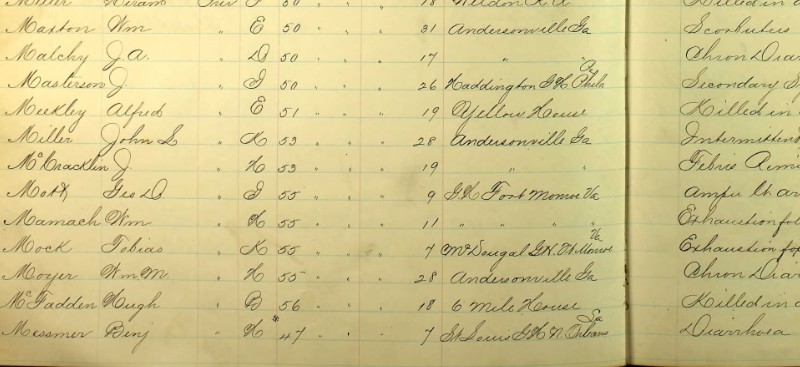
Hospitalization and death ledger entries: Private Benjamin Missmer, 47th Pennsylvania Volunteers, 7 August 1864 (U.S. Registers of Deaths of Volunteer Soldiers, U.S. National Archives and Records Administration, public domain; click to enlarge).
In truth, Private Benjamin Missmer had become very ill within three months of signing up to serve as a substitute soldier for a fellow resident of Catasauqua, Pennsylvania. Felled by one of the tropical diseases that had sickened so many of his comrades during the long marches across Louisiana, or by the dysentery that was spread by the poor water quality available to the 47th Pennsylvania Volunteers and the close, often unsanitary conditions in which they were forced to live, he found himself visiting the latrine more and more frequently as the symptoms associated with the diarrhea he was experiencing worsened. Initially uncomfortable and, at times, likely embarassing, his frequent bouts with disease soon interfered with his ability to effectively perform his duties as an infantryman in enemy territory. As his condition became chronic, it weakened him to the point that he needed to be hospitalized.
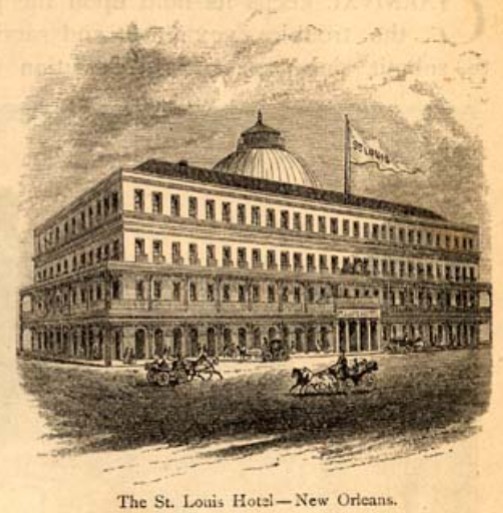
The Union Army’s St. Louis General Hospital was housed in the former St. Louis Hotel in New Orleans, Louisiana (St. Louis Hotel, circa 1875, public domain).
Initially confined to the 47th Pennsylvania’s regimental hospital, he was subsequently transported to the St. Louis Hospital in New Orleans, Louisiana, where he died from disease-related complications on 7 August 1864. Laid to rest at the Monument Cemetery (now the Chalmette National Cemetery) in St. Bernard Parish, Louisiana on 8 August, his service to the nation was later memorialized on the Soldiers’ Monument at the Fairview Cemetery in West Catasauqua, Lehigh County, which was dedicated on 3 October 1866.
When his personal effects were tallied, Union Army clerks noted that Private Missmer had been wearing or carrying just the bare essentials of an infantryman on the march: one cap, one flannel shirt, one vest, one pair of socks, one pair of shoes, one knapsack, one woolen blanket, and one rubber blanket.
What Happened to Benjamin Missmer’s Family?
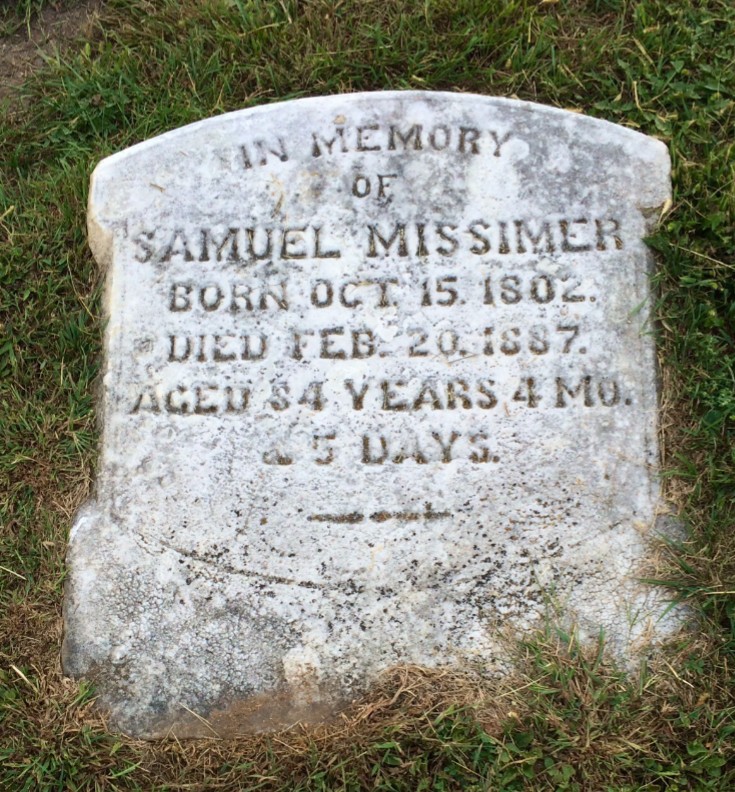
Samuel Missimer’s gravestone, Fairview Cemetery, West Catasauqua, Pennsylvania, 2014 (used with permission, courtesy of Christian N.).
Both of Benjamin’s parents survived him by more than a decade. By 1870, they were “empty nesters” who lived alone in Catasauqua. Ailing with dropsy, Catharine (Hartman) Missimer subsequently died in Lehigh County at the age of seventy-six, on 31 May 1880, and was laid to rest at the Fairview Cemetery in West Catasauqua. Samuel Missimer, who survived her by nearly seven years, passed away in Catasauqua at the age of eighty-four, on 20 February 1887. He was then laid to rest beside her.
Benjamin’s older brother, Willoughby Missimer, went on to become a wheelwright and had a large family with his wife, Carolina. Following the birth of daughter Ella in 1855 (who later wed Edward F. Rudy), they welcomed the arrivals of: Emma L. Missimer (1865-1961), who was born in Saegersville, Lehigh County on 12 May 1865 and later wed Hiram Amandus Frantz in 1887; Samuel H. Missimer (1868-1939), who was born on 17 January 1868 and later wed Ida J. Daubert; Charles C. Missimer (1870-1931), who was born in Alburtis, Lehigh County on 6 October 1870 and later wed Ellen Jane Keck; Cora O. Missimer (1873-1930), who was born in Slatington, Lehigh County on 2 June 1873 and later wed George Oliver Bechtel in 1893; Clara Caroline Missimer (1875-1942), who was born in Saegersville on 1 November 1875 and later wed Norman M. Kresge; and Anna L. Missimer (1878-1961), who was born in 1878 and later wed William U. Barr.
Just over a decade after the birth of his youngest child, Willoughby Missimer died in Allentown on 17 October 1891, and was laid to rest at that city’s Union-West End Cemetery. He was just fifty-nine years old at the time of his passing. According to Allentown’s The Critic newspaper:
Willoughby Missimer, residing at no. 449 North Tenth street, died suddenly in bed on Saturday afternoon between three and four o’clock.
Missimer had not been in the best of health in the past few weeks and on Saturday afternoon he called at the office of Dr. W. P. Kistler, on North Seventh street, but finding the doctor out he concluded to go home. On the way he was overcome and several men were obliged to carry him thither. Missimer was beyond assistance and although Dr. Hiestand was summoned, the latter arrived too late, as Missimer died ten minutes after reaching his home.
Deceased was 59 years of age, a wheelwright by occupation and was well known in the city. He leaves a widow and several children.
Coroner Kramer made an investigation of the case and pronounced death due to paralysis of the heart.
Benjamin’s sister, Fianna (Missmer) Laubach, who had worked as a servant for the Fuller family in 1860 before marrying Tilghman Reuben Laubach later that decade, went on to become the mother of: Preston U. Laubach (1868-1869), who was born on 30 January 1868, but died the following year on 28 August 1869; Minna Alice Laubach (1869-1883), who was born three days after Christmas in 1869, but died in her early teen years on 2 November 1883; and Edwin T. Laubach (1876-1856), who was born in Catasauqua in 1876 and later wed Annetta D. Shiffert. A witness to the turn of the century and the progression of its first decade, Fianna Laubach died in North Catasauqua, Northampton County, Pennsylvania at the age of seventy-two, on 25 October 1913, and was then laid to rest at the same cemetery where her parents were buried (the Fairview Cemetery in West Catasauqua, Lehigh County).
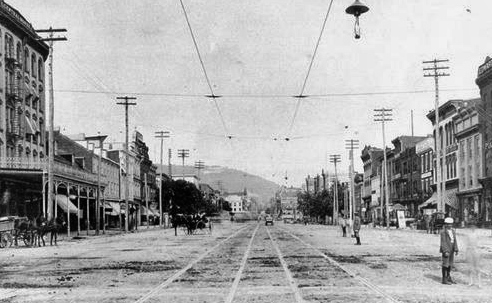
Penn Street looking East toward what is presently 4th Street, Reading, Pennsylvania (circa 1900, public domain).
Less than seven months later, Benjamin’s sister, Angelina (Missimer) Kreider was also gone. After marrying Edmund Kreider, she had also become a parent of a large family. Following the birth of son Milton in 1854 (who later wed Willeria M. Kreider), they welcomed the arrivals of: Annie Kreider (1859-1935), who was born in Reading, Berks County on 14 November 1859 and later wed Benjamin F. Schoenberger; Edward Kreider (1861-1873), who was born on 21 October 1861, but died at the age of eleven on 13 March 1873; Robert D. Kreider (1867-1940), who was born in Reading on 4 December 1867 and later wed Mary E. Mengle; Harry J. Kreider (1871-1932), who was born on 7 January 1871, later wed Sallie E. Matz, and became an automobile painter and a volunteer fireman; Clarence S. Kreider (1876-1906), who was born in Berks County on 17 April 1876; and George B. Kreider (1883-1885), who was born on 2 October 1883, but then died at the age of two on 21 November 1885.
Despite this heartache, Angelina (Missimer) Kreider went on to live a long, full life. Following her death in Reading at the age of eighty-five, on 3 May 1914, she was laid to rest at the Charles Evans Cemetery.
Benjamin’s brother, Samuel Missmer, who had wed Anna Treichler sometime during the early 1860s, also went on to become the father of a large family. His children were: Ralph Missmer (1862-1864), who was born in 1862, but died in 1864; John H. Missmer (1866-1930), who was born in Catasauqua on 14 June 1866 and later wed a woman named Anna; Mary F. Missmer (1872-1874), who was born in 1872, but died in 1874; James Eugene Missmer (1875-1955), who was born in Catasauqua on 25 February 1875 and later wed Elda K. Merkel in 1901, followed by Ida Ruth Lingard in 1909, after being widowed by his first wife; Mabel M. Missmer (1880-1972), who was born in 1880; and Melvin H. Missmer (1889-1960), who was born in 1889.
A longtime employee of the Catasauqua Manufacturing Company’s rolling mills, Samuel Missmer subsequently became the owner of a business that was later managed by his son James. Ailing with gallstones, he was described by local newspapers as “a good citizen” at the time of his death at his home in North Catasauqua on 11 December 1917. He, too, was laid to rest at the Fairview Cemetery.
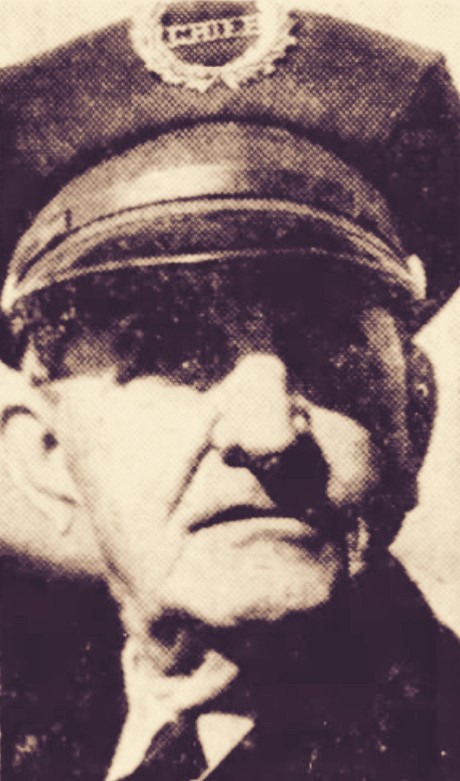
Harvey E. Missmer, a nephew of Private Benjamin Missmer, 47th Pennsylvania Volunteer Infantry, served as the chief of police in North Catasauqua, Pennsylvania for thirty years (photo circa 1955, public domain).
Benjamin’s brother, Henry John Missmer, who had wed Lavina L. Simons in 1861, went on to become the father of: Anna Missmer (1863-1863), who was stillborn on 15 May 1863; Harrison Ellsworth Missmer (1865-1923), who was born in Catasauqua, Lehigh County on 26 January 1865 and later wed Laura Agnes Frey; Minnie M. Missmer (1867-1888), who was born in Catasauqua on 16 September 1867, who later wed William Schwab, and then died in Catasauqua at the age of twenty on 2 February 1888; Emily L. C. Missmer (1871-1880), who was born on 17 August 1871, but died at the age of nine on 2 December 1880; Harvey E. Missmer (1874-1958), who was born in Hanover Township in 1874, later wed Cora Confer, and who went on to serve as North Catasauqua’s chief of police for three decades; Elsie L. Missmer (1877-1933), who was born in Catasauqua on 6 March 1877 and later wed Alvin J. Hoffman in 1899; and Mary Lovina Missmer, who was just two months old when she died.
Unlike the little ones who predeceased him, Henry John Missmer went on to live a long, full life. A clerk with P. Eberhart and Bros. during the 1880s, he was widowed by his wife, Lavina, and ultimately died from acute cystitis in Catasauqua at the age of eighty-five, on 21 April 1922. He, too, was interred at the Fairview Cemetery.
Benjamin’s sister, Anna Amelia (Missmer) Ehrie, who had wed Henry W. Ehrie during the early 1860s, went on to become the mother of: Albert W. Ehrie (1862-1909), who was born in Catasauqua on 2 July 1862; Elmer A. Ehrie (1866-1879), who was born in Catasauqua in 1866; and Annie Ehrie (1870-1927), who was born in Catasauqua on 18 May 1870 and later wed John A. Steele. Widowed by her husband in 1876, Amelia (Missmer) Ehrie was also preceded in death by her sons, Elmer, who had died in Catasauqua on 20 November 1879 before he could fully enjoy his teen years; and Albert, who had died in Philadelphia at the age of forty-six, on 28 March 1909. Following her death from apoplexy in Philadelphia at the age of eighty, on 21 May 1926, her remains were returned home to Lehigh County for interment at the Fairview Cemetery. Her daughter, Annie (Ehrie) Steele, followed her in death less than a year later. After her passing in Philadelphia at the age of fifty-six, on 14 March 1927, Annie Steele was also buried at the Fairview Cemetery.
Sources:
- “A Sudden Death: Willoughby Missimer Overcome While on His Way Home.” Allentown, Pennsylvania: The Critic, 19 October 1891.
- Bates, Samuel P. History of Pennsylvania Volunteers, 1861-5, vol. 1: 47th Pennsylvania Volunteer Infantry. Harrisburg, Pennsylvania: B. Singerly, State Printer, 1869.
- Bates, Samuel P. History of Pennsylvania Volunteers, 1861-5, vol. 5: “38th Pennsylvania Militia.” Harrisburg, Pennsylvania: B. Singerly, State Printer, 1871.
- De Luca, Sylvia Matis. Military Records of Benjamin Missmer and Oral History of the Missimer/Missmer Family. Pennsylvania: De Luca Family Archives.
- “Dies at Philadelphia” (obituary of Amelia Missmer Ehrie). Allentown, Pennsylvania: The Morning Call, 23 May 1926.
- Fianna Laubach (sister of Benjamin Missmer), in Death Certificates (file no.: 101824, registered no.: 24, date of death: 25 October 1903). Harrisburg, Pennsylvania: Commonwealth of Pennsylvania, Department of Health, Bureau of Vital Statistics.
- “H. E. Missmer Dies at 84; A Policeman for 50 Years.” Allentown, Pennsylvania: The Morning Call, 28 November 1958.
- John Henry Missmer (brother of Benjamin Missmer), in Death Certificates (file no.: 39706, registered no.: 32, date of death: 21 April 1922). Harrisburg, Pennsylvania: Commonwealth of Pennsylvania, Department of Health, Bureau of Vital Statistics.
- Mapes, Christopher David. “From a Feudal Electorate to Nation State: Secularization and Reformation in Bavaria, 1700-1825.” Baton Rouge, Louisiana: Ogden Honors College, Louisiana State University, 2009.
- Messamer, Samuel, Catharina, Henry, Fianna, and Amelia, in U.S. Census (Upper Macungie Township, Lehigh County, Pennsylvania, 1850). Washington, D.C.: U.S. National Archives and Records Administration.
- Mesmer, Samuel (father), Catharina, Samuel (son), Henry, Benjamin, Fyanna, Amelia, and Mary, in U.S. Census (Borough of Catasauqua, Lehigh County, Pennsylvania, 1860). Washington, D.C.: U.S. National Archives and Records Administration.
- Messimer, Benjamin and Messmer, Benjamin, in Civil War Veterans’ Card File, 1861-1866 (Company H, 47th Pennsylvania Infantry). Harrisburg, Pennsylvania: Pennsylvania State Archives.
- Messmer, Benj., in U.S. Registers of Deaths of Volunteer Soldiers (St. Louis General Hospital, New Orleans, Louisiana, 7 August 1864). Washington, D.C.: U.S. National Archives and Records Administration.
- Messmer, Benjamin, in Burial Records, Monument Cemetery (now the Chalmette National Cemetery, St. Bernard Parish, Louisiana, 8 August 1864). Washington, D.C.: U.S. National Archives and Records Administration.
- Messmer, Benjamin, in Civil War Muster Rolls (Company H, 47thPensylvania Infantry). Washingon, D.C.: U.S. National Archives and Records Administration.
- Missamer, Benjamin and Samuel, in U.S. Civil War Pension General Index Cards (application no.: 309425, certificate no.: 225857, filed from Pennsylvania by the soldier’s father, Samuel Missimer, 6 October 1883). Washington, D.C.: U.S. National Archives and Records Administration.
- Missamer, Catharine, in U.S. Federal Mortality Schedules (Lehigh County, 1880). Washington, D.C.: U.S. National Archives and Records Administration.
- Missamer, Sam and Catharine, in U.S. Census (Borough of Catasauqua, Lehigh County, Pennsylvania, 1870). Washington, D.C.: U.S. National Archives and Records Administration.
- “Mrs. Tilghman R. Laubach” (obituary of Fianna Missmer Laubach). Reading, Pennsylvania: The Reading Times, 27 October 1913.
- “Obituary: Samuel Missmer.” Allentown, Pennsylvania: Allentown Democrat, 13 December 1917.
- Schmidt, Lewis. A Civil War History of the 47th Regiment of Pennsylvania Veteran Volunteers. Allentown, Pennsylvania: Self-published, 1986.
- “Wedding at Unionville: Dr. Fogel Officiates at the Hoffman–Missmer Nuptials.” Allentown, Pennsylvania: The Allentown Daily Leader, 21 March 1899.
 47th Pennsylvania Volunteers
You must be logged in to post a comment.