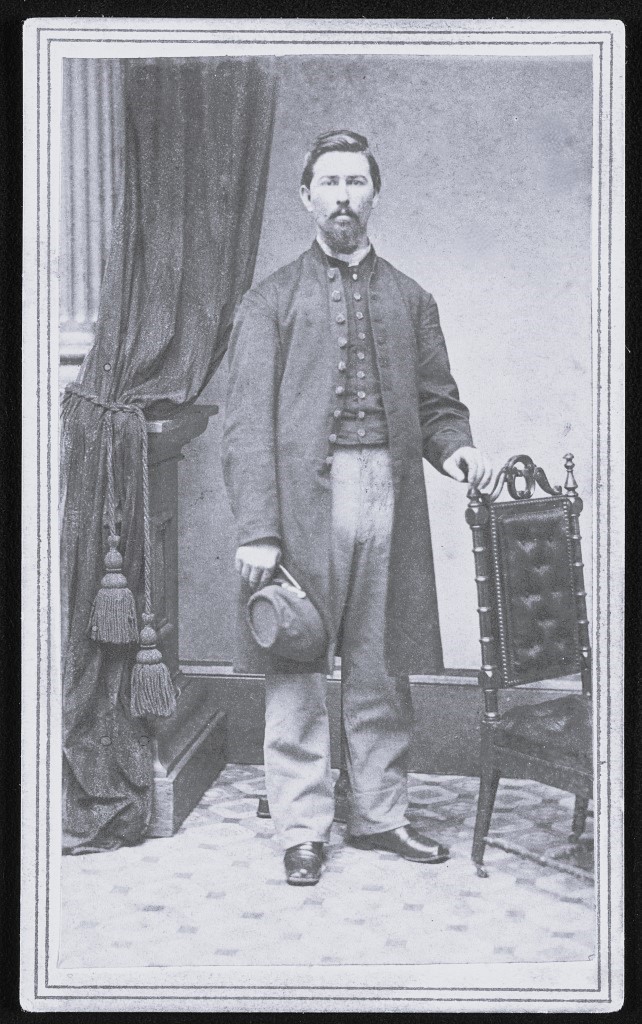
Private Oliver H. Campbell, Company H, 47th Pennsylvania Volunteers, 1864 (public domain),
Born circa 1842, Oliver H. Campbell resided in Northumberland County, Pennsylvania during the mid-nineteenth century. During the early 1860s, he was employed as a teacher.
American Civil War
On 30 January 1864, Oliver Campbell enrolled and officially mustered in for military service at Camp Curtin in Harrisburg, Dauphin County. Entering at the rank of private, he was assigned to Company H of the 47th Pennsylvania Volunteer Infantry. Military records at the time described him as a twenty-two-year-old teacher from Northumberland County who was five feet, eleven inches tall with dark hair, black eyes and a florid complexion.
Although he became a member of the 47th Pennsylvania Volunteer Infantry that month, he did not officially connect with his regiment until nine months later— at his regiment’s encampment near Berryville, Virgina on 18 September 1864—the day before his regiment took part in the Battle of Opequan (also known as “Third Winchester”).
Sheridan’s 1864 Shenandoah Valley Campaign
Attached to the Middle Military Division, U.S. Army of the Shenandoah since early August 1864, the 47th Pennsylvania Volunteer Infantry had recently participated in the Battle of Berryville and had also previously completed the arduous Red River Campaign across Louisiana earlier that same year.
Battles of Opequan and Fisher’s Hill, September 1864

Battle of Opequan (aka Third Winchester), Virginia, 19 September 1864 (public domain).
Together with other regiments under the command of Union Major-General Philip H. Sheridan (“Little Phil”) and Brigadier-General William H. Emory, commander of the U.S. Army’s 19th Corps, the members of Company H and their fellow 47th Pennsylvania Volunteers helped to inflict heavy casualties on the Confederate forces of Lieutenant-General Jubal Early in the Battle of Opequan (also spelled as “Opequon” and referred to as “Third Winchester”). The battle is still considered by many historians to be one of the most important during Sheridan’s 1864 campaign; the Union’s victory here helped to ensure the reelection of President Abraham Lincoln.
The 47th Pennsylvania’s march toward destiny at Opequan began at 2 a.m. on 19 September 1864 as the regiment left camp and joined up with others in the Union’s 19th Corps. After advancing slowly from Berryville toward Winchester, the 19th Corps became bogged down for several hours by the massive movement of Union troops and supply wagons, enabling Early’s men to dig in.
After finally reaching the Opequon Creek, Sheridan’s men came face to face with the Confederate Army commanded by Early. The fighting, which began in earnest at noon, was long and brutal. The Union’s left flank (6th Corps) took a beating from Confederate artillery stationed on high ground.
Meanwhile, the 47th Pennsylvania and the 19th Corps were directed by Emory to attack and pursue Major-General John B. Gordon’s Confederate forces. Some success was achieved, but casualties mounted as another Confederate artillery group opened fire on Union troops trying to cross a clearing.

Victory of Philip Sheridan’s Union Army over Jubal Early’s Confederate forces, Battle of Opequan, 19 September 1864 (Kurz & Allison, circa 1893, U.S. Library of Congress, public domain).
When a nearly fatal gap began to open between the 6th and 19th Corps, Sheridan sent in units led by Brigadier-Generals Emory Upton and David A. Russell. Russell, hit twice—once in the chest, was mortally wounded. The 47th Pennsylvania opened its lines long enough to enable the Union cavalry under William Woods Averell and the foot soldiers of General George Crook to charge the Confederates’ left flank.
The 19th Corps, with the 47th in the thick of the fighting, then began pushing the Confederates back. Early’s “grays” retreated in the face of the valor displayed by Sheridan’s “blue jackets.” Leaving 2,500 wounded behind, the Rebels retreated to Fisher’s Hill (21-22 September), eight miles south of Winchester, and then to Waynesboro, following a successful early morning flanking attack by Sheridan’s Union men which outnumbered Early’s three to one. Afterward, the 47th Pennsylvania Volunteers were sent out on skirmishing parties before making camp at Cedar Creek.
During this phase of service, Private Oliver Campbell fell ill. Confined to a Union Army hospital on 29 September 1864, he was mustered out from the regiment sometime later; however, regimental muster rolls indicated that no discharge was given at his muster out.
* Researchers for 47th Pennsylvania Volunteers: One Civil War Regiment’s Story are still searching for details about the early and post-war years of Oliver Campbell’s life. You can help support this research by making a donation to this project on our website’s secure donations page.
Sources:
- Bates, Samuel P. History of Pennsylvania Volunteers, 1861-5, vol. 1. Harrisburg, Pennsylvania: B. Singerly, State Printer, 1869.
- Campbell, Oliver H., in Civil War Muster Rolls (Company H, 47th Pennsylvania Infantry). Harrisburg, Pennsylvania: Pennsylvania State Archives.
- Campbell, Oliver H., in Civil War Veterans’ Card File (Company H, 47th Pennsylvania Infantry). Harrisburg, Pennsylvania: Pennsylvania State Archives.
- Schmidt, Lewis. A Civil War History of the 47th Regiment of Pennsylvania Veteran Volunteers. Allentown, Pennsylvania: Self-published, 1986.
 47th Pennsylvania Volunteers
You must be logged in to post a comment.