At the conclusion of part one of this biographical sketch, both of the Barber brothers who had enlisted with the 47th Pennsylvania Volunteer Infantry during the American Civil War, had been honorably discharged. Part two opens with their respective returns home to their loved ones in Pennsylvania’s Lehigh Valley.
Return to Civilian Life — Joseph Barber
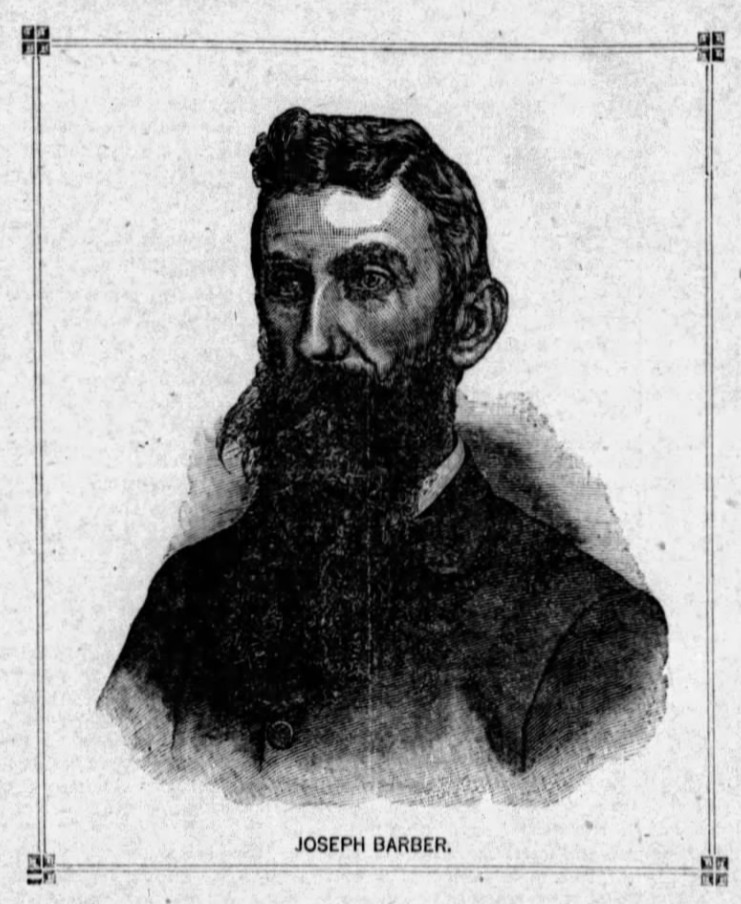
Joseph Barber, circa 1880s, The Morning Call, Allentown, Pennsylvania, 24 August 1889 (public domain).
Following his honorable discharge from the military in July 1864, Private Joseph Barber returned home to Pennsylvania’s Lehigh Valley, where he resumed life with his wife and son, William E. Barber. More children soon followed: Anna Barber (1866-1922), who was born in Allentown on 19 March 1866 and later wed John Correll; Minerva L. Barber (1868-1894), who was born on 27 January 1868 and later wed John Koch; Edwin F. Barber (1870-1880), who was born in Allentown on 18 March 1870; and Joseph Harrison Barber (1875-1903), who was born in 1875 and remained single throughout his life.
By 1870, Joseph Barber’s father, Thomas Barber, had become the nineteenth-century equivalent of a multi-millionaire, with real estate and personal property estimated at ninety-six thousand dollars (an amount that would equal well over than two million U.S. dollars in 2025), thanks to the success of the family’s holdings in Barber, Keiser & Co.
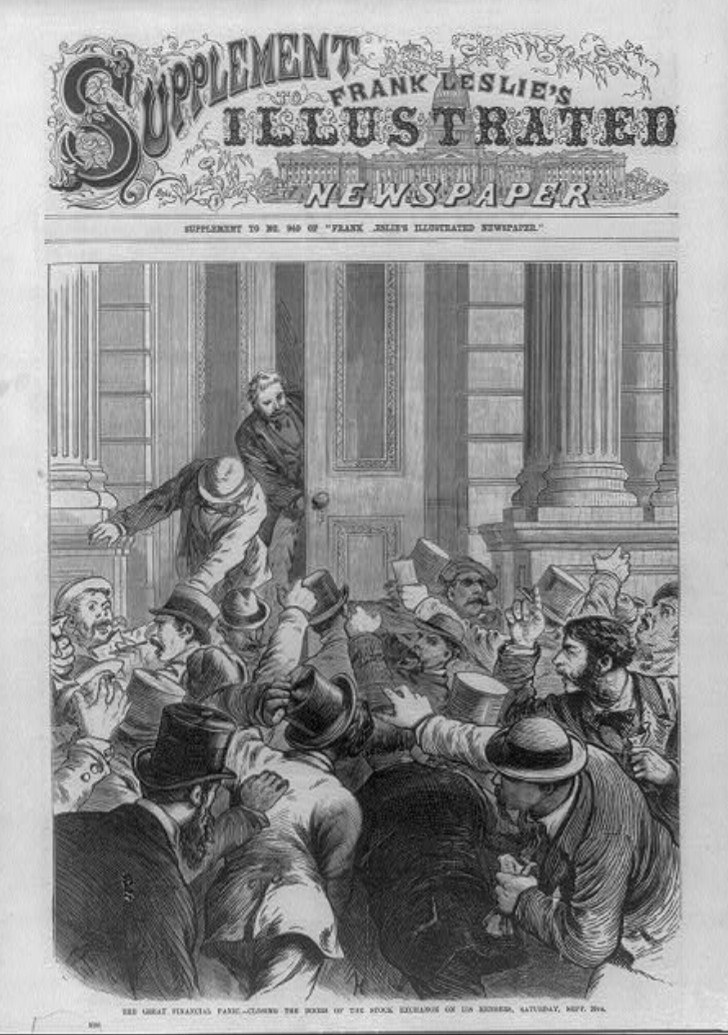
“The Great Panic of 1873 — Closing the Door of the Stock Exchange on Its Members” (Supplement, Frank Leslie’s Illustrated Newspaper, 20 September 1873, public domain).
Just three years later, all of that success would be threatened with The Panic of 1873, a major economic crisis that swept across the United States and Europe and turned into the world’s first Great Depression as it dragged on into 1877.
The crisis had its genesis in a post-Civil War boom of the railroad industry, which was fueled by an aggressive, westward migration of Americans and American businesses that was underwritten by banks, the coal and iron industries and other corporate concerns that were heavily invested in the various railroad companies that were competing to not only complete the Transcontinental Railroad, but expand upon it by building more and more railroad lines and train depots.
Among the financiers leading that great charge was Jay Cooke and Company, “the government’s chief financier of the Union military effort during the Civil War,” which had then gone on to become a post-war, “federal agent in the government financing of railroad costruction,” according to historians at American Experience. That frenzy of financing was upended, however, when bank executives realized that their banks were “overextended,” declared bankruptcy and shut their doors to head off “runs” on their respective banks, sparking The Great Panic of 1873.
As more banks were subsequently driven into insolvency, companies and industries of all sizes that relied on those banks to fund and operate their businesses also went under, prompting those companies to terminate large segments of their respective workforces. The resulting widespread collapse of so many different segments of the nation’s economy propelled the United States and its global trade partners into a recession — and then into a more serious depression, which then deepened into the Great Depression of the 1870s. “By 1876, unemployment had risen to a frightening 14 percent,” according to American Experience.
According to The Allentown Critic, “During the panic of 1873 and in succeeding years, the iron business was so terribly depressed in this section that they [Thomas Barber and his business partners] began to seek for a wider business market, and … succeeded in building up a trade throughout the United States in Canada [over a period of nine years that began in 1875].”
The principal products of the works are turbine water-wheels, bark-mills, engines, boilers, mill-gearing, and all other work common to such extensive machine-shops. The firm, consisting of W. H. Barber [Joseph Barber’s brother, William Harrison Barber] and Bernard Keyser, with silent partner, employs about eighty men. Thomas Barber, the son of William Barber [the grandfather of siblings Joseph and William Harrison Barber], was born in Bath, Northampton County, in the year 1811. His trade [Thomas Barber’s] was that of a millwright, at which he achieved great distinction in his early days, and was known far and wide as a skilled artisan. His services were constantly in demand, and many of the mills in the eastern section of the State were erected under his immediate supervision. As early as 1844 he proceeded to Como, Ill., built one of the most extensive mills then in existence in that part of Illinois. He then left Como for Dayton, a small town in another part of the state, and engaged in the milling business until the death of his first wife.
Subsequently he removed to Allentown, and was prevented from going to Australia by his brother Stephen, who induced him to take an interest in the foundry and machine-shop then owned by George Probst and others.
Thomas Barber’s company not only weathered The Panic of 1873, it grew and prospered in very large part because he had hired his son, William Harrison Barber (Joseph Barber’s younger brother) after the American Civil War, and then had made him a partner in his business as the nation’s economy began to spiral downward during the 1870s. Seeing opportunities where his father could not, William H. Barber, Sr. went on to revolutionize the company’s operations by expanding its product line and increasing its workforce. As a result, the firm was subsequently renamed as Barber & Son.
But that success was a costly one. Just two years after Thomas Barber and his son, William (who by this time was known to family and friends as “Harry”), had muscled their company through The Panic of 1873, the Barber family’s patriarch was gone. Halfway through his sixty-eighth year, Thomas Barber fell ill with typhoid and died at his home on Union Street in Allentown three days later, on 6 August 1879. Following funeral services that were attended by a large number of family, friends, business colleagues, and government officials, he was laid to rest in the Barber family plot at the Fairview Cemetery in Allentown. According to The Allentown Democrat:
The great reaper, death, has again made his presence deeply felt in our midst. This time, our much respected townsman, Mr. Thomas Barber, of the firm, Barber & Son, foundrymen and machinists, has fallen into his icy embrace. The sad event occurred at his residence on Union street, below Fourth, on Wednesday afternoon last, after an illness of only three days with typhoid fever. — He had been complaining of feeling unwell for some time, but continued to move about and was seen on our streets on the Saturday evening preceding his demise. Next day, however, Sunday, he was compelled to remain in his bed, and on a physician being summoned he was declared to be a very sick man. By Tuesday, his case had become alarming, and he gradually grew weaker and weaker until his powerful constitution finally yielded to the ravages of the fell destroyer at about 1 p.m. on Wednesday.
He, for many years, and up to the time of his death, was the head of one of our leading industrial establishments, and besides the large fortune that he realized possessed a wealth of energy, activity and character which is rare in this world of ours. He was not only extensively known among the manufacturers and business men of this vicinity, but throughout neighboring and distant states, and was indeed everywhere esteemed for his high sense of honor and integrity and for the clear and sound judgment which was among the leading traits of his character. He was one of our most useful and enterprising citizens, and his loss will be sorely felt by the community at large. He was always among the first to engage in any enterprise that had a tendency to elevate the poor and the distressed, or to advance the public’s welfare — in a word, he was in every sense a public benefactor, and his memory will live long in the hearts of the people of this city. During the continuance of the panic he kept his Works steadily going, long at a disadvantage to himself, but to the benefit of and solely with an eye to help along those in his employ, and if we err not he too was the first in these parts to voluntarily raise the wages of his workingmen this spring. His regard for the workmen under him won their esteem, and in his death many families in and about the city feel that they have lost a friend.
He was however a rigid disciplinarian and enforced subordination to his orders at every sacrifice. In his intercourse with his fellow men Mr. Barber was hospitable, courteous and kindhearted, and possessed estimable qualities which endeared him to all classes. With his long and useful life in or midst all our readers are familiar, and the sincerest regrets over his death are felt by those who knew him longest and best. At his demise he had attained to the age of 68 years, 6 months and 6 days. He had been twice married, and leaves a widow and four grown children — two sons and two daughters. The funeral took place on Saturday last and was very largely attended.
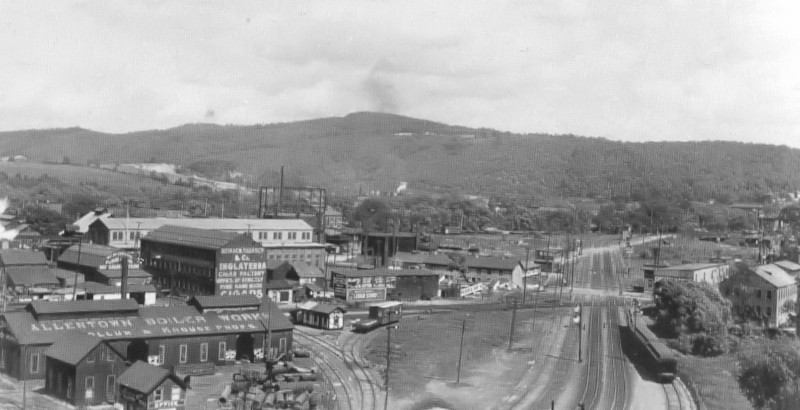
Joseph Barber worked at the Allentown Boiler Works, which was founded by Charles Collum and John D. Knouse in 1883 (Allentown Boiler Works, Allentown, Pennsylvania, 1883, public domain).
Having inherited twenty-five percent of his father’s company when his father died in 1879, Joseph Barber subsequently sold that share of his inheritance to his brother, William Harrison Barber, so that he could try his hand at boiler manufacturing and the sale of hardware and tobacco products.
An active member of the Grand Army of the Republic (Yeager Post, No. 13) and the Patriotic Order, Sons of America (Camp No. 63), Joseph Barber’s tenure with the Patriotic Order, Sons of America included terms of service as a department president and as a delegate to the organization’s national convention in Chicago.
Tragically, Joseph Barber’s son, Edwin F. Barber, died in Allentown on 7 October 1880, and was laid to rest at Allentown’s Union-West End Cemetery.
Less than three years later, Joseph Barber’s younger brother, William Harrison Barber, Sr., died in Allentown on 18 July 1883. Following funeral services, he was laid to rest at the same cemetery where their parents had been interred (Fairview Cemetery in Allentown).
Death and Interment
Despite having survived the dangers of combat during the American Civil War, Joseph Barber was not able to win his battle with declining health. By the early to mid-1880s, he was so ill that he was unable to work. In 1889, he contracted a severe case of dysentery, which ultimately ended his life on 23 August 1889. Just fifty-one at the time of his passing in Allentown, Joseph Barber was laid to rest at that city’s Union-West End Cemetery.
Following his death, he was lauded by area newspapers as a citizen who was “widely known and well liked, and among old army comrades … was a special favorite, being ever sociable and full of life and anecdote.”
Return to Civilian Life — William Harrison Barber
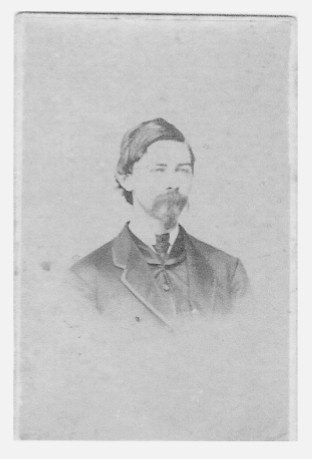
William Harrison Barber (1843-1883), shown here circa 1862-1865 (public domain).
Following his own honorable discharge from the military in June of 1865, William H. Barber also returned home to Pennsylvania’s Lehigh Valley, where was subsequently hired by his father, Thomas Barber, at the family’s Allentown-based firm, Barber, Keiser & Co., which had become an increasingly important and prosperous cog in the city and state’s booming iron industry. (See the profile of Joseph Barber above for information about Thomas Barber’s company.)
In 1869, William H. Barber wed Annie Louise Wilson (1846-1893), a native of Maryland whose father had emigrated from Scotland. Their first child, Thomas W. Barber (1870-1897), was born in Allentown in January 1870. By the Fourth of July that same year, the trio lived together in comfortable circumstances in Allentown’s Second Ward, thanks to the salary that William Barber was receiving as a clerk at his father’s foundry. His real estate and personal property were valued at one thousand sixty hundred and fifty dollars by that year’s federal census enumerator (an amount equivalent to roughly forty thousand U.S. dollars in 2025). Also residing with the family at this time was Mary Gallagher, a fifteen-year-old domestic servant.

Allentown, Pennsylvania (circa 1865, public domain).
By 1870, William Harrison Barber’s father, Thomas Barber, had become the nineteenth-century equivalent of a multi-millionaire, with real estate and personal property estimated at ninety-six thousand dollars (an amount that would equal well over than two million U.S. dollars in 2025), thanks to the success of the family’s holdings in Barber, Keiser & Co.
Sometime during the early years of this new decade, Thomas Barber made his son a partner in his company. Seeing opportunities where his father could not, William H. Barber, Sr. went on to revolutionize the company’s operations by expanding its product line and increasing its workforce. As a result, the firm was subsequently renamed as Barber & Son.
According to The Allentown Critic, William Harrison Barber, who had served in the military during the American Civil War, had made a post-war return to Allentown, where he “applied for employment in the shop.”
At this time the factory numbered but sixteen men on its labor roll, and its business was entirely local. His father, then at the head of it, was largely interested in blast-furnaces, and tired of the management of the shop. Harry [William Harrison Barber] at once conceived the idea of enlarging the works and extending the business. This was effected, and orders multiplied, until it required eighty-five to ninety men to do the work.
The 1870s were also a period of growth for William H. Barber’s family thanks to the births of: George Romig Barber (1871-1894), who was born in 1871; Laura A. Barber (1873-1874), who was born on 11 June 1873 but was soon laid to rest at the Fairview Cemetery in Allentown after passing away at the age of seven months and thirteen days on 24 January 1874; Annie L. E. Barber (1875-1888), who was born on 20 February 1875 but also died before reaching adulthood; and Robert Archibald Barber (1876-1932), who was born in Allentown on 3 September 1876.
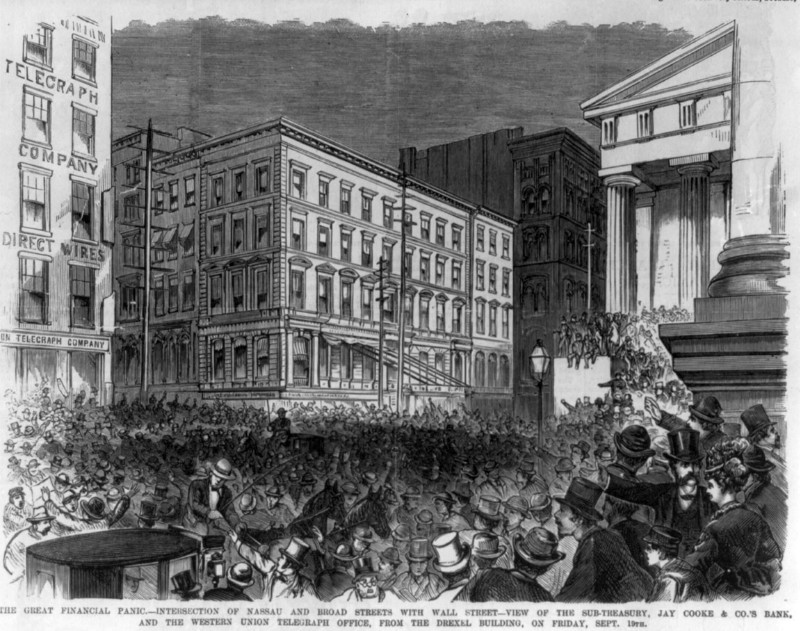
“The Great Financial Panic — Intersection of Nassau and Broad Streets with Wall Street — View of the Sub-Treasury, Jay Cooke & Co.’s Bank … Sept. 19th” (Frank Leslie’s Illustrated Newspaper, October 1873, public domain).
But that decade, while filled with joy, was also filled with worry as The Panic of 1873, swept across the United States and Europe, turning into the world’s first Great Depression as it dragged on into 1877.
Caused by a railroad construction frenzy that had unfolded with the massive, westward migration of Americans and American businesses, after the Civil War — a frenzy that was largely funded by banks tied to coal and iron companies that were racing to complete the Transcontinental Railroad, the financial panic had begun when bank executives at Jay Cooke and Company (a major Union military financier during the Civil War with ties to the post-war railroad construction boom) discovered that their bank had “overextended itself” and declared bankruptcy. That announcement set off a “run” on Jay Cooke, which set off runs on other banks, driving multiple financial institutions into insolvency and spurring the Great Panic of 1873.
As more banks went under, so did companies and industries of all sizes, prompting massive layoffs and firings of workers across the United States. “By 1876, unemployment had risen to a frightening 14 percent,” according to American Experience. As the crisis worsened, the United States and multiple other countries across the globe became mired in an increasingly dangerous recession that quickly devolved into the Great Depression of the 1870s.
According to The Allentown Critic, “During the panic of 1873 and in succeeding years, the iron business was so terribly depressed in this section that they [Thomas Barber and his business partners] began to seek for a wider business market, and … succeeded in building up a trade throughout the United States in Canada [over a period of nine years that began in 1875].”
The principal products of the works [were] turbine water-wheels, bark-mills, engines, boilers, mill-gearing, and all other work common to such extensive machine-shops. The firm, consisting of W. H. Barber [Joseph Barber’s brother, William Harrison Barber] and Bernard Keyser, with silent partner, employ[ed] about eighty men.…
During [The Panic of 1873, William Harrison Barber] found it necessary to find additional fields for their products. He became acquainted with A. N. Wolf, Esq. [Abraham N. Wolf] the inventor of the turbine waterwheel, still made by the firm. Considering the invention a good one, he secured the right to manufacture them on royalty, advertised extensively with mill machinery, etc., and succeeded in building up an excellent trade. By this time he [William Harrison Barber] owned one fourth of the establishment.
* Editor’s Note: William Harrison Barber likely knew Abraham N. Wolf from their service together during the American Civil War. Both were members of the 47th Pennsylvania Volunteer Infantry between the fall of 1862 and the fall of 1864.
Thomas and William Harrison Barber’s company not only weathered a major economic downturn, it grew and prospered in very large part because Thomas had had the foresight to hire and mentor his son, William, who was able to see opportunities that Thomas could not — new pathways for growth that revolutionized the company’s operations. As a result, the firm was renamed as Barber & Son.
But their joint success prove to be a costly one in the end. Just two years after the dynamic father and son duo had powered their company through The Panic of 1873, the Barber family’s patriarch was gone. Halfway through his sixty-eighth year, Thomas Barber died in Allentown on 6 August 1879. Following funeral services, he was laid to rest in the Barber family plot at the Fairview Cemetery in Allentown.
In the aftermath of that family tragedy, Thomas Barber’s substantial estate was divided among his second wife (now his widow) and his children from his first marriage. Among the beneficiaries was Joseph Barber, the older brother of William Harrison Barber, Sr., who was bequeathed a twenty-five percent share of their father’s company, Barber & Son. Having no interest in the firm’s operations, Joseph Barber subsequently sold that share of his inheritance to his brother, William, giving William Harrison Barber substantial control of the family business.
A persuasive man, William Harrison Barber quickly convinced Thomas Barber’s remaining heirs to sell their shares in the family business, and also purchased the rights to Abraham N. Wolf’s turbine waterwheel patent, leaving him as the sole proprietor of Barber & Son. He subsequently invented a bark-mill, which, combined with his company’s other product offerings, enabled him to make the firm an international player in the iron industry, with sales to Brazil, Canada (British Columbia, Nova Scotia), England, and Germany, as well as every state in the United States.
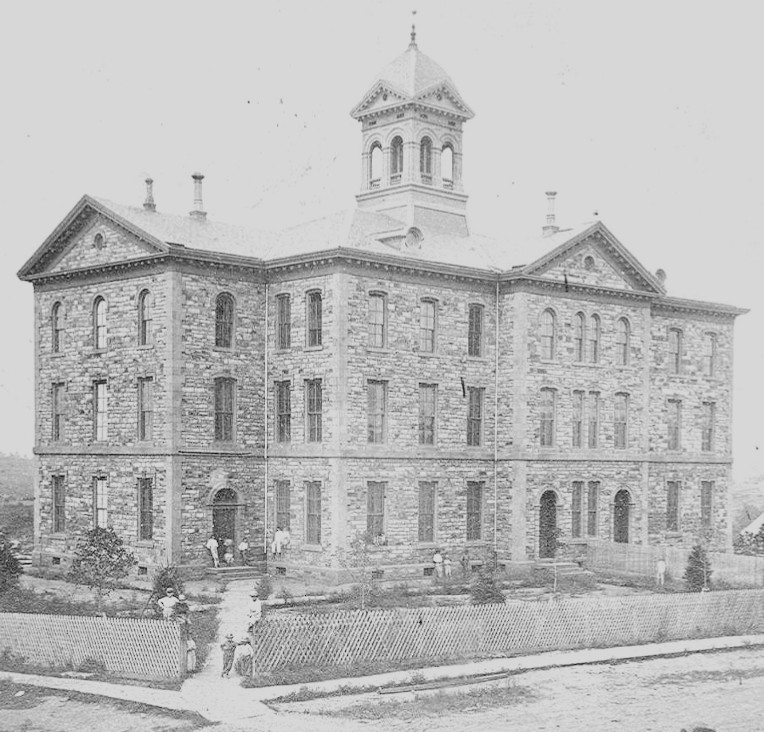
The Herbst School, Fifth Ward, Allentown, Pennsylvania, 1880 (public domain).
By 1880, William Harrison Barber was residing in Allentown’s Fifth Ward with his wife, Annie B., and their children: Thomas W., George B., Annie L., and Robert A. Barber. Although the federal census that year indicated that William was supporting his family on the wages of a machinist, he was, in reality, a very wealthy business owner.
On 10 June 1883, William Harrison Barber and his wife, Annie, welcomed the birth of their final child — another son — William Harrison Barber., Jr. (1883-1906), who grew up to become a pianist and composer during the twentieth century.
Death and Interment
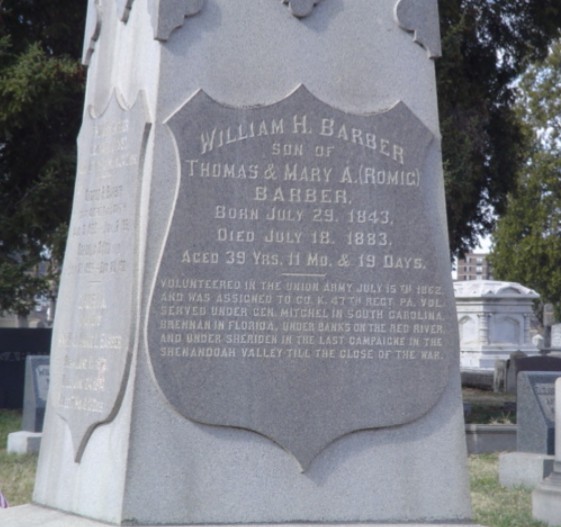
William H. Barber, Sr.’s plaque, Barber Family Monument, Fairview Cemetery, Allentown, Pennsylvania (public domain).
Sadly, the wheels of fate gave the elder William Harrison Barber barely a month to enjoy his good fortune. Eleven days shy of his fortieth birthday, William H. Barber, Sr. died from consumption (tuberculosis) in Allentown on 18 July 1883. Following funeral services, he was laid to rest at the same cemetery where his mother had been interred (Fairview Cemetery in Allentown) roughly three decades earlier.
What Happened to the Siblings of Willam Harrison Barber, Sr. and Joseph Barber?
Hannah Barber, the older sister of 47th Pennsylania Veteran Volunteers William Harrison Barber, Sr. and Joseph Barber, wed Joseph Harrison Smith (1832-1919) in 1855. Initially settled in Allentown, Pennsylvania, they welcomed the birth of Edwin Alan Smith (1857-1928), who was born on 14 August 1857 and later wed Elizabeth Augusta Cornwall (1861-1928) in 1892. They then relocated to Connecticut, where they welcomed the birth of daughter Annie L. Smith (1859-1948), who was born in Connecticut in November 1859 and later wed Thomas J. McRonald in 1889. After a long, full life, Hannah (Barber) Smith died in her mid-eighties in New Haven County, Connecticut on 8 January 1921, and was laid to rest at that city’s Evergreen Cemetery.
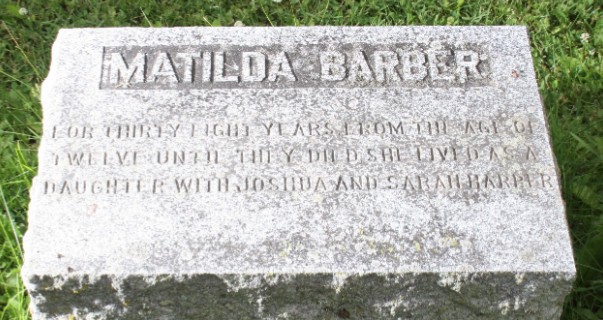
Matilda Barber used her own gravestone at the Oakwood Cemetery in Geneseo, Henry County, Illinois to document her two most important personal relationships (public domain).
Matilda Barber, who was known to family and friends as “Mattie,” was still living in Illinois at the time of her father’s death in 1879. A resident of Geneseo, Henry County, Illinois, she had resided with Joshua Harper (1798-1882) and Sarah M. Harper (circa 1807-1890) from the age of twelve until both of the Harpers passed away.
Following Sarah Harper’s death on 3 November 1890, Matilda Barber was brought to New Haven County, Connecticut to be closer to her birth sister, Hannah (Barber) Smith. Three years later, in 1893, Matilda was listed in the New Haven city directory as an unmarried resident of the Invalids’ Home at Hill and Summit, which was located in the Fair Haven neighborhood of New Haven’s eastern section (between the Mill and Quinnipiac rivers).
By early June of 1900, however, Matilda Barber was documented by a federal census enumerator as a resident of her sister Hannah’s house, which was located at 37 Ward Street in the city of New Haven Connecticut. That household was headed by Hannah’s husband, sixty-seven-year-old wheelwright Joseph H. Smith.
It was sometime during this period of her life that Matilda Barber became a member of the First Congregational Church in West Haven, Connecticut, according to church records.
In January 1907, The Allentown Leader reported that Matilda Barber’s nephew, William Harrison Barber, Jr. had bequeathed “the whole of his considerable estate” to her, prior to his death from tuberculosis at the Oakes Home for Consumptives in Denver, Colorado on 19 October 1906. (A talented pianist and composer, he had made it a special point to spend time with Matilda during a return visit that he had made to the East Coast for his birthday in June 1904.)
By the summer of 1908, Matilda Barber was residing at 434 Washington Avenue in the town of Orange, New Haven County, Connecticut, where she completed her own last will and testament. Signed and sealed on 28 June 1908, it was witnessed by three of her Washington Avenue neighbors, Lillian Baldwin, Thomas C. Brett and H. B. Dayton. Still living at 434 Washington Avenue at the time of the 1910 federal census, Matilda Barber was documented as the home’s owner and sole resident, who had her own income and was still single.
Three years later, she was gone. Following her death in Orange, Connecticut on 25 July 1913, her remains were returned to Geneseo, Henry County, Illinois for interment in the Oakwood Cemetery near the Harpers, the couple she described as her parents for thirty-eight years. That unusual arrangement was documented in the death and burial records of the First Congregational Church in West Haven, Connecticut. When her final will was probated in August of that same year, it revealed that she had made the following significant bequests:
- Ten thousand dollars to her executor [her nephew, Edwin A. Smith] “to hold, to invest and reinvest the same at his discretion, not being confined to investments legal for trust funds in Connecticut, and to pay [Matilda’s] sister Hannah B. Smith of New Haven Connecticut semi annually the net income thereof during her life”; and upon the death of Hannah B. Smith, that that ten thousand dollars” be divided equally … between the Congregational Home Missionary Society and the American Bible Society”;
- Seven thousand dollars to her nephew, Robert A. Barber, Allentown, Pennsylvania;
- Five thousand dollars to her niece, Annie L. McRonald, the wife of Thomas J. McRonald, Hartford, Connecticut;
- Five thousand dollars to her nephew, Edwin A. Smith, West Haven, Connecticut;
- One thousand dollars to her brother-in-law, Joseph H. Smith, the husband of Hannah (Barber) Smith, New Haven, Connecticut; and
- Five hundred dollars each to her grandnieces and grandnephews.
What Happened to the Widow and Children of Joseph Barber?
Joseph Barber’s widow, Sarah (Lilly) Barber, survived the deaths of her husband and four of her five children. Shortly after her husband’s death, she filed for a U.S. Civil War Widow’s Pension on 29 October 1889, which helped her to keep a roof over her head for two more decades. She died at the age of sixty-nine at her home at 33 North Second Street in Allentown on 31 August 1909, and was laid to rest beside her husband at Allentown’s Union-West End Cemetery. Described in her obituary as the “widow of Joseph Barber, former foundryman, hardware merchant and boiler-maker and one of the originators of the boiler firm now under the name of Collum & Knouse,” she was survived by six people: her oldest daughter, Anna (Barber) Correll; her sister, Mrs. Anna Focht; and four grandchildren.
Joseph Barber’s first-born son, William E. Barber, who never married, grew up to be a moulder with the Allentown Foundry and Machine Company and a member of his local chapter of the International Molders’ Union. Sometime during the late 1800s or early 1900s, he contracted tuberculosis. Also known as “consumption,” the disease gradually caused him to waste away. Unemployed for four months after the foundry closed during the winter of 1907-1908, he succumbed to tuberculosis-related complications at the home he had shared with his mother at 33 North Second Street in Allentown. Just forty-nine at the time of his passing on 9 April 1908, he was laid to rest at the same cemetery where his father was buried (the Union-West End Cemetery in Allentown).
Joseph Barber’s first-born daughter, Anna Barber, was educated in Allentown’s public schools, and was preceded in death by her husband, John Correll, who was killed in Bethlehem, Pennsylvania on Friday evening, 21 September 1906 when he “was struck by a Lehigh and New England night shifting engine at the Bath Junction.” Still alive when he was found by the shifter’s engineer, he “died before the dispatcher could be reached at Pen Argyl.” Childless, she resided at 312 Halstead Street in Allentown’s Fourteenth Ward, and supported herself as a dressmaker until she fell ill in early 1922. Admitted to Allentown’s Sacred Heart Hospital for surgery in January of that year, she died there at the age of fifty-five on 10 February 1922, from complications related to that surgery. She was subsequently buried at Allentown’s Union-West End Cemetery.
Joseph Barber’s daughter, Minerva L. Barber, endured an entirely different series of tragedies. Following her marriage to John Koch, she was beaten by him during multiple episodes of domestic violence, several of which were so severe that it motivated her to call the police for help. On Monday, 22 June 1892, “Constable Lilly of the First Ward … arrested John Koch on a charge of aggravated assault and battery preferred by his wife.” Following his arrest, her husband posted bail in the amount of two hundred dollars and was scheduled for a hearing before Alderman Butz, according to The Allentown Democrat.
Koch was then arrested twice by Constable Lilly for beating Minnie (Barber) Koch in early and mid-November 1893. Able to post bail of one hundred dollars after his first arrest, he was unable to make bail for the second and was sent to jail to await his trial. According to news reports of that trial, Koch admitted to being drunk and kicking his wife in the stomach. Minnie, who was holding an infant as she testified, informed the judge that her stomach still hurt from the battery that she had endured. Subsequently sentenced to pay a fine of five dollars and spend thirty days in jail, John Koch was released in mid-December of that same year.
Sadly, Minnie (Barber) Koch died just five months later. Just twenty-six years old at the time of her death in Allentown on 17 May 1894, she was interred at Allentown’s Union-West End Cemetery.
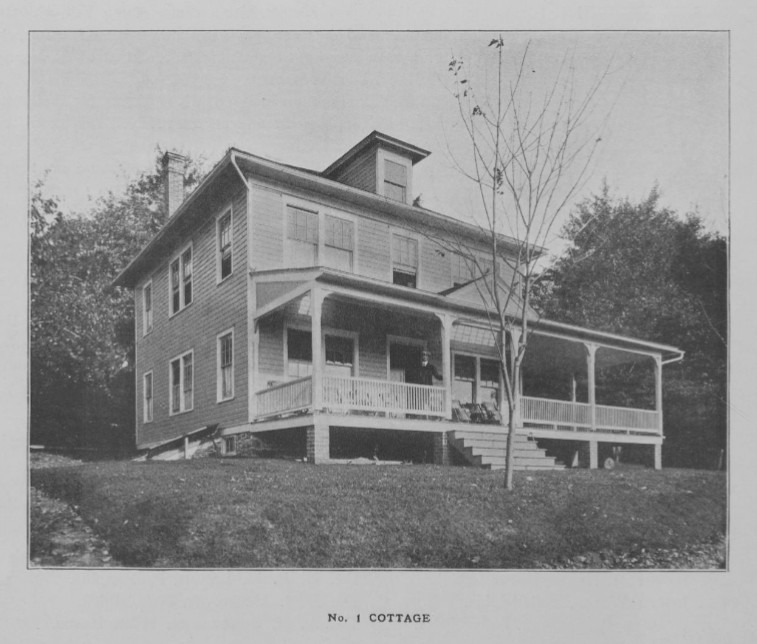
Cottage No. 1, White Haven Sanatorium, Luzerne County, Pennsylvania (public domain).
Joseph Barber’s youngest son, Joseph Harrison Barber, who was known to family and friends as “Harris,” was employed as a ribbon weaver by the Adelaide Silk Mill in Allentown during his early to mid-twenties — a job he was ultimately forced to leave when his heath began to decline after contracting tuberculosis. Sent to the White Haven Sanatorium in Luzerne County, Pennsylvania, he received treatment there until four weeks before his death at the age of twenty-eight. Following his passing, which occurred at the home of his mother in Allentown on 19 August 1903, he was also laid to rest at Allentown’s Union-West End Cemetery.
What Happened to the Widow and Children of William Harrison Barber?
On 9 July 1888, William H. Barber, Sr.’s widow, Annie Louise (Wilson) Barber, filed for a U.S. Civil War Widow’s Pension. That application was subsequently approved. Tragically, that same year, her thirteen-year-old daughter and namesake, Annie L. E. Barber, died in Allentown on 10 December. She was subsequently buried near her father in Allentown’s Fairview Cemetery.
Little Annie’s mother, Annie Louise (Wilson) Barber (William H. Barber, Sr.’s widow), apparently then remarried, taking the married surname of “Basler,” if federal pension records are accurate. Sadly, her life would also prove to be a short one; she died at the age of forty-seven years and seven months in Allentown on Christmas Day in 1893. Following funeral services at her home at the corner of Liberty and Fifth streets, she was laid to rest beside her husband at Allentown’s Fairview Cemetery.
On 2 January 1894, a court-appointed guardian filed for a U.S. Civil War Orphans’ Pension for her children, which was subsequently managed by the Lehigh Valley Trust & Safe Deposit Company.
William H. Barber, Sr.’s first-born son, Thomas W. Barber, subsequently married Mary Rebecca Gibson (1875-1969) in 1894. Together, they welcomed the birth of son Howard George Barber (1895-1970), but their journey together came to an abrupt, tragic end when Thomas W. Barber died at the age of twenty-seven on 14 April 1897. Following funeral services, he was laid to rest at Allentown’s Fairview Cemetery (the same cemetery where his father had been buried). His widow subsequently remarried — to William Romig Stackhouse (1870-1930), who then adopted Howard George Barber, whose name was subsequently changed to Howard George Barber Stackhouse. Howard G. Stackhouse went on to serve as a sergeant in the U.S. Army during World War I.
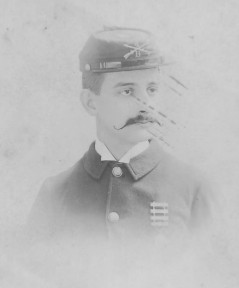
George Romig Barber, Company B, 4th Regiment, Pennsylvania National Guard, circa 1894 (public domain).
Like his father before him, William H. Barber, Sr.’s second son, George Romig Barber, chose to enlist in the army. Following his enrollment in 1888, he was assigned to Company B of the Fourth Regiment of the Pennsylvania National Guard. In 1902, while still serving with his army unit, George R. Barber wed Cora M. Dieter, a daughter of Northampton, Pennsylvania resident Charles Dieter. They subsequently welcomed the birth of a child, Marion D. Barber (1893-1894), who did not survive infancy. Born in Allentown in July 1893, Marion Barber was roughly nine months old when she passed away on 5 May 1894; she was subsequently interred at Allentown’s Fairview Cemetery.
Six months after his daughter’s death, George R. Barber was honorably discharged from the U.S. Army (in November 1894). Seemingly now out of harm’s way, he was killed just weeks later during a gruesome, work-related accident inside of the power house operated by the Lehigh Traction and Electric Light and Power Company in Allentown on 12 December 1894.
Just twenty-three years old at the time of the tragedy, George Barber was laid to rest with military honors at the same cemetery where his parents were buried (Allentown’s Fairview Cemetery). His pallbearers were former members of his regiment: Guy and Ray Brown, Frank Drake, Luther Hudders, David Hume, and A. W. Walters. His widow, Cora M. Barber was subsequently “granted letters of administration in the estate of her husband,” according to newspapers in Allentown. In a follow-up report about the accident a week later, The Allentown Democrat noted that George Barber had died instantly and provided these additional details about the incident:
The Power House of the Lehigh Traction and Electric Light and Power Co., on Front street, between Hamilton and Linden, was the scene of an accident on Wednesday [12 December 1894], at near noon, by which George R. Barber, a draughtsman, lost his life instantly. During the morning Mr. Barber assisted Superintendent Frank S. Drake, of the Electric Light and Power Company, in making some changes in the exhaust service from the eletric light power house to the station from which the electric road is operated. At the time of the accident, however, Mr. Barber was not actively engaged, and as he was of an experimental turn of mind it is supposed that he was making measurements near the large belt in the power station. In some manner, which no one knows, he was caught and thrown upwards toward the roof a distance of 18 feet above the floor and 40 feet away, striking a ladder that stood against the north wall of the building. From this he was thrown against the wall, and then fell dead toward the floor.
He was hurled against the ladder with such force that several rungs were broken, and his shoes torn from his feet and cast sixty feet away in opposite directions. The belt is 36 inches wide, driven by a 750 horse power motor, and connects the engine and the dynamo. It revolves 287 times a minute. There is a rule in the light and power station forbidding close approach to belts by any of the employees, the penalty of violation being discharge, but seemingly Mr. Barber, who evidently was seeking to make some improvements, did not obey the order….
That news report went on to describe, in graphic detail, the injuries that were inflicted upon George Barber’s head and body, noting that the clothing he was wearing was “badly torn.”
Superintendent Drake, Taylor Fogel and Robert Barber, a brother of the deceased, were working in another part of the building, and heard a report as of a breaking belt. Robert made efforts to talk with his brother, but they were unsuccessful. Coroner Yost was called and empanelled the following jury: W. L. Hartman, Harvey Keiper, Melville Shafer, Daniel Clausser, Charles Musselman and Frank J. Diehl. The evidence of Superintendent Drake and Chief Engineer Price was heard, and a verdict of accidental death rendered. The body was taken to Undertaker Wonderly’s rooms, and later to his late home, No. 516 North Fifth street. Deceased was 25 years of age, and was a son of the late W. H. Barber, of Barber’s foundry at Third and Walnut streets. His father died about ten years ago, and his mother a year ago. Three brothers, Thomas, Henry and Robert Barber, survive. Deceased was married two years ago to Cora Dieter, daughter of Charles Dieter, of Northampton, and she survives him. Up to a month ago he was a member of Co. B, Fourth Regiment. His wife is suffering deeply. Some time ago the couple lost their only child by death.
Sometime after the horrific death of George Barber, George’s younger brother, Robert Archibald Barber, married Mary E. Hoffman (1877-1902), a daughter of Civil War veteran Daniel Hoffman (1841-1889) and Ellen (Allender) Hoffman (1849-1924). Together, they welcomed the births of: Leroy Archibald Barber (1896-1937), who was born on 3 November 1896 and later wed Sarah May Chaplin (1908-1990); Mildred M. Barber (1898-1974), who was born on 5 February 1898 and never married, but grew up to become an elementary school teacher in the city of Allentown’s public school system; and Forrest W. Barber (1900-1947), who was born in Allentown on 27 December 1900 and later wed Naomi Majer (1993-1973) in 1923.
By the turn of the century, Robert A. Barber had left his job at Lehigh Traction and Electric Light and Power Company, and was employed as an insurance agent. He resided in relative security in Salisbury Township, Lehigh County with his wife, Mary, and their children, Leroy, Mildred and Forrest until the winter of 1902, when his wife fell ill. Diagnosed with typhoid, Mary (Hoffman) Barber initially recovered after being hospitalized for five weeks, but then developed typhoid-related heart disease, which claimed her life at the family’s home in Allentown two days after Christmas. She was just twenty-five years old when she, too, was laid to rest at the Fairview Cemetery in Allentown.
Robert Archibald Barber then married a second time — to Annie Levan (1887-1924) in 1903. Together, they raised his children from his first marriage, and also welcomed the births of two of their own daughters: Pauline V. Barber (1904-2000), who was born in 1904 and later wed Robert T. Roth (1904-1976) in 1925; and an unnamed infant (1909-1909), who was born on 1 March 1909 and died that same month, according to her Pennsylvania birth certificate.
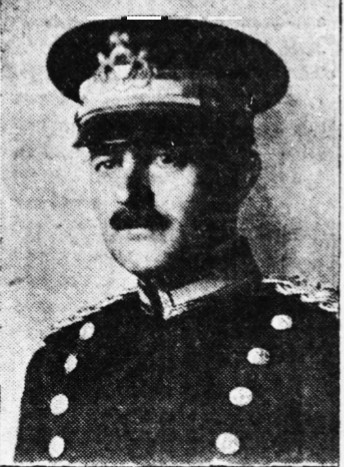
Lieutenant Robert A. Barber, Company C, 109th Machine Gun Battalion, 28th Division, U.S. Army, circa 1918 (The Allentown Morning Call, 12 March 1932).
When the United States entered World War I, Robert A. Barber enrolled for military service and was assigned to Company C of the 109th Machine Gun Battalion in the U.S. Army’s 28th Division. Deployed overseas, he “took part in six major engagements during the war and was gassed in the battle of Chateau Thierry,” according to Allentown’s Morning Call newspaper.
Following his honorable discharge from the army, he returned home to Pennsylvania and enrolled at the University of Pennsylvania in Philadelphia. After graduating with a Bachelor of Science degree in economics in 1923, he was hired as a bank examiner in Philadelphia. He then obtained a similar position in the Lehigh Valley area the following year.
Preceded in death by his second wife, Annie, who had been ailing for some time and had passed away from disease-related complications at the family’s home in Allentown on 2 June 1924, Robert A. Barber continued to raise his children in Allentown, while still working as a bank examiner. A resident of 26 North Madison Street in Allentown during the early 1930s, Robert A. Barber fell ill in early March 1932. Diagnosed with pneumonia while he was also suffering from myocarditis, he was confined to the Allentown Hospital, where he died at the age of fifty-five, roughly a week later, on 11 March. Following funeral services, he was buried at the Fairview Cemetery on 16 March.
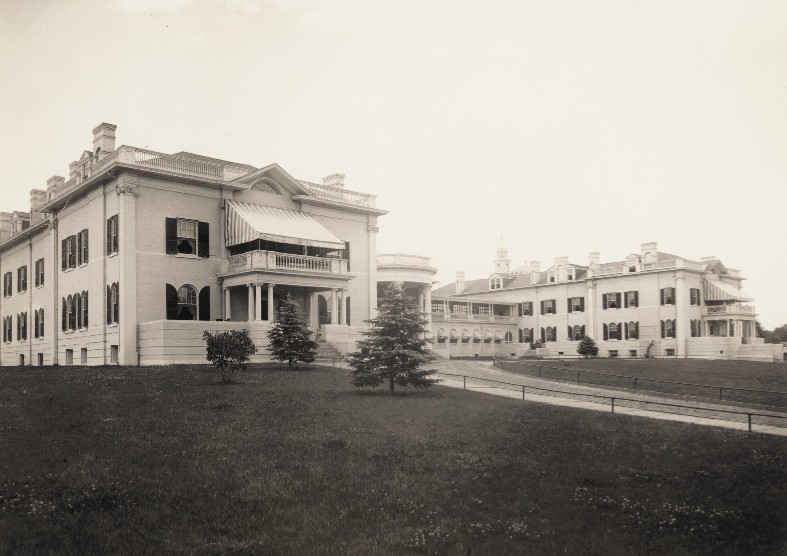
William Harrison Barber, Jr. sought treatment for tuberculosis at the Oakes Home Colorado twice between 1902 and 1906, and died there in 1906 (Oakes Home, Denver, Colorado, 1905, public domain).
William Harrison Barber, Sr.’s son, William Harrison Barber, Jr., graduated from Allentown High School on 1902. Diagnosed with tuberculosis (also known as “consumption”), he was subsequently sent to Denver, Colorado by his family for treatment at the Oakes Home for Consumptives. According to Allentown’s Morning Call newspaper, this was done “for the benefit of his health,” and resulted in him “rapidly gaining strength.” While there, he became known as “a fine musician” who “composed numerous selections, many of them being used by the musical places in the West.”
Well enough to travel by 1904, he returned to the East Coast in time to celebrate his twenty-first birthday on 10 June with family and friends in Allentown and to spend time with his paternal aunts, Matilda Barber and Hannah (Barber) Smith in New Haven, Connecticut. Sadly, his condition worsened while there, and he suffered a series of hemorrhages, which required intensive treatment and more rest. Sent by his family to the Adirondack Cottage Sanatorium, which had been founded in 1884 by Dr. Edward Livingston Trudeau in the Village of Saranac Lake in New York’s Adirondack Mountains, he recovered enough to return to the Oakes Home in Denver, Colorado.
Still unmarried and just twenty-three years old at the time of his death at the Oakes Home in Denver on 19 October 1906, his remains were returned for interment in the Barber family plot at the Fairview Cemetery in Allentown, Pennsylvania. Members of his family were asked to gather for a private memorial service at the home of his brother, Robert A. Barber, at 1335 Maple Street in Allentown; former high school classmates were encouraged to attend the public funeral, which was held at Allentown’s First Presbyterian Church, Fifth and Court streets on Saturday, 27 October.
His obituary in The Allentown Leader described him as “an excellent pianist” who “composed several pieces of music, for which there was a great demand.”
According to a notice regarding the probate of his estate, which was published in The Allentown Leader, William Harrison Barber, Jr. bequeathed “the whole of his considerable estate to his aunt, Matilda Barber of Allentown.”
Sources:
- “Barber,” in “Deaths” (death notice of William Harrison Barber, Sr.’s youngest son, William Harrison Barber, Jr., at the Oakes Home in Denver, Colorado). Allentown, Pennsylvania: The Morning Call, 24 October 1906.
- Barber, Anna L. (the widow of William Harrison Barber, Sr.), in “Deaths.” Allentown, Pennsylvania: The Allentown Leader, 26 December 1893.
- Barber, Joseph and Sarah L., in U.S. Civil War Pension General Index Cards (widow’s application no.: 407437, certificate no.: 356429, filed from Pennsylvania by the widow, 29 October 1889). Washington, D.C.: U.S. National Archives and Records Administration.
- Barber, Joseph and William H., in Civil War Muster Rolls (Joseph Barber, Company G, 47th Pennsylvania Infantry; William H. Barber, Company K, 47th Pennsylvania Infantry). Harrisburg, Pennsylvania: Pennsylvania State Archives.
- Barber, Joseph and William H., in Civil War Veterans Card File, 1861-1866 (Joseph Barber, Company G, 47th Pennsylvania Infantry; William H. Barber, Company K, 47th Pennsylvania Infantry). Harrisburg, Pennsylvania: Pennsylvania State Archives.
- Barber, Matilda (a sister of Joseph and William Harrison Barber, Sr.), in Death Index (Orange, New Haven County, Connecticut, 25 July 1913). Hartford, Connecticut: Connecticut State Library, retrieved online 27 March 2025.
- Barber, Matilda (a sister of Joseph and William Harrison Barber, Sr.), in U.S. Census (West Haven, Orange Township, New Haven County, Connecticut, 1910). Washington, D.C.: U.S. National Archives and Records Administration.
- Barber, Matilda H. (a sister of Joseph and William Harrison Barber, Sr.), in New Haven City Directory, 1909. New Haven, Connecticut: The Price & Lee Company Directory Publishers.
- “Barber, Matilda Miss” (death and burial records of a sister of Joshua and William Harrison Barber, Sr.). West Haven, Connecticut: First Congregational Church, 1913.
- Barber, Mildred M. (a granddaughter of William Harrison Barber, Sr. and a daughter of Robert Archibald Barber), in U.S. Census (Allentown, Lehigh County, Pennsylvania, 1930, 1940, 1950). Washington, D.C.: U.S. National Archives and Records Administration.
- Barber, Robert (a son of William Harrison Barber, Sr.), Mary E., Leroy, and Mildred M., in U.S. Census (Salisbury Township, Lehigh County, Pennsylvania, 1900). Washington, D.C.: U.S. National Archives and Records Administration.
- Barber, Thos., Mary, Hannah, Joseph, Matilda, and Harrison, in U.S. Census (Henry County, Illinois, 1850). Washington, D.C.: U.S. National Archives and Records Administration.
- Barber, Thomas (father of William Harrison Barber, Sr.) and Mary, in U.S. Census (Allentown, First Ward, Lehigh County, Pennsylvania, 1860). Washington, D.C.: U.S. National Archives and Records Administration.
- Barber, William H.; Basler, Annie L., and Lehigh Valley Trust & Safe Deposit Co., Gdn., in U.S. Civil War General Pension Index Cards (widow’s application no.: 375927, certificate no.: 381370, filed by the veteran’s widow from Pennsylvania on 9 July 1888; orphans’ pension application no.: 587548, certificate no.: 392768, filed by the veteran’s widow, Annie L. Basler, from Pennsylvania on 2 January 1894; subsequently managed by the orphans’ guardian via the Lehigh Valley Trust & Safe Deposit Co.). Washington, D.C.: U.S. National Archives and Records Administration.
- Barber, William, Annie B., Thomas W., George B., Annie L., and Robert A., in U.S. Census (Allentown, Fifth Ward, Lehigh County, Pennsylvania, 1880). Washington, D.C.: U.S. National Archives and Records Administration.
- Barber, Wm., Annie and Thomas and Gallagher, Mary, in U.S. Census (Allentown, Second Ward, Lehigh County, Pennsylvania, 1870). Washington, D.C.: U.S. National Archives and Records Administration.
- Barber, Wm. H., in Records of Burial Places of Veterans (Fairview Cemetery, Allentown, Pennsylvania, 1883). Harrisburg, Pennsylvania: Commonwealth of Pennsylvania, Department of Military Affairs.
- Bates, Samuel P. History of Pennsylvania Volunteers, 1861-5, vol. 1. Harrisburg, Pennsylvania: B. Singerly, State Printer, 1869.
- “Charged with Wife Abuse”; “Jailed for Abusing His Wife”; ” Evil That Men Do”; “In Criminal Court”; and “Released from Jail” (notices of the arrest of John Koch for aggravated assault and battery against Joseph Barber’s daughter, Minerva L. (Barber) Koch). Allentown, Pennsylvania: The Allentown Democrat, 22 June 1892; The Allentown Leader, 11 November 1893; The Allentown Leader, 15 November 1893; and The Allentown Critic, 15 November 1893 and 14 December 1893.
- “Death of a Young Wife: Mrs. Barber Expiring as Her Husband Returns from Work” (obituary of a daughter-in-law of William Harrison Barber, Sr.). Allentown, Pennsylvania: The Allentown Leader, 29 December 1902.
- “Death of Joseph Barber.” Allentown, Pennsylvania: The Allentown Critic, 24 August 1889.
- “Death of Thomas Barber” (obituary of Joseph and William Barber, Sr.’s father). Allentown, Pennsylvania: The Allentown Democrat, 13 August 1879.
- “Death of W. Harrison Barber: Young Allentown Pianist Passes Away at Denver” (obituary of William Harrison Barber, Sr.’s youngest son, William Harrison Barber, Jr.) Allentown, Pennsylvania: The Allentown Leader, 22 October 1906.
- “Gestorben” (notice of the death of Joseph and William H. Barber, Sr.’s mother, Mary Ann (Romig) Barber). Allentown, Pennsylvania: Der Lecha Caunty Patriot, 17 November 1852.
- “Joseph H. Barber” (obituary of Joseph Barber’s son, Joseph H. Barber). Allentown, Pennsylvania: The Morning Call, 20 August 1903.
- “Killed at Bethlehem: John Correll Run Over by Shifting Engine -Badly Injured” (death of Joseph Barber’s son-in-law). Allentown, Pennsylvania: The Morning Call, 24 September 1906.
- “Letters Granted” (details regarding the management of the estate of William Harrison Barber, Sr.’s son, George Romig Barber). Allentown, Pennsylvania: The Morning Critic, 29 December 1894.
- “Making Steel,” in “Stories from PA History.” Harrisburg, Pennsylvania: Pennsylvania Historical and Museum Commission, 2023.
- Miller, Randall M. and William A. Pencak. Pennsylvania: A History of the Commonwealth. University Park, Pennsylvania: The Pennsylvania State University Press, 2002.
- Minerva L. Koch (death notice of Joseph Barber’s daughter), in “Died.” Allentown, Pennsylvania: The Allentown Democrat, 23 May 1894.
- “Miss Matilda Barber” (a sister of Joseph and William Harrison Barber, Sr.), in New Haven City Directory, 1893. New Haven, Connecticut: The Price & Lee Company Directory Publishers.
- “Mr. Barber’s Funeral” (death and funeral notice of William Harrison Barber, Sr.’s son, William Harrison Barber, Jr.). Allentown, Pennsylvania: The Allentown Leader, 22 October 1906.
- “Mrs. Anna M. Correll” (obituary of Wlliam Harrison Barber, Sr.’s oldest daughter). Allentown, Pennsylvania: The Morning Call, 11 February 1922.
- “Mrs. Robert A. Barber” (obituary of the daughter-in-law of William Harrison Barber, Sr.). Allentown, Pennsylvania: The Morning Call, 3 June 1924.
- “Obituary: Mrs. Sarah Barber” (obituary of Joseph Barber’s widow). Allentown, Pennsylvania: The Morning Call, 1 September 1909.
- “Our Iron Centre: The Many Houses Who Have Helped Build the Trade.” Allentown, Pennsylvania: The Allentown Critic, 18 July 1884.
- “Pneumonia Cuts Short Career of Veteran: Lieut. R. A. Barber, Bank Examiner Dies After Brief Illness” (obituary of William Harrison Barber, Sr.’s son, Robert A. Barber). Allentown, Pennsylvania: The Morning Call, 12 March 1932.
- “Rise of Industrial America, 1876-1900,” in “U.S. History Primary Source Timeline.” Washington, D.C.: U.S. Library of Congress, retrieved 26 March 2025.
- Robert A. Barber (a son of William Harrison Barber, Sr.), in Death Certificates (file no.: 28502, registered no.: 302, date of death: 11 March 1932). Harrisburg, Pennsylvania: Commonwealth of Pennsylvania, Department of Health, Bureau of Vital Statistics.
- Schmidt, Lewis G. A Civil War History of the 47th Regiment of Pennsylvania Veteran Volunteers. Allentown, Pennsylvania: Self-published, 1986.
- Smith, Joseph H., Harriet and Mattie (sisters of Joseph and William Harrison Barber, Sr.), in U.S. Census (City of New Haven, New Haven Township, New Haven County, Connecticut, 1900). Washington, D.C.: U.S. National Archives and Records Administration.
- “The Forgotten Plague: Tuberculosis in America,” in “American Experience.” Boston, Massachusetts: GBH Education, 2015.
- “The Funeral of Mrs. Barber” (funeral notice for the widow of William Harrison Barber, Sr.). Allentown, Pennsylvania: The Allentown Leader, 27 December 1893.
- “The Panic of 1873,” in “American Experience.” Boston, Massachusetts: GBH Education, retrieved online 25 March 2025.
- “The Pennsylvania Iron Industry: Furnace and Forge of America,” in “Stories from PA History.” Harrisburg, Pennsylvania: Pennsylvania Historical and Museum Commission, 2023.
- W. Harry Barber, in “Died” (death notice of William Harrison Barber, Sr.). Allentown, Pennsylvania: The Allentown Democrat, 25 July 1883.
- “W. Harrison Barber,” in “Obituary,” (obituary of William Harrison Barber, Sr.’s youngest son, William Harrison Barber, Jr.). Allentown, Pennsylvania: The Morning Call, 23 October 1906.
- “Will Be Buried with Military Honors” (notice of the death and funeral of William H. Barber, Sr.’s son, George Romig Barber). Allentown, Pennsylvania: The Morning Critic, 14 December 1894.
- “Will of Harry Barber” (announcement of the filing and probate of the last will and testament of William Harrison Barber, Sr.) Allentown, Pennsylvania: The Allentown Democrat, 1 August 1883.
- “Will of M. H. Barber [sic, W. H. Barber]” (announcement of the bequest by William Harrison Barber, Jr. of his estate to his patenal aunt, Matilda H. Barber). Allentown, Pennsylvania: The Allentown Leader, 28 January 1908.
- “William E. Barber” (obituary of Joseph Barber’s first-born son). Allentown, Pennsylvania: The Morning Call, 10 April 1908.
- “Young Man Killed Instantly” (news report regarding the work-related death of William Harrison Barber, Sr.’s son, George Romig Barber). Allentown, Pennsylvania: The Allentown Democrat, 19 December 1894.
 47th Pennsylvania Volunteers
You must be logged in to post a comment.