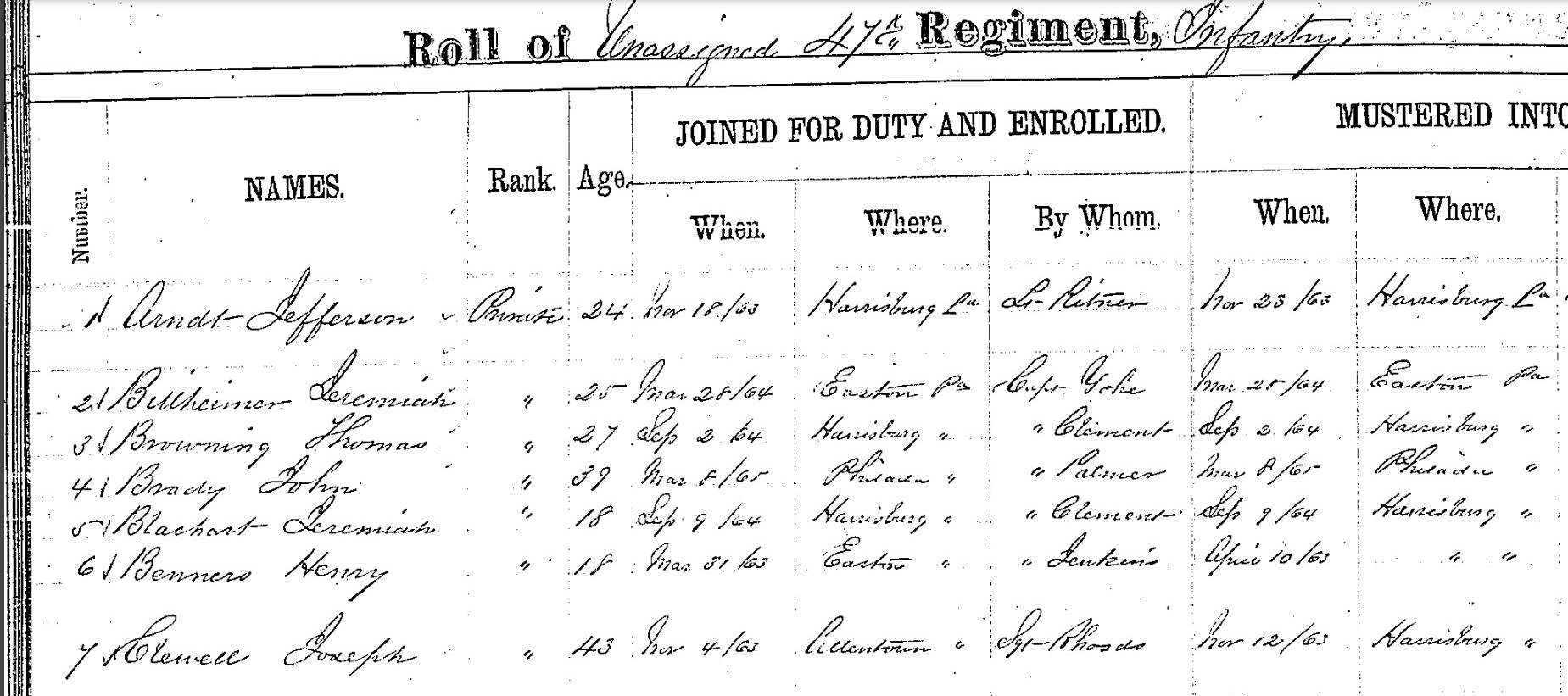
Excerpt of Private Joseph Clewell’s entry on the 47th Pennsylvania Volunteer Infantry’s roster of Unassigned Men (Registers of Pennsylvania Volunteers, 1861-1865, Pennsylvania State Archives, public domain; click to enlarge).
One of the true “mystery men” of the 47th Pennsylvania, Joseph Clewell, Jr. was also one of the many 47th Pennsylvania Volunteers who never made it home from the war. Unlike so many of his comrades, however, he did not die on a field of battle, surrounded by his brothers in blue jackets.
He withered away, most likely bereft of any companionship from other Union Army soldiers because he fell ill and died behind enemy lines—at a Confederate Army hospital in the Western Theater of the American Civil War.
Formative Years
Born in the Lehigh County, Pennsylvania village of Emaus (now Emmaus) circa 1820, Joseph Clewell, Jr. grew up to become a farmer in Lehigh County, residing and working near where he spent his formative years, according to Lewis B. Clewell’s History of the Clewell Family in the United States of America.
Very little else has been uncovered about his early years, but researchers for 47th Pennsylvania Volunteers: One Civil War Regiment’s Story are continuing to search for details about his life.
What is known for certain is that he was one of the 47th Pennsylvanians who enlisted with the regiment later in the war, joining as a draftee or as one of the new recruits that regimental officers hoped would fill the void left by members of the regiment who had been felled by disease between 1861 and 1863, or had been killed during the Battle of Pocotaligo, South Carolina on 22 October 1862.
Civil War
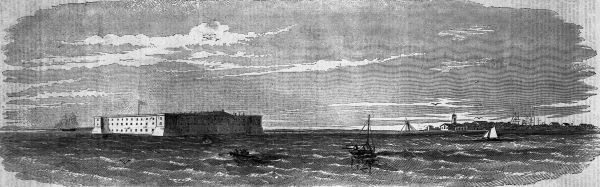
Fort Taylor, Key West, Florida, circa 1861 (courtesy, State Archives of Florida; click to enlarge).
On 4 November 1863, Joseph Clewell was enrolled for Civil War military service in Allentown, Lehigh County, Pennsylvania by Captain Emanuel P. Rhoads, the commanding officer of the 47th Pennsylvania Volunteer Infantry’s Company B. Initially designated as one of the “Unassigned Men” of the 47th Pennsylvania, Joseph Clewell subsequently mustered in as a private with the regiment at Camp Curtin in Harrisburg, Dauphin County on 12 November. After a brief indoctrination period, he was transported south to Florida, where the regiment was serving on garrison duty at Fort Taylor in Key West and at Fort Jefferson in the Dry Tortugas.
Sometime after connecting with his regiment, Private Joseph Clewell was moved from the roster of Unassigned men to Company G, which had been badly battered during the Battle of Pocotaligo, South Carolina in October 1862. He arrived just in time to connect with a regiment that was about to make history as the only regiment from Pennsylvania to serve in the Union’s 1864 Red River Campaign across Louisiana. But his timing could not have been worse.
Not nearly as physically conditioned, he was ill-prepared for the grueling marches that his regiment was about to endure. Not nearly as well trained militarily, either, he also had little time to prepare himself during his brief garrison duty assignment at Fort Taylor in Key West between late 1863 and the first weeks of 1864, making him “easy pickings” for Confederate troops during the 47th Pennsylvania’s earliest moments of Red River combat in April 1864.
Red River Campaign
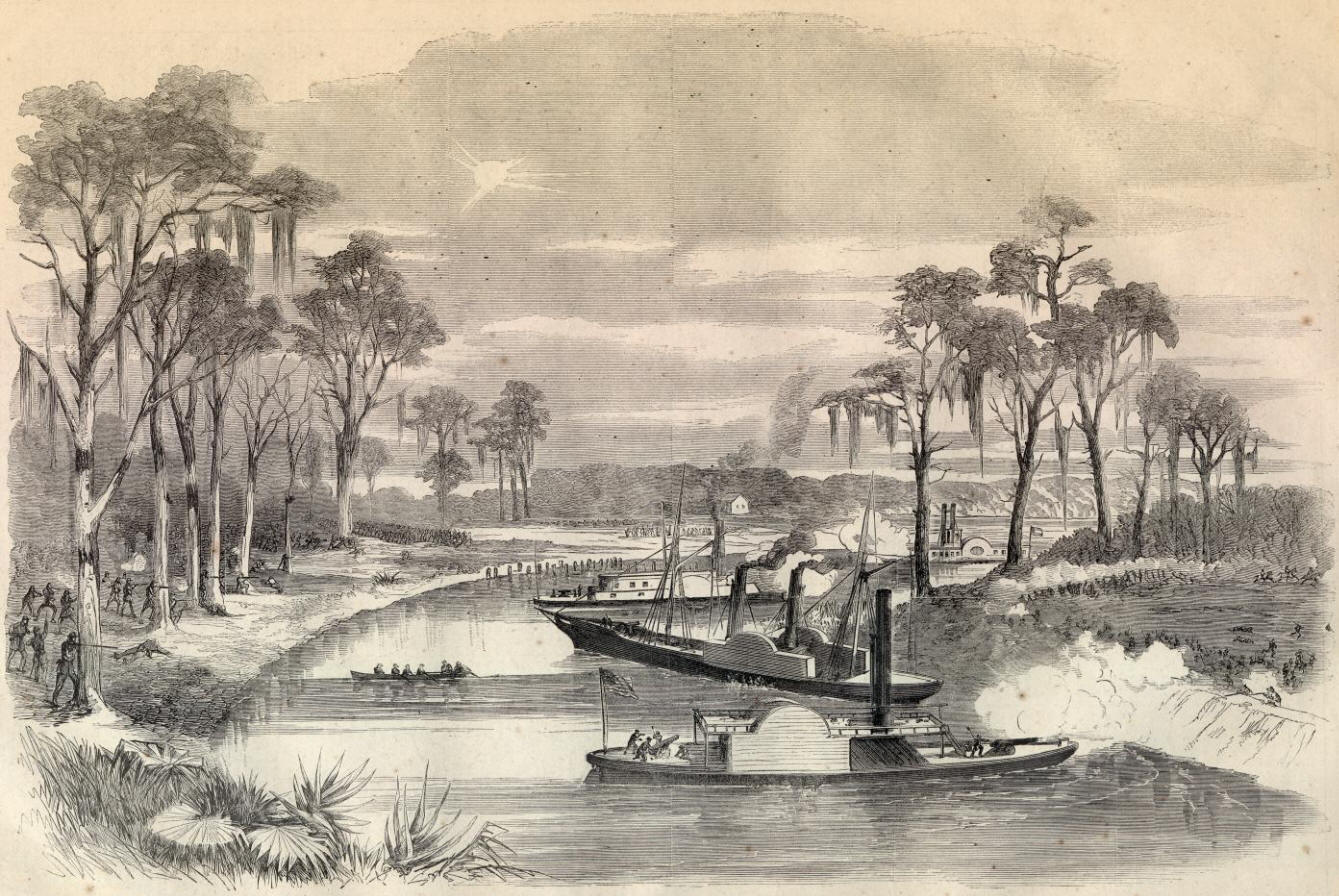
Bayou Teche, Louisiana (Harper’s Weekly, 14 February 1863, public domain).
Boarding the steamer Charles Thomas on 25 February 1864, the men from the 47th Pennsylvania Volunteer Infantry’s Companies B, C, D, I, and K headed for Algiers, Louisiana (across the river from New Orleans), followed on 1 March by other members of the regiment from Companies E, F, G, and H.
Upon the second group’s arrival, the almost-fully-reunited regiment moved by train on 28 February to Brashear City (now Morgan City, Louisiana) before heading to Franklin by steamer through the Bayou Teche. There, the 47th Pennsylvania Volunteer Infantry joined the 2nd Brigade, 1st Division of the Department of the Gulf’s 19th Army Corps (XIX Corps) as part of the U.S. Army of the Gulf under Union Major-General Nathaniel P. Banks.
* Note: Unable to reach Louisiana until 23 March, the men from Company A had been placed on a different type of detached duty in New Orleans while they awaited transport to enable them to catch up with the main part of their regiment. Charged with guarding two hundred and forty-five Confederate prisoners, they were finally able to board the Ohio Belle on 7 April, and reached Alexandria, Louisiana with those prisoners on 9 April.
Often short on food and water throughout their long, harsh-climate trek through enemy territory, the 47th Pennsylvania encamped briefly at Pleasant Hill the night of 7 April before continuing on the next day.
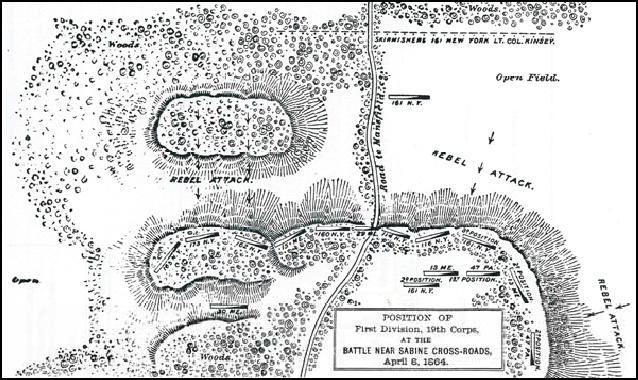
19th U.S. Army Map, Phase 3, Battle of Sabine Cross Roads/Mansfield (8 April 1864, public domain).
Rushed into battle ahead of other regiments in the 2nd Division, sixty members of the 47th were cut down on 8 April during the intense volley of fire unleashed during the Battle of Sabine Cross Roads (also known as the Battle of Mansfield because of its proximity to the community of Mansfield). The fighting waned only when darkness fell. The exhausted, but uninjured collapsed beside the gravely wounded. After midnight, the surviving Union troops withdrew to Pleasant Hill.
The next day, the 47th Pennsylvania Volunteers were ordered into a critically important defensive position at the far right of the Union lines, their right flank spreading up onto a high bluff. By 3 p.m., after enduring a midday charge by the troops of Confederate Major-General Richard Taylor (a plantation owner who was the son of Zachary Taylor, former president of the United States), the brutal fighting still showed no signs of ending. Suddenly, just as the 47th was shifting to the left side of the massed Union forces, the men of the 47th Pennsylvania were forced to bolster the 165th New York’s buckling lines by blocking another Confederate assault.
During this engagement, which has since become known as the Battle of Pleasant Hill, the 47th Pennsylvania succeeded in recapturing a Massachusetts artillery battery lost during the earlier Confederate assault. Unfortunately, the regiment’s second-in-command, Lieutenant-Colonel George Warren Alexander, was grievously wounded during the fight that day, and Color-Sergeant Benjamin Walls was shot in the left shoulder while mounting the 47th Pennsylvania’s colors on one of the Union Artillery’s recaptured caissons. Sergeant William Pyers was then also wounded while grabbing the American flag from Walls as he fell to prevent it from falling into enemy hands.
Alexander, Walls and Pyers all survived the day and continued to fight on with the 47th, but many others, like Second Lieutenant Alfred Swoyer of Company K, were killed in action during the two days of chaotic fighting, or wounded so severely that they were unable to continue their service with the 47th. (Swoyer’s final words were, “They’re coming nine deep!” His body was never recovered.)
Still others from the 47th were captured by Confederate troops, marched roughly one hundred and twenty-five miles to Camp Ford, a Confederate Army prison camp near Tyler, Texas, and held there as prisoners of war until they were released during prisoner exchanges that began in July and continued through November. At least two members of the 47th Pennsylvania never made it out of there alive. Private Samuel Kern of Company D died there on 12 June 1864, and Private John Weiss of F Company, who had been wounded in action at Pleasant Hill, died from those wounds on 15 July.
A third—Private Joseph Clewell—who had only been a member of the 47th Pennsylvania since mid-November 1863, fell ill sometime after being captured by Confederate troops during one of the aforementioned battles or during one of the 47th Pennsylvania’s subsequent Red River Campaign engagements. Suffering from chronic diarrhea due to the poor water quality and unsanitary living conditions that he endured while being held as a prisoner of war (POW), he was subsequently confined to the Confederate States Army hospital in Shreveport, Louisiana sometime in May or early June. Held at that hospital as a POW, his health continued its decline until he died there on 18 June 1864, according to the U.S. Army’s Registers of Deaths of Volunteer Soldiers.
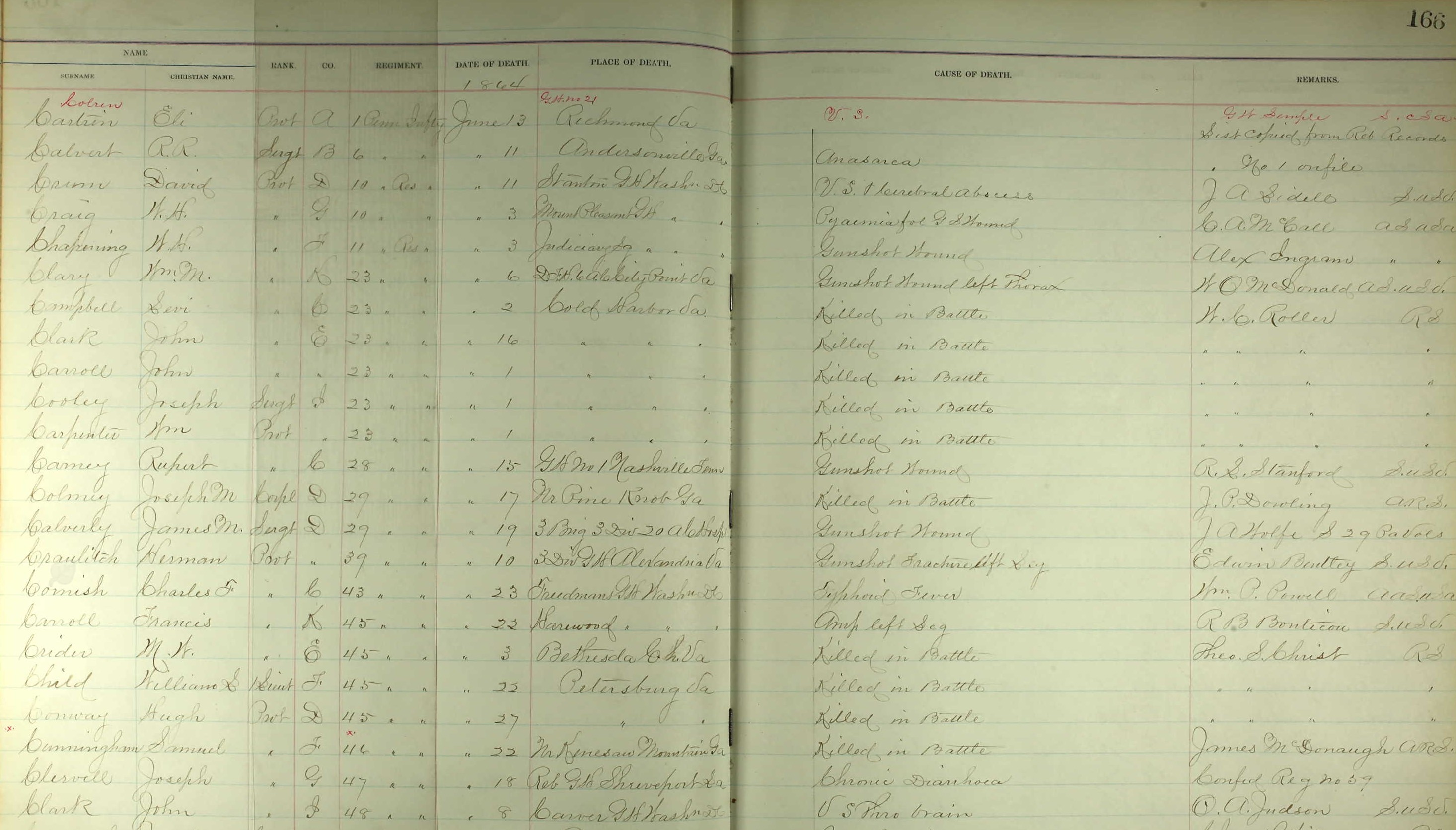
The June 1864 death of Private Joseph Clewell, Company G, 47th Pennsylvania Volunteer Infantry, was documented by the U.S. Army as having occurred at the Confederate Army Hospital No. 59 in Shreveport, Louisiana (Registers of Deaths of Volunteers, 1864, U.S. Army and U.S. National Archives and Records Administration, public domain; click to enlarge).
Burial Location
Although Private Clewell’s burial location has not yet been confirmed, it is possible that he was initially interred in one of the unmarked graves in Shreveport’s Greenwood Cemetery, according to Joe Slattery, the longtime Genealogy Library Specialist with the Shreve Memorial Library in Shreveport.
But, because his name was entered into the U.S. Army’s death ledger for volunteer soldiers when the names of other members of the 47th Pennsylvania who died at Camp Ford were not, it is possible that Private Clewell’s remains were among those of the soldiers’ bodies that were exhumed and returned to the Union Army for reburial in national cemeteries. According to historian Lewis Schmidt:
The men who died on the battlefields at Sabine Cross Roads and Pleasant Hill; as prisoners at Pleasant Hill and Tyler, Texas; and as a result of disease at Grand Ecore; are probably buried at Alexandria National Cemetery, 209 E. Shamrock Road, Pineville, La. 71360. No graves of members of the 47th are known to be identified at Alexandria, which was established in 1867. At least some burials in the cemetery are known to have been disinterred at Shreveport, Natchitoches, Fort Jessup and Colite Landing, Louisiana; and Jefferson, Fort Ringold, Fort Brown, Fort Ringo and Camp Ford at Tyler, Texas. In 1867, there were 1378 interments, 871 of whom were unknown.
It is also possible that Private Clewell’s body was never returned by the Confederate States Army or was never found during the federal government’s exhumation process and remains at rest in an unmarked grave at Shreveport’s Greenwood Cemetery or another burial site that was located near the Confederate Army’s general hospital.
* Researchers are continuing their search for additional information about Private Joseph Clewell’s life and burial location. If you would like to assist with our efforts, please consider making a donation to our project via the secure donations page on our website.
Sources:
- Bates, Samuel P. History of Pennsylvania Volunteers, 1861-5, vol. 1. Harrisburg, Pennsylvania: B. Singerly, State Printer, 1869.
- Clewell, Joseph, in “Registers of Pennsylvania Volunteers, 1861-1865: 47th Regiment, Unassigned Men,” in Records of the Department of Military and Veterans’ Affairs. Harrisburg, Pennsylvania: Pennsylvania State Archives.
- Clewell, Lewis B., the Rev. Lewis P. Clewell and Wilson D. Seyfried. History of the Clewell Family in the United States of America, 1737-1907, p. 290. Bethlehem, Pennsylvania: The Keystone Printing Company, 1907.
- Schmidt, Lewis. A Civil War History of the 47th Regiment of Pennsylvania Veteran Volunteers. Allentown, Pennsylvania: Self-published, 1986.
- Slattery, Joe. “Confederate Soldiers Who Died at the Confederate General Hospital in Shreveport, Louisiana,” in The Genie, vol. 37, no. 1 (First Quarter, 2003), p. 12. Shreveport, Louisiana: Ark-La-Tex Genealogical Association, Inc.
- “Union Army Deaths in Shreveport, 1864-1865.” Shreveport, Louisiana: Sons of Union Veterans, Brig. Gen. Joseph Bailey Camp No. 5, retrieved online 29 April 2021.
 47th Pennsylvania Volunteers
You must be logged in to post a comment.