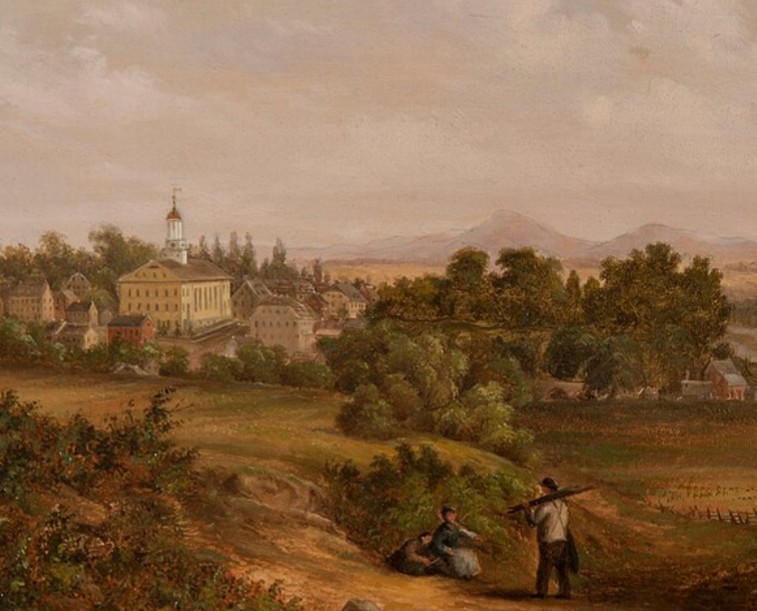
Bethlehem, Northampton County, Pennsylvania, circa 1860 (detail from the painting by Reuben Oliver Luckenbach, public domain).
Born in 1825 in the Kingdom of Prussia (in what is now part of Germany), George W. Lightfoot grew up in a country that was transitioning from a relatively tranquil time to one of the most turbulent periods in European history. According to the Independence Hall Association of Philadelphia:
In the decade from 1845 to 1855, more than a million Germans fled to the United States to escape economic hardship. They also sought to escape the political unrest caused by riots, rebellion and eventually a revolution in 1848. The Germans had little choice — few other places besides the United States allowed German immigration.
So, George W. Lightfoot made the difficult decision to leave all that he knew behind in order to emigrate from his homeland during the mid-nineteenth century. After arriving in the United States of America, he settled in the Commonwealth of Pennsylvania. He then began his own family line by marrying Pennsylvania native Elizabeth Elnora Brown (1831-1908) during the mid to late 1850s.
By the summer of 1860, George Lightfoot was a master shoemaker living with his wife, Elizabeth, in the city of Bethlehem in East Allen Township, Northampton County, according to that year’s federal census, which was conducted in his neighborhood on 3 July of that year. He subsequently welcomed the birth with her of a son, William Lightfoot, who was born in Northampton County in August 1860 and later wed Mary C. Straub.
A time of hope, it also was a time of worry for George Lightfoot who was realizing that he, like so many of his fellow immigrants, had left the turbulence of Europe only to be drawn into one of the most tumultuous and heartbreaking periods in American history.
American Civil War

Victory of Philip Sheridan’s Union Army over Jubal Early’s Confederate forces, Battle of Opequan, 19 September 1864 (Kurz & Allison, circa 1893, U.S. Library of Congress, public domain).
As the American Civil War raged on into yet another year of horrific carnage, George W. Lightfoot enrolled for military service in Easton, Northampton County on 25 February 1864. He then officially mustered in for duty there that same day as a private with Company G of the 47th Pennsylvania Volunteer Infantry; however, he did not actually “start work” with his regiment at its duty station until 18 September 1864 — the day before the 47th Pennsylvania took part in the Battle of Opequan in Virginia.
It was highly likely, therefore, that Private Lightfoot did not actually fight in that particular battle or in the subsequent Battle of Fisher’s Hill (21-22 September 1864) due to his inexperience as a new soldier. His personal “baptism of fire” most likely occurred a month later, during the Battle of Cedar Creek, Virginia.
Military records at that time described him as a native of Germany and thirty-eight-year-old shoemaker who was five feet, five inches tall with brown hair, gray eyes and a ruddy complexion.
Sheridan’s 1864 Shenandoah Valley Campaign
Battle of Cedar Creek, Virginia

Alfred Waud’s 1864 sketch, “Surprise at Cedar Creek,” captured the flanking attack on the rear of Union Brigadier-General William Emory’s 19th Corps by Lieutenant-General Jubal Early’s Confederate army, and the subsequent resistance by Emory’s troops from their Union rifle-pit positions, 19 October 1864 (public domain).
During the fall of 1864, Union Major-General Philip H. Sheridan began the first true “scorched earth” campaign by the Army of the United States in which it starved the enemy into submission by destroying Virginia’s farming infrastructure. Viewed today through the lens of history as inhumane, the strategy claimed the lives of many innocent civilians, whose lives were uprooted or even cut short by the inability to find food or adequate shelter. This same strategy, however, almost certainly contributed to the further turning of the war in the Union’s favor during the Battle of Cedar Creek on 19 October 1864.
Successful throughout most of their engagement with Union forces at Cedar Creek, Lieutenant-General Jubal Early’s Confederates began peeling off in ever greater numbers as the battle wore on in order to search for food to ease their gnawing hunger, thus enabling Sheridan’s well-fed troops to rally and win the day.
From a military standpoint, it was another impressive show of the Union’s might. From a human perspective, it was both inspiring and heartbreaking. During the morning of 19 October, Early launched a surprise attack on Sheridan’s Cedar Creek-encamped forces. Early’s men were able to capture Union weapons while freeing a number of Confederates who had been taken prisoner during previous battles, all while pushing seven Union divisions back.

Sheridan Rallying His Troops, Battle of Cedar Creek, Virginia, 19 October 1864 (U.S. Library of Congress, public domain).
But then “The men were aroused to the highest pitch of enthusiasm by the exploits of their dashing leader, General Phil Sheridan,” according to Allentown’s Morning Call newspaper. Historian Samuel P. Bates later described that epic battle, noting that:
When the Army of West Virginia, under Crook, was surprised and driven from its works, the Second Brigade, with the Forty-seventh on the right was thrown into the breach to arrest the retreat…. Scarcely was it in position before the enemy came suddenly upon it, under the cover of fog. The right of the regiment was thrown back until it was almost a semi-circle. The brigade, only fifteen hundred strong, was contending against Gordon’s entire division, and was forced to retire, but, in comparative good order, exposed, as it was, to raking fire. Repeatedly forming, as it was pushed back, and making a stand at every available point, it finally succeeded in checking the enemy’s onset, when General Sheridan suddenly appeared upon the field, who ‘met his crest-fallen, shattered battalions without a word of reproach, but joyously swinging his cap, shouted to the stragglers as he rode rapidly past them – ‘Face the other way, boys! We are going back to our camp! We are going to lick them out of their boots!'”
The 47th Pennsylvania Volunteer Infantry, which participated in that tide-turning battle as part of the Union Army’s XIX Corps (19th Corps), which was commanded by Brigadier-General William H. Emory, was subsequently commended for the bravery displayed by its members by General Stephen Thomas, who, in 1892, was awarded the Medal of Honor for his own “distinguished conduct in a desperate hand-to-hand encounter, in which the advance of the enemy was checked” that day.
But the day had proven to be a particularly costly one for the 47th Pennsylvania Volunteers. The regiment lost the equivalent of two full companies of men in killed, wounded and missing, as well as soldiers who were captured by Rebel troops and dragged off to prisoner of war (POW) camps, including the Confederates’ Libby Prison in Virginia, the notorious Salisbury Prison in North Carolina and the hellhole known as “Andersonville” in Georgia. Subjected to harsh treatment at the latter two, many of the 47th Pennsylvanians confined there never made it out alive. Those who did either died soon after their release, or lived lives that were greatly reduced in quality by their damaged health.

General J. D. Fessenden’s headquarters, U.S. Army of the Shenandoah at Camp Russell near Stephens City (now Newtown) in Virginia (Lieutenant S. S. Davis, Frank Leslie’s Illustrated Newspaper, December 31, 1864, public domain).
Following those major battles, Private George W. Lightfoot and his fellow 47th Pennsylvania Volunteers were ordered to march to Camp Russell near Winchester, where they rested and began the long recovery process from their physical and mental wounds. Rested and somewhat healed, the 47th was then ordered to outpost and railroad guard duties at Camp Fairview in Charlestown, West Virginia five days before Christmas.
1865 — 1866
Still stationed at Camp Fairview as the New Year progressed, the 47th Pennsylvania Volunteers continued to patrol key Union railroad lines in the vicinity of Charlestown and chase down Confederate guerrillas who had repeatedly attempted to disrupt railroad operations and kill soldiers from other Union regiments. During this phase of duty, they were re-assigned to the Provisional Division of the 2nd Brigade of the U.S. Army of the Shenandoah in February 1865, and continued to perform those same duties until late March, when they were ordered to head back to Washington, D.C., by way of Winchester and Kernstown, Virginia.
Joyous News and Then Tragedy

Spectators gather for the Grand Review of the Armies, 23-24 May 1865, beside the crepe-draped U.S. Capitol, flag at half-staff after the assassination of President Abraham Lincoln (Matthew Brady, U.S. Library of Congress, public domain).
As April 1865 opened, the battles between the Army of the United States and the Confederate States Army intensified, finally reaching the decisive moment when the Confederate troops of General Robert E. Lee surrendered to Union General Ulysses S. Grant at Appomattox on 9 April.
The long war, it seemed, was finally over. Less than a week later, however, the fragile peace was threatened when an assassin’s bullet ended the life of President Abraham Lincoln. Shot while attending an evening performance of Our American Cousin at Ford’s Theatre on 14 April 1865, he died from his head wound at 7:22 a.m. the next morning.
Shocked, and devastated by the news, which was received at their Fort Stevens encampment, the 47th Pennsylvania Volunteers were given little time to mourn their beloved commander-in-chief before they were ordered to grab their weapons and move into the regiment’s assigned position, from which it helped to protect the nation’s capital and thwart any attempt by Confederate soldiers and their sympathizers to re-ignite the flames of civil war that had finally been stamped out.
So key was their assignment that the 47th Pennsylvania Volunteers were not even allowed to march in the funeral procession of their slain leader. Instead, they took part in a memorial service with other members of their brigade that was officiated by the 47th Pennsylvania’s regimental chaplain, the Reverend William D. C. Rodrock.
As all of that was unfolding, regimental surgeons of the 47th Pennsylvania Volunteer Infantry were evaluating Private George W. Lightfoot. They concluded that he was no longer fit to serve in a regiment that might still be called upon to serve in combat, and transferred him to Company I of the 24th Regiment of the Veteran Reserve Corps (also known as the “invalid corps”) on 25 April 1865. He was then honorably discharged from the VRC on 8 May 1865 — a timeframe which signals that he had either been too badly wounded during the Battle of Cedar Creek or had been felled by a disease or other medical condition that was so severe that he was unable to perform the guard duties assigned to the 24th VRC at that time.
Return to Civilian Life
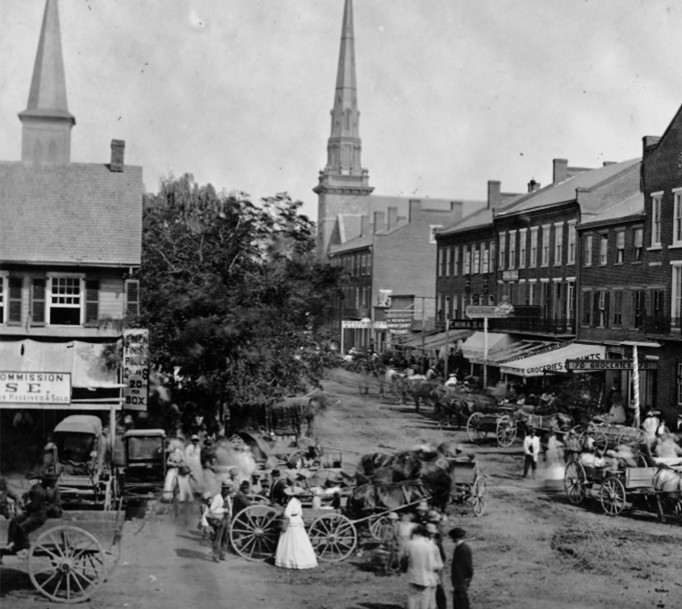
Williamsport, Pennsylvania, circa 1885 (public domain).
Following his honorable discharge from the military, George W. Lightfoot returned to his wife and son in his adopted home state of Pennsylvania. More children soon followed: Alfred Theodore Lightfoot (1865-1947), who was born in Bath Township, Northampton County on 9 July 1865 and later became a machinist and resident of Missouri; Charles Lightfoot (1867-1951), who was born in June 1867 and later wed Carrie Ellen Shearer (1866-1928); and Sarah C. Lightfoot (1869-1882), who was born in November 1869.
Still working as a shoemaker in 1870, George Lightfoot was living with his children, William, Alfred, Charles, and Sarah, in Lycoming County, Pennsylvania in the city of Williamsport’s First Ward. Two years later, another son — Silas Swallow Lightfoot (1872-1943) — was born in Williamsport on 10 June 1872. (Silas would later migrate west to California and become a longtime employee of the Santa Fe Railroad.)
On 3 September 1873, Williamsport’s Daily Gazette and Bulletin published a brief article about George Lightfoot’s boot and shoemaking business:
CUSTOM WORK — Among the home enterprises which commend themselves to our readers and the public in general is the boot and shoe manufactory of George W. Lightfoot, on Pine Alley, a few doors south of Fourth street, near the Academy of Music. A practical workman, superintending every department of his business or executing it in person, — purchasing none but the very best of stock, and employing only first-class workmen, his work is giving very general satisfaction to all his patrons. He has just received a full line of French and calf, glove kid, oil, brush, and pebble goat, French kip, oak sole, &c., and is prepared to make up orders for fall and winter. Persons wishing a good fitting boot or shoe, made of good stock, and warranted to give good satisfaction, will do well to call on Lightfoot.
He also paid the publishers of the Daily Gazette and Bulletin to run a series of advertisements thoughout that year which promoted his business:
Boots and Shoes.
Geo. W. Lightfoot.Practical Boot and Shoe Maker, is in receipt of a full line of the very choicest FRENCH and AMERICAN CALF and KIP SKINS, SOLE LEATHER, of the best brands, and with experienced workmen is prepared to furnish the ladies and gentlemen of Williamsport with good stock, good fits and good work, at fair, remunerative prices. All work warranted as represented.
His shop has been refitted, on Pine Alley, a few doors south of Fourth street, between Pine and William streets, where he will be pleased to see all who wish to patronize home industry and secure a good article. Repairing done at short notice.
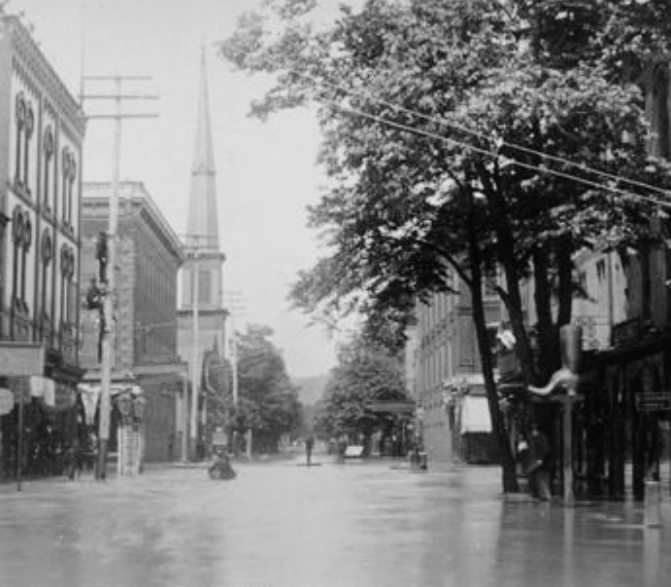
Pine Street in Williamsport, Pennsylvania was under deep water on 1 June 1889, after catastrophic flooding began during the previous month (public domain).
In 1880, shoemaker George Lightfoot resided in Williamsport’s Third Ward with his wife and children, William, who worked at a furniture factory; Alfred, who was employed as an apprentice sawmaker; Charles, who worked at a planing mill; Sarah, and Silas.
Sadly, tragedy struck the Lightfoot family two years later when George Lightfoot’s daughter, Sarah C. Lightfoot, died in Williamsport in early May 1882. Just twelve years and six months old at the time of her passing, her funeral was held on 6 May 1882, according to a report by Williamsport’s Daily Gazette and Bulletin, which noted that she was laid to rest at the Williamsport Cemetery.
Tragedy then struck again with the Great Flood and Storms of 1889. According to the U.S. National Weather Service:
On May 31, 1889, a catastrophic failure of the South Fork Dam on the Little Connemaugh River, approximately 14 miles upstream of Johnstown, Pennsylvania, resulted in one of the worst natural catastrophes in the history of the United States, creating the largest loss of life from a natural disaster not caused by a hurricane or earthquake.
Intense heavy rains fell across the area in the day preceding the failure, and the poorly maintained earthen dam weakened and subsequently failed during the afternoon hours. This sudden failure sent a torrent of water down a canyon, into the heart of Johnstown. It was reported that the flood wave produced a wall of water 35 feet high and a half mile wide….
Flooding was also widespread across the state from this weather event. Major flooding was reported along the West Branch of the Susquehanna River. The prosperous lumber town of Williamsport reported that 75 percent of the town was under water during the peak of the flooding.
According to the Johnstown Area Heritage Association, “The rain, which began in the late afternoon of Thursday, May 30, continued with increased violence until Saturday, June 1. Clearfield borough had flooded streets by 5 a.m., May 31…. Renovo, southeast of Clearfield on the West Branch, was flooded by evening, May 31.”
At 8 p.m. [on 31 May 1889], the West Branch [of the Susquehanna River] at Lock Haven began to rise rapidly…. The log dam held until 2 a.m., Saturday, June 1, when it broke with a great roar….
The West Branch was running seventeen feet deep at the time that the boom at Lock Haven broke. With the endless procession of the 73,000,000 million feet of lumber spanning the river, the flood bore down on Williamsport where another log boom crossed the river.
The flood entered Williamsport at 3 a.m., Saturday morning [1 June 1889].
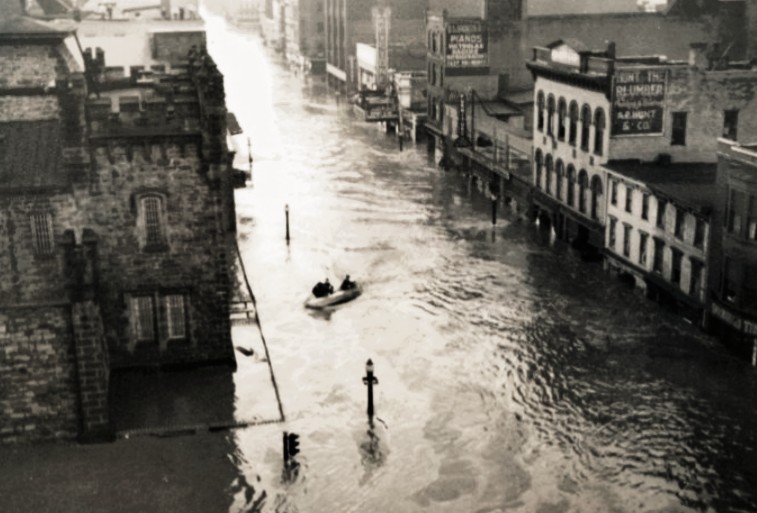
The great flood of 1889 inundated the streets of Williamsport, Pennsylvania with more than thirty feet of water (photo: early June 1889, public domain; click to enlarge).
Six hours later, Williamsport’s log boom also burst, effectively doubling the log and lumber debris that was being propelled through the region by the flood waters, and adding more debris from Williamsport’s railroad infrastructure, businesses and homes that had been swept away. According to a report by the Indiana Weekly News: “Since Saturday morning last this city has undergone the experience of being flooded with 34 feet of water.”
A level of surface water extended from the northern line of the city entirely across the city to the mountain on the south side. This meant that the water was six feet deep on the floors of the buildings in Market Square; over four feet deep in the station of the Pennsylvania Railroad and at the Park Hotel. Fully three quarters of the city is submerged. The loss is enormous.
Illness, Death and Interment
Just over eight years after the death of his daughter — and a year after the catastrophic flood hit Williamsport, George W. Lightfoot was gone. In his mid-sixties when he died in Williamsport on 18 May 1890, he was also laid to rest at the Williamsport Cemetery. On 23 May, his adopted hometown’s newspaper, the Daily Gazette and Bulletin, published the following short notice entitled, “Card of Thanks”:
Mrs. Elizabeth Lightfoot and children wish to return their sincere thanks to the friends and neighbors who assisted during the illness, death and burial of the husband and father, and to those who contributed flowers. Also to Barrows Post, and to the Women’s Relief Corps.
Williamsport, May 22nd.
The Philadelphia Inquirer then reported in June that U.S. Pension Bureau officials had finally gotten around to approving a “restoration and increase” of his U.S. Civil War Pension — vital financial assistance that might have helped extend his life had those officials acted more quickly.
What Happened to George W. Lightfoot’s Widow and Children?
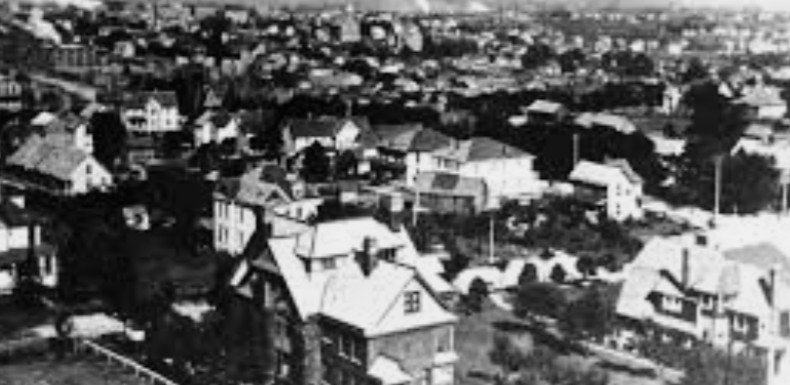
Aerial view of the Borough of Kane, Pennsylvania, 1907 (public domain).
Having secured financial assistance from the federal government in the form of a U.S. Civil War Widow’s Pension, George W. Lightfoot’s widow, Elizabeth Elnora (Brown) Lightfoot, continued to reside in Williamsport. By 1900, she was living alone there. Still able to interact with family and friends, she traveled to the Borough of Kane in McKean County, Pennsylvania during the fall of 1907 to visit her son, Charles Lightfoot. Sadly, she was badly burned during an accident at his home in November of that year, and was required to stay there, under the care of physicians, for the remainder of her days. She died there in her mid-seventies on 19 March 1908. Her remains were subsequently returned to Lycoming County for interment beside her husband at the Williamsport Cemetery.
Having married Mary C. Straub at the Pine Street Methodist Church in Williamsport on 21 November 1883, George W. Lightfoot’s son, William Lightfoot, settled with her in the city of Philadelphia, where they welcomed the birth of a daughter, Ruth Ora Lightfoot (1892-1958), on 10 June 1892. (Ruth later went on to marry William Cavanaugh.) By 1900, William Lightfoot was residing with his wife and daughter in Philadelphia’s Twentieth Ward, where he was employed as a cabinetmaker. Separated from his wife by April 1910, he continued to work as a cabinetmaker, but resided at a boarding house in Philadelphia’s Thirteenth Ward. Divorced from her by the time of the federal census of April 1930, he was still working as a cabinetmaker that year, but was living at a different boarding house in Philadelphia’s Fifteenth Ward. Researchers have not yet determined what happened to him after that census; his burial location also remains unidentified.
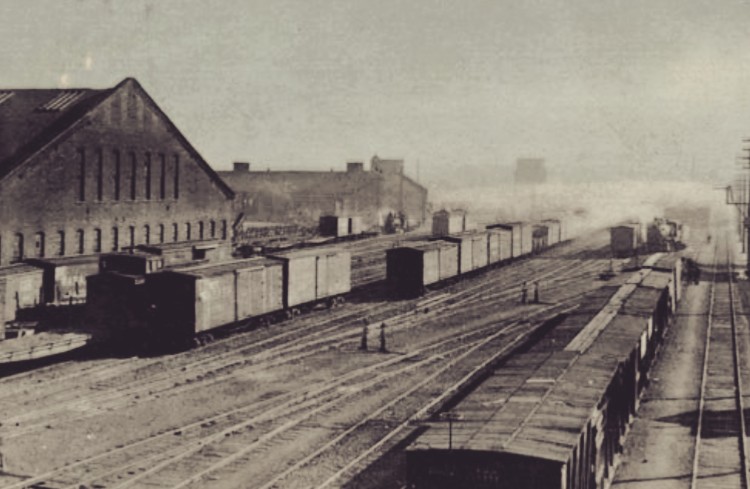
Wabash Railroad Yards, Moberly, Missouri, circa 1910 (public domain).
George W. Lightfoot’s son, Alfred Theodore Lightfoot, grew up to become a machinist. Following his marriage to Jennie Freelove Winegartner (1868-1942), he settled with her in Williamsport, where he welcomed the births with her of: Alfred Lewis Wood Lightfoot (1889-1955), who was born in 1889 and later wed Emma Edkin (1887-1983); and Alverta Lightfoot (1893-1981), who was born on 19 March 1893 and later wed Lester Kelly Ade (1892-1975). Subsequently divorced from his first wife, Alfred T. Lightfoot then married Iowa native Grace Gilfillan (1872-1969). In 1913, he migrated south to the town of Moberly in Randolph County, Missouri, where he took a job as a machinist at the Wabash Railroad yards — a job he held until his retirement. Ailing during the final year of his life, he was admitted to the Wabash Hospital, where he died at the age of eighty-two, on 12 November 1947. A longtime Mason, he was buried with Masonic honors at the Oakland Cemetery in Moberly.
George W. Lightfoot’s son, Charles H. Lightfoot, grew up to become a chemist and nurse. Following his marriage to Carrie Ellen Shearer in 1887, he welcomed the births with her of: William Charles Lightfoot, who was born on 9 April 1889; Harry Orlando Lightfoot (1890-1918), who was born on 30 September 1890 and later died from pneumonia while in service to the nation as a corporal in the U.S. Army; Warren Russell Lightfoot (1891-1952), who was born on 16 April 1891 and later served as a corporal in the U.S. Army during World War I; Elmira E. Lightfoot (1896-1966), who was born in the Borough of Kane in McKean County, Pennsylvania on 29 June 1896 and later wed Charles Edward Caugherty (1897-1971); Ellen B. Lightfoot (1893-1900), who was born in Kane on 18 December 1893 but died there at the age of six on 27 August 1900; Martha Muriel Lightfoot (1901-1993), who was born in Kane on 7 April 1901 and later wed Ray McCulley Gross (1897-1945); and Grace Lightfoot (1904-1998), who was born on 31 January 1904 and later wed Edward E. Schlanger. Sadly, tragedy struck in November of 1907 when Charles H. Lightfoot’s mother, Elizabeth Elnora (Brown) Lightfoot, was badly burned during an accident at his home in Kane that month. Required to stay at his home, under the care of physicians for the remainder of her days, she died from injury-related complications at his home in her mid-seventies on 19 March 1908. Employed as a retail merchant in 1910, Charles H. Lightfoot resided in Wetmore Township, McKean County that year with his wife and children: William, Warren, Harry, Elmira, Martha, and Grace. Sometime after that year’s federal census was conducted on 15 April, he and his wife relocated to Ohio with several of their children. Another son, Eugene Robert Lightfoot (1912-1975), was born in the city of Canton in Stark County, Ohio on 24 April 1912. By 1920, Charles H. Lightfoot was employed as a policeman by a steel mill and was residing in Plain Township, Stark County with his wife and children: Martha, Grace and Eugene. Roughly eight years later, tragedy struck the Lightfoot family again when George Lughtfoot was widowed by his wife, Carrie Ellen (Shearer) Lightfoot, who passed away in her early sixties on Christmas Eve in 1928 in Coulter, Richland County, Ohio. Following funeral services, she was laid to rest at the Mansfield Cemetery in Mansfield, Richland County. By 1930, Charles H. Lightfoot had retired and returned to the East Coast, and was living in an apartment in Brooklyn, New York with his seventeen-year-old son, Eugene. A decade later, he was living alone in a boarding house in the Bronx. A New York City resident for the remainder of his life, he died there at the age of ninety-four in June 1951. Researchers have not yet identified his burial location.
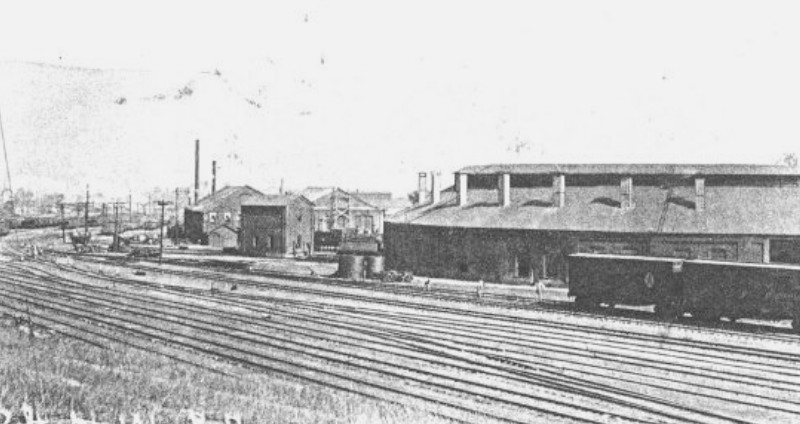
Railroad yards, Bellwood, Blair County, Pennsylvania, date unknown (public domain).
George W. Lightfoot’s son, Silas Swallow Lightfoot, grew up to become a longtime railroad industry employee. In 1895, he resided in Bellwood, Blair County, Pennsylvania, where he was employed at the railroad shop. In mid-August of that year, he underwent surgery to remove glass fragments that had been propelled into his eye during an explosion at work. Married that same year to Emma Shofer (1873-1941), he welcomed the births with her of: Verona Cecilia Lightfoot (1896-1973), who was born in Pennsylvania on 23 August 1896, was baptized at St. Mark’s Lutheran Church in Williamsport on 2 September 1896 and later graduated from the University of California, Los Angeles (UCLA) and became a stenographer and private secretary for an insurance company; and Helen E. Lightfoot (1899-1967), who was born in Pennsylvania on 16 April 1899 and grew up to become a nurse for a private medical practice. By June of 1900, he had relocated with his wife and two daughters to the city of Philadelphia’s Twentieth Ward, where he was employed as a machinist. A third daughter, Katherine Edith Lightfoot (1903-1935), was then born there on 11 June 1903.
* Note: Although Katherine Edith (Lightfoot) Madsen would subsequently marry Harold V. B. Madsen and welcome the birth of a daughter, Joanna Madsen, Katherine’s life would prove to be a short one. Ailing with rheumatic heart disease, she would subsequently die from disease-related complications in Pittsburgh, Pennsylvania roughly three weeks before her thirty-second birthday in 1935.
Sometime after the birth of their third daughter, Silas S. Lightfoot and his wife, Emma, packed up their belongings and migrated west to California, where they initially settled in San Bernardino County, California, and where he began his long career with the Santa Fe Railroad. More children soon followed: Margaret E. Lightfoot (1905-1985), who was born in San Bernardino County on 23 November 1905 and would later graduate from medical school and open her own private medical practice in Los Angeles County, California as an osteopathic physician, before marrying fellow physician Fred H. Stone; and Richard Owen Lightfoot (1910-1983), who was born on 9 March 1910 and would later became a chemist.
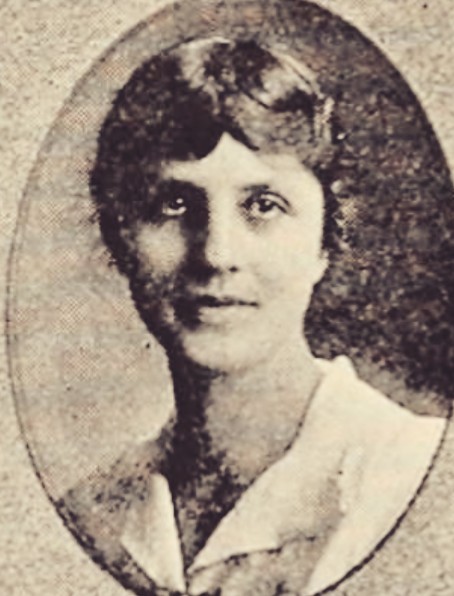
Verona Lightfoot, University of California, Los Angeles, 1917 (UCLA yearbook photo, public domain).
By 1910, Silas S. Lightfoot was employed as a “bonus demonstrator” by the Santa Fe Railroad and was residing in a home that he owned at 1024 Ninth Street in the city of Colton in Colton Township, San Bernardino County. Living with him were his wife, Emma, and their children: Verona, Helen, Katherine, Margaret, and Richard, as well as Silas’s twenty-two-year-old sister-in-law, Anna Shofer, who was employed as a cashier at a traction company.
By 1919, they had relocated to the city of Los Angeles. During the summer of that year, they took “an extended trip” to Chicago. Employed as an equipment engineer by the Santa Fe Railroad in 1920, Silas S. Lightfoot resided at 1219 Thirty-Sixth Street in the city of Los Angeles with his wife, Emma, and their children: Verona; Helen, who was employed by a bank as a filing clerk; Katherine E.; Margaret E.; and Richard O. Lightfoot. Also still living with them was Silas’s sister-in-law, who was employed as an auditor by a railroad company.
By 1930, however, Silas Lightfoot had bought a three-bedroom, two-bath, Spanish-style house at 3520 West 59th Street in Los Angeles, and had moved most of his family into it. (Built in 1925, it still exists today.) Living with him were his wife, Emma, and their children: Verona, who was working as a stenographer at a real estate company; Helen, who was employed as a nurse in the private practice office of a physician; Margaret, who was employed as an osteopathic physician and surgeon; and Richard Lightfoot, as well as Silas’s sister-in-law, Anna Shofer, who was employed as a railroad company clerk.
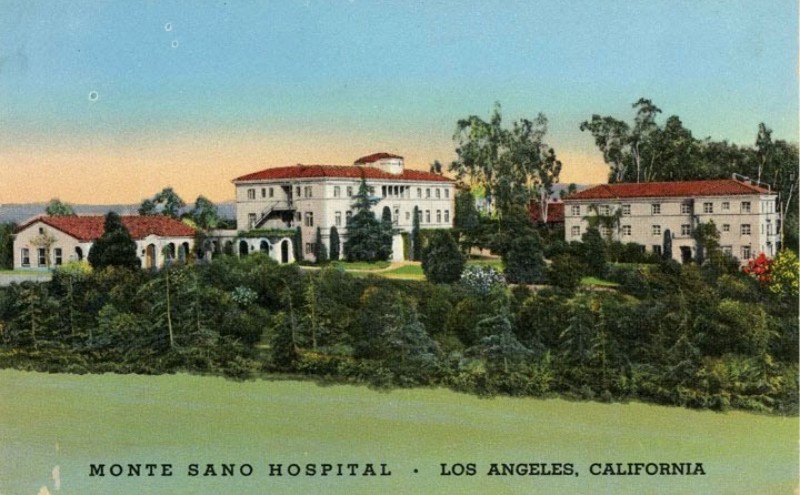
Postcard depicting the Monte Sano Hospital and Sanitarium in Los Angeles, California, circa 1930s (pubic domain).
Having reached the position of engine inspector, Silas S. Lightfoot retired from the Santa Fe Railroad during or before the spring of 1940, according to the 7 April 1940 edition of the San Bernardino Daily Sun, which described him as a “pensioner” who was one of multiple “Santa Fe system employes who [had] retired from active services since enactment of the railroad retirement act.” Later that same month, on 30 April 1940, Silas, his wife and all three of their unmarried daughters, Verona, Helen and Margaret Lightfoot, were documented by state and federal recordkeepers as members of the Republican Party who were still living together at 3520 West 59th Street in Los Angeles.
Sometime after the federal census of 1940, Silas and Emma Lightfoot moved into a much larger home at 1218 South Gramercy Place in what is now the Olympic Park section of Los Angeles. Their home, which had been built in 1923, remains in excellent condition today. Sadly, his wife, Emma Louise (Shofer) Lightfoot, then widowed him when she passed away on 19 October 1941. Subsequently hospitalized at the Monte Sano Hospital and Sanitarium in Los Angeles County, he died there at the age of seventy-two on 16 October 1943. Following funeral services, he was laid to rest at the Inglewood Park Cemetery in Inglewood, Los Angeles County. His four surviving children were all still living in that same county at the time of his passing.
Sources:
- “Alfred T. Lightfoot Dies Here at 82; Funeral Saturday” (obituary of a son of George W. Lightfoot). Moberly, Missouri: Moberly Monitor-Index and Democrat, 13 November 1947.
- Alfred Theodore Lightfoot (a son of George W. Lightfoot), in U.S. Social Security Application and Claims Index. Washington, D.C.: U.S. National Archives and Records Administration.
- Bates, Samuel P. History of Pennsylvania Volunteers, 1961-5, vol. 1. Harrisburg, Pennsylvania: B. Singerly, State Printer, 1869.
- “Boots and Shoes” (advertisements for George W. Lightfoot’s shoemaking and repair business). Williamsport, Pennsylvania: Daily Gazette and Bulletin, 28 May 1873, 26 July 1873, 26 August 1873, 24 September 1873, and 19 December 1873, etc.
- “Card of Thanks” (thank you notice from George W. Ligutfoot’s wife and children to members of the Williamsport community for their support during George Lightfoot’s illness, death and burial). Williamsport, Pennsylvania: Daily Gazette and Bulletin, 23 May 1890.
- “Custom Work” (brief news article regarding George W. Lightfoot’s shoemaking and repair business). Williamsport, Pennsylvania: Daily Gazette and Bulletin, 3 September 1873.
- Emma Louise Lightfoot (the wife of George W Lightfoot’s son, Silas S. Lightfoot), in California Death Index (Los Angeles County, California, 19 October 1941). Sacramento, California: Vital Statistics, California Department of Public Health.
- Eugene Robert Lightfoot (a grandson of George W. Lightfoot and a son of Charles H. Lightfoot), in U.S. World War II Draft Registration Cards, 1942. Washington, D.C.: U.S. National Archives and Records Administration.
- “Flood at Williamsport.” Indiana, Pennsylvania: Indiana Weekly News, 5 June 1889.
- “Florida’s Role in the Civil War,” in “Florida Memory.” Tallahassee, Florida: State Archives of Florida.
- “Got Glass in His Eye” (report on the work-related injury of Silas S. Lightfoot, a son of George W. Lightfoot). Williamsport, Pennsylvania: Daily Gazette and Bulletin, 23 August 1895.
- Grodzins, Dean and David Moss. “The U.S. Secession Crisis as a Breakdown of Democracy,” in When Democracy Breaks: Studies in Democratic Erosion and Collapse, from Ancient Athens to the Present Day (chapter 3). New York, New York: Oxford University Press, 2024.
- Homan, John F., Ella J., J.Theodore, and John F. (boarding house operators); and Lightfoot, William (a son of George W. Lightfoot), in U.S. Census (City of Philadelphia, Fifteenth Ward, Philadelphia County, Pennsylvania, 1930). Washington, D.C.: U.S. National Archives and Records Administration.
- “Irish and German Immigration,” in U.S. History Online Textbook. Philadelphia, Pennsylvania: Independence Hall Association of Philadelphia, retrieved online 6 October 2025.
- Katherine Edith Madsen (a granddaughter of George W. Lightfoot and a daughter of Silas S. Lightfoot), in Death Certificates (file no.: 45292, registered no.: 3633, date of death: 16 May 1935). Harrisburg, Pennsylvania: Commonwealth of Pennsylvania, Department of Health, Bureau of Vital Statistics.
- Lightfoot, Charles (a son of George W. Lightfoot), Carrie, William, Warren R., Harry O., Elmira E., and Ellen B., in U.S. Census (Borough of Kane, McKean County, Pennsylvania, 1900). Washington, D.C.: U.S. National Archives and Records Administration.
- Lightfoot, Charles (a son of George W. Lightfoot), Carrie, William, Warren R., Harry O., Elmira E., Martha M., and Grace, in U.S. Census (Wetmore Township, McKean County, Pennsylvania, 1910). Washington, D.C.: U.S. National Archives and Records Administration.
- Lightfoot, Charles (a son of George W. Lightfoot) and Eugene, in U.S. Census (Borough of Brooklyn, Kings County, New York, 1930). Washington, D.C.: U.S. National Archives and Records Administration.
- Lightfoot, Charles (a son of George W. Lightfoot), in U.S. Census (Borough of Bronx County, New York, 1940). Washington, D.C.: U.S. National Archives and Records Administration.
- Lightfoot, Chas (a son of George W. Lightfoot), Carry, Martha, Grace, and Eugene, in U.S. Census (Plain Township, Stark County, Ohio, 1920). Washington, D.C.: U.S. National Archives and Records Administration.
- Lightfoot, Elisabeth (the widow of George W. Lightfoot), in U.S. Census (Williamsport, Second Ward, Lycoming County, Pennsylvania, 1900). Washington, D.C.: U.S. National Archives and Records Administration.
- “Lightfoot, Emma L.” (death notice). Los Angeles, California: The Los Angeles Times, 20 October 1941.
- Lightfoot, G. W., in Records of Burial Places of Veterans (Williamsport Cemetery, Wlliamsport, Lycoming County, Pennsylvania, date of death: 18 May 1890). Harrisburg, Pennsylvania: Commonwealth of Pennsylvania: Department of Military Affairs.
- Lightfoot, Geo. W., Elizabeth, William, Alfred, Charles, and Sarah, in U.S. Census (Williamsport, First Ward, Lycoming County, Pennsylvania, 1870). Washington, D.C.: U.S. National Archives and Records Administration.
- Lightfoot, Geo. W., Elizabeth, William, Alfred, Charles, Sarah, and Silas, in U.S. Census (Williamsport, Third Ward, Lycoming County, Pennsylvania, 1880). Washington, D.C.: U.S. National Archives and Records Administration.
- Lightfoot, George, in U.S. Civil War Draft Registration Records (Borough of Bath, Northampton County, Pennsylvania, June 1863). Washington, D.C.: U.S. National Archives and Records Administration.
- Lightfoot, George and Elizabeth, in U.S. Census (Bethlehem, East Allen Township, Northampton County, Pennsylvania, 1860). Washington, D.C.: U.S. National Archives and Records Administration.
- Lightfoot, George W., in Civil War Muster Rolls (Company G, 47th Pennsylvania Infantry). Harrisburg, Pennsylvania: Pennsylvania State Archives.
- Lightfoot, George W., in Civil War Veterans’ Card File, 1861-1866 (Company G, 47th Pennsylvania Infantry). Harrisburg, Pennsylvania: Pennsylvania State Archives.
- Lightfoot, George W. and Elizabeth, in U.S. Civil War Pension General Index Cards (veteran’s application no.: 188376, veteran’s certificate no.: 268767, filed by the veteran, 7 December 1873; widow’s application no.: 427569, widow’s certificate no.: 300752, filed by the veteran’s widow from Pennsylvania, 26 June 1890). Washington, D.C.: U.S. National Archives and Records Administration.
- “Lightfoot, Mrs. Carrie Ellen” (obituary of a daughter-in-law of George W. Lightfoot and the wife of Charles H. Lightfoot), in “Deaths.” Mansfield, Ohio: The Mansfield News, 24 December 1928.
- Lightfoot, Mrs. Emma L., Helen E., Margaret E., Silas S. (a son of George W. Lightfoot), and Verona C., in Index to Register of Voters (Los Angeles City Precinct No. 1898, Los Angeles County, California, 1940). Los Angeles, California: Office of the Los Angeles County Registrar of Voters.
- Lightfoot, Margaret E., Verona C. and Helen E. (granddaughters of George W. Lightfoot and daughters of Silas S. Lightfoot); and Madsen, Joanna L. (their niece and a daughter of their deceased sister, Katherine (Lightfoot) Madsen), in U.S. Census (Hunter House, City of Los Angeles, Los Angeles County, California, 1950). Washington, D.C.: U.S. National Archives and Records Administration.
- Lightfoot, Silas (a son of George W. Lightfoot), Emma, Vera [sic, “Verona”], and Helen, in U.S. Census (City of Philadelphia, Twentieth Ward, Philadelphia County, Pennsylvania, 1900). Washington, D.C.: U.S. National Archives and Records Administration.
- Lightfoot, Silas (a son of George W. Lightfoot), Emma, Verona, Helen, Katherine, Margaret, and Richard; and Shofer, Anna (Silas Lightfoot’s sister-in-law), in U.S. Census (City of Colton, Colton Township, San Bernardino County, California, 1910). Washington, D.C.: U.S. National Archives and Records Administration.
- Lightfoot, Silas S. (a son of George W. Lightfoot), Emma, Verona, Helen, Katherine, Margaret, and Richard; and Shofer, Anna (Silas Lightfoot’s sister-in-law), in U.S. Census (City of Los Angeles, Los Angeles County, California, 1920). Washington, D.C.: U.S. National Archives and Records Administration.
- Lightfoot, Silas S. (a son of George W. Lightfoot), Emma, Verona, Helen, Margaret, and Richard; and Shofer, Anna (Silas Lightfoot’s sister-in-law), in U.S. Census (City of Los Angeles, Los Angeles County, California, 1930). Washington, D.C.: U.S. National Archives and Records Administration.
- Lightfoot, William F. (a son of George W. Lightfoot) and Mary C. Straub, in Marriage Records (Pine Street Methodist Church, Williamsport, Lycoming County, Pennsylvania, 21 November 1883). Williamsport, Pennsylvania: Pine Street Methodist Church.
- Lightfoot, William F., Mary C. and Ruth O., in U.S. Census (City of Philadelphia, Twentieth Ward, Philadelphia County, Pennsylvania, 1900). Washington, D.C.: U.S. National Archives and Records Administration.
- Llewellyn, William and Olivia (boarding house operators); Wells, Ida (servant); and lodgers: Lightfoot, William (a son of George W. Lightfoot); Hicke, Sylvester J.; Kane, Harry; Schnitz, Arthur; Wilson, Thomas; and Wood, John and Robert, in U.S. Census (City of Philadephia, Thirteenth Ward, Philadelphia County, Pennsylvania, 1920). Washington, D.C.: U.S. National Archives and Records Administration.
- “Mansfielder’s Father Stricken” (death notice of George W. Lightfoot’s son, Charles H. Lightfoot). Mansfield, Ohio: Mansfield News-Journal, 12 June 1951.
- Mr. and Mrs. Silas S. Lightfoot, in “Personals.” San Bernardino, California: The Evening Index, 18 June 1919.
- “Mrs. Elizabeth Lightfoot,” in “In Nearby Counties.” Altoona, Pennsylvania: Morning Tribune, 23 March 1908.
- “Pensions for Veterans: Certificates Granted to Persons Who Suffered Through the War.” Philadelphia, Pennsylvania: The Philadelphia Inquirer, 23 June 1890.
- “Retired Employe of Santa Fe Succumbs” (obituary of George W. Lightfoot’s son, Silas Swallow Lightfoot). San Bernardino, Californian The San Bernardino County Sun, 21 October 1943.
- “Roster of the 47th P. V. Inf.” Allentown, Pennsylvania: The Morning Call, 26 October 1930.
- Ruth Ora Cavanaugh (a granddaughter of George W. Lightfoot and a daughter of William Lightfoot), in California Death Index (Los Angeles County, 3 January 1958). Sacramento, California: Vital Statistics, California Department of Public Health.
- “S. F. Magazine Compiles List of Pensioners” (confirmation of Silas S. Lightfoot’s retirement from the Santa Fe Railroad as an engine inspector). San Bernardino, California: San Bernardino Daily Sun, 7 April 1940).
- “Sarah C. Lightfoot” (report on the funeral of George Lightfoot’s daughter). Williamsport, Pennsylvania: The Daily Gazette and Bulletin, 8 May 1882.
- Schmidt, Lewis G. A Civil War History of the 47th Regiment of Pennsylvania Veteran Volunteers. Allentown, Pennsylvania: Self-published, 1986.
- “Stone, Margaret Lightfoot” (death notice of a granddaughter of George W. Lightfoot and a daughter of Silas S. Lightfoot). Los Angeles, California: The Los Angeles Times, 11 January 1985.
- “The Great Storm of 1889,” in “Education.” Johnstown, Pennsylvania: Johnstown Area Heritage Association.
- “The History of the Forty-Seventh Regt. P. V.” Allentown, Pennsylvania: The Lehigh Register, 20 July 1870.
- Verona Celia Lightfoot, in Birth and Baptism Records (St. Mark’s Evangelical Lutheran Church, Williamsport, Lycoming County, Pennsylvania). Williamsport, Pennsylvania: St. Mark’s Evangelical Lutheran Church.
- William Charles Lightfoot (a grandson of George W. Lightfoot and a son of Charles H. Lightfoot), in U.S. World War II Draft Registration Cards, 1942. Washington, D.C.: U.S. National Archives and Records Administration.
 47th Pennsylvania Volunteers
You must be logged in to post a comment.