“Fate is shaped half by expectation, half by inattention.” – Amy Tan
Although those words were penned for a bestselling novel about Chinese immigrant families in San Francisco more than a century after America’s Civil War, they also eloquently sum up the extraordinary twists of fate experienced by a simple laborer-soldier who survived a desperate battle far from home — only to lose his life as a result of children at play in Pennsylvania’s Lehigh Valley.
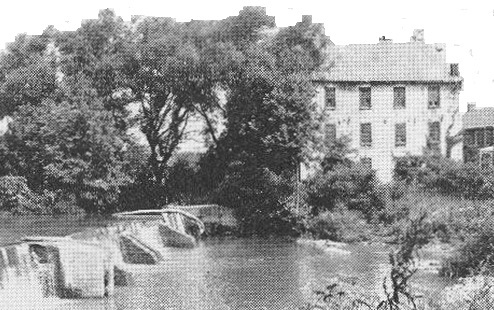
Sieger’s Mill of the U.S. Civil War era is familiar to today’s residents of South Whitehall Township in Lehigh County, Pennsylvania as Wehr’s Mill and Dam (photo circa 1930, public domain).
Born at Sieger’s Mill in South Whitehall Township, Lehigh County, Pennsylvania on 3 October 1844, Griffin Reinert was a son of Reuben Reinert, a brother to Alfred, Frank and Martha Reinert, and a husband to Sarah Ann (Smith) Reinert (1847-1936), a daughter of Mountainville resident Reuben Smith. Among his progeny were two daughters, five sons and a number of grandchildren who each went on to make their mark on the world in their own unique ways.
During his own formative years, Griffin Reinert took up the trade of shoemaking, honed it and then, as 1860 waned and 1861 dawned, watched in concern with his family, friends and neighbors as their community’s horizons were darkened by a nation descending into one of the darkest periods in American History.
American Civil War
As the American Civil War raged on through 1863, Griffin Reinert joined his fellow Allentonians in fighting to preserve America’s Union by enrolling and mustering in for military service on 21 December 1863 in Norristown, Montgomery County, Pennsylvania as a private with Company F of the 47th Regiment, Pennsylvania Volunteer Infantry. Military records at the time described him as being a twenty-year-old shoemaker and Lehigh County native who was five feet, five and one-half inches tall with light hair, gray eyes and a fair complexion.
* Note: The discrepancies between Griffin Reinert’s real and reported ages could simply have been due to clerical errors since variations on the spelling of his given name and surname also appear in military records and newspaper accounts of his life (Griff and Griffin vs. Griffith; Reinert vs. Reinhard and Reinhart). Or they might have been due to his decision to inflate his age, a common occurrence with Civil War-era teenagers who lied about their respective ages in order to be accepted into military service.
Joining a unit that had already been bloodied in battle and tested by the hardships of long marches and the ever-present foe of disease, the newly minted Private Griff Reinert connected with his regiment on 28 January 1864. Although he could not have known it at the time, he was about to make history with his fellow 47th Pennsylvanians.
1864 – The Red River Campaign
On 25 February 1864, the 47th Pennsylvania Volunteers set off for a phase of duty which would forever notch their names in the pages of American history. Steaming from Florida where they had been garrisoning Forts Taylor and Jefferson in Key West and the Dry Tortugas, they headed for New Orleans, Louisiana aboard the Charles Thomas. Arriving at Algiers on 28 February, they were then transported by train to Brashear City.
Following another steamer ride — this time to Franklin via the Bayou Teche, Private Griff Reinert and his fellow 47th Pennsylvanians finally reached their intended destination, and met up with the 2nd Brigade, 1st Division of the U.S. Department of the Gulf’s 19th Army Corps. In short order, the 47th Regiment, Pennsylvania Volunteer Infantry would become the only regiment from the Keystone State to serve in the Red River Campaign spearheaded by Union General Nathaniel P. Banks.
From 14-26 March, the 47th passed through New Iberia, Vermilionville, Opelousas, and Washington while enroute to Alexandria and Natchitoches at the top of the L-shaped state. Often short on food and water, the remaining members of the regiment encamped briefly at Pleasant Hill the night of 7 April before continuing on the next day, marching until mid-afternoon.
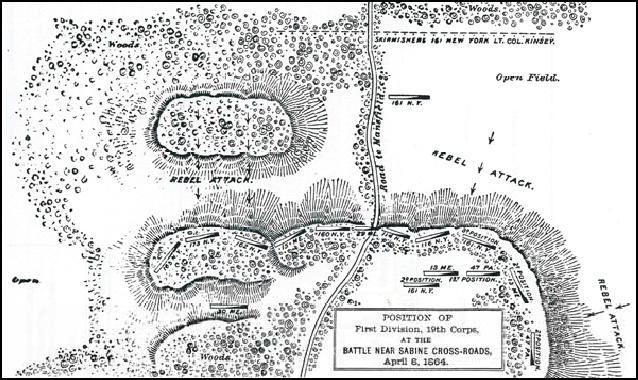
19th U.S. Army Map, Phase 3, Battle of Sabine Cross Roads/Mansfield (8 April 1864, public domain).
Rushed into battle ahead of other regiments in the 2nd Division, sixty members of the 47th were cut down on 8 April during the volley of fire unleashed in the Battle of Sabine Cross Roads (also known as the Battle of Mansfield due to its proximity to the townof Mansfield). The fighting waned only when darkness fell.
The exhausted, but uninjured collapsed beside the gravely wounded as the dark of night descended. Compelled to remain still, in fear of sparking another confrontation with the enemy, the surviving 47th Pennsylvanians stayed prostrate, enduring the terrible sounds of the wounded and dying men around them until, finally, after midnight, they received orders to withdraw to Pleasant Hill.
Sadly, among those felled in that first major battle of the Red River Campaign was Private Griffin Reinert. Shot through the lower jaw less than three months into his military service with the 47th Pennsylvania, his days of combat were already over. His new battle would be to survive the grievous facial wound he had sustained and the medical complications he would experience as military surgeons fought to keep him alive.
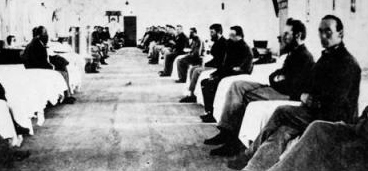
Ward of U.S. Army General Hospital, Penn Park, York, Pennsylvania (circa 1864, public domain).
Initially treated in the field, Private Reinert was transferred to a 19th Corps hospital and then through the Union Army’s system of military hospitals for the necessary, more advanced care — until he was finally moved to U.S. Army’s General Hospital in Penn Park at York, Pennsylvania to continue his convalescence. Three days after Christmas in 1864, and just over ten months after he had been wounded in action, he was discharged from that hospital on a surgeon’s certificate of disability, and transported home to the Lehigh Valley.
Return to Civilian Life

Center Square at 7th Street (Allen House Hotel at right; Allentown Bank and Board of Trade, looking north, top), Allentown, Pennsylvania (1876, public domain).
After his honorable discharge from the army hospital in York, Pennsylvania, Griffin Reinert returned to Lehigh County, where he began to make a home for himself and build a family. Together, he and his wife Sarah welcomed to the world daughter Bessie and sons Benjamin, Edwin, Franklin, Preston, and Wilson Reinert.
By 1873, he and his family had relocated to Allentown, the community he would call home for the remainder of his life. An attendee at reunions by his former regiment — the 47th Pennsylvania Volunteers — he was also a member of Company E of the 2nd Regiment, Sons of Veterans (S. of V.).
Like many of his fellow 47th Pennsylvanians who had been wounded in combat during America’s long Civil War, Griff Reinert found that life had its ups and downs — especially where health matters were concerned. Suffering from persistent battle wound-related problems, he tried valiantly to soldier on, continuing to support his family via his job at a local broom and brush works.
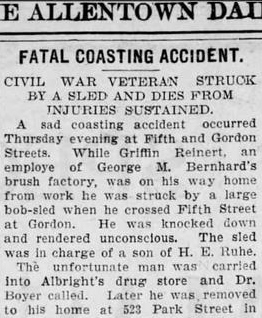
Headline of article in The Allentown Leader announcing Griffin Reinert’s tragic death (18 December 1903).
Life may have appeared brighter as the new century beckoned — probably never more so than when he and his family moved into one of the new row homes which had opened their doors on Park Street in Allentown in 1891. But just as it did in 1864, fate intervened, placing Griff Reinert in the wrong place at the wrong time in 1903. On Friday, 18 December, The Allentown Leader carried the shocking news that:
A sad coasting accident occurred Thursday evening at Fifth and Gordon Streets. While Griffin Reinert, an employe [sic] of George M. Bernhard’s brush factory, was on his way home from work he was struck by a large bob-sled when he crossed Fifth Street at Gordon. He was knocked down and rendered unconscious. The sled was in charge of a son of H. E. Ruhe.
The unfortunate man was carried into Albright’s drug store and Dr. Boyer called. Later he was removed to his home at 523 Park Street in the ambulance. Dr. L. D. Christman, the family physician, was then summoned. Upon examination it was found that the man was suffering from concussion of the brain, that his left leg and hip were badly bruised, and that his eyes were badly swollen and discolored.
Everything possible was done to save the man’s life, but he died Friday morning at 8:45 without gaining consciousness. The cause of death was concussion of the brain. Coroner Scheirer was notified and empaneled a jury this afternoon. The inquest will be held this evening at 7:30 at the coroner’s office.
The family is very sadly afflicted and has the sincere sympathy of the entire community. A daughter has been confined to bed by chronic illness for the past 18 months.
Mr. Reinert was a veteran of the Civil War and held a proud record. He was a member of the famous 47th Regiment, having been a private in Company F, of which County Treasurer Wm. H. Bartholomew of Catasauqua was captain. He was shot through the lower jaw in the battle of Sabine Cross Roads, La., April 8, 1864, and suffered from gastric trouble ever since.
Deceased was a son of the late Mr. and Mrs. Reuben Reinert and was born at Sieger’s mill in South Whitehall Township, October 3, 1844. He was a resident of Allentown for 30 years. His wife is a daughter of Reuben Smith of Mountainville. His wife, two daughters, Mrs. William Block and Bessie Reinert, and these sons survive: Franklin A., Benjamin H., Preston A., Edwin I. and Wilson R. Reinert, all of Allentown, together with three grandchildren. Three brothers, Alfred and Frank Reinert of Coplay and William Reinert of Northampton and one sister, Mrs. Martha Guth of Orefield, also survive.
He was a member of the Jordan Lutheran Church and of the 47th Regiment Survivors’ Association. The funeral arrangements have not been completed.
A brief death notice printed in that same edition of the newspaper added that Reinert was just fifty-nine years, two months and thirteen days old at the time of his death. The day after Christmas, the Pennsburg Town and Courier added further details about the accident:
At the juncture of Fifth and Gordon Streets, Allentown, Griffin REINERT, a veteran of the Civil War, met with injuries which resulted in his death several hours later. The hill near there is used by boys in coasting and the crossing is a dangerous one during the coasting season. Shortly after 5.30 o’clock last Thursday evening Mr. REINERT, was on his way home. When he reached the corner there were comparatively few coasters on the hill but when half way across he noticed a big bob sled, occupied by half a dozen youngsters, dashing towards him. According to the boys’ story they attempted to steer the sled to one side and claim that REINERT, becoming confused, turned in the same direction. The big sled struck the man squarely, knocking him off his feet. He fell on the icy street, striking his head on the left side. In an unconscious condition he was carried to his home and a physician summoned, but he never regained consciousness, dying the next morning.
Funeral services were held at 1:30 p.m. at the Reinert family home at 523 Park Street in Allentown on 22 December 1903, and he was then laid to rest with military honors at Allentown’s Greenwood Cemetery:
The funeral of Griffin Reinert, who died on Friday from the effects of injuries received the previous evening in a coasting accident, took place Tuesday afternoon from his late home, No. 523 Park Street. Services were held at the house and interment was made with military honors in Greenwood Cemetery. Rev. R. M. Kern officiated. Many survivors of the 47th Regiment, and Company E, Second Regiment, S. of V. Reserves, attended.
That same evening, during the coroner’s inquest, Dr. Christman revealed autopsy results which showed that Reinert had sustained a wound causing “a hemorrhage of the brain which undoubtedly caused death.”
A decade later, on 1 April 1913, his sister, Martha (Reinert) Guth, lost her long battle with cancer, and passed away at her home near Siegersville in Lehigh County. Previously widowed by Harrison Guth, a former 47th Pennsylvania comrade of her brother’s, she was interred at Allentown’s Jordan Reformed Church Cemetery (now known as the Jordan United Church of Christ Cemetery).
Just over two decades after his sister’s passing, Griffin Reinert’s widow, Sarah Ann (Smith) Reinert, then also followed him in death, and was laid to rest beside him at Allentown’s Greenwood Cemetery in 1936.
Sources:
- Bates, Samuel P. History of Pennsylvania Volunteers, 1861-5, vol. 1. Harrisburg, Pennsylvania: B. Singerly, State Printer, 1869.
- “Coasting Accident.” Pennsburg, Pennsylvania: Town and Country, 26 December 1903.
- “Fatal Coasting Accident: Civil War Veteran Struck by Sled and Dies from Injuries Sustained” and “Griffin S. Reinert.” Allentown, Pennsylvania: The Allentown Leader, 18 December 1903 and 21 December 1903.
- “Laid to Rest.” Allentown, Pennsylvania: The Allentown Leader, 22 December 1903.
- “Mrs. Martha Guth” (obituary of Griffin Reinert’s sister). Allentown, Pennsylvania: The Allentown Leader, 2 April 1913.
- “Reinert Inquest.” Allentown, Pennsylvania: The Allentown Leader, 22 December 1903.
- Reinhart, Griff, in Civil War Muster Rolls (Company F, 47th Pennsylvania Infantry). Harrisburg, Pennsylvania: Pennsylvania State Archives.
- Reinhart, Griff, in Civil War Veterans’ Card File, 1861-1866 (Company F, 47th Pennsylvania Infantry). Harrisburg, Pennsylvania: Pennsylvania State Archives.
- Schmidt, Lewis. A Civil War History of the 47th Regiment of Pennsylvania Veteran Volunteers. Allentown, Pennsylvania: Self-published, 1986.
 47th Pennsylvania Volunteers
You must be logged in to post a comment.