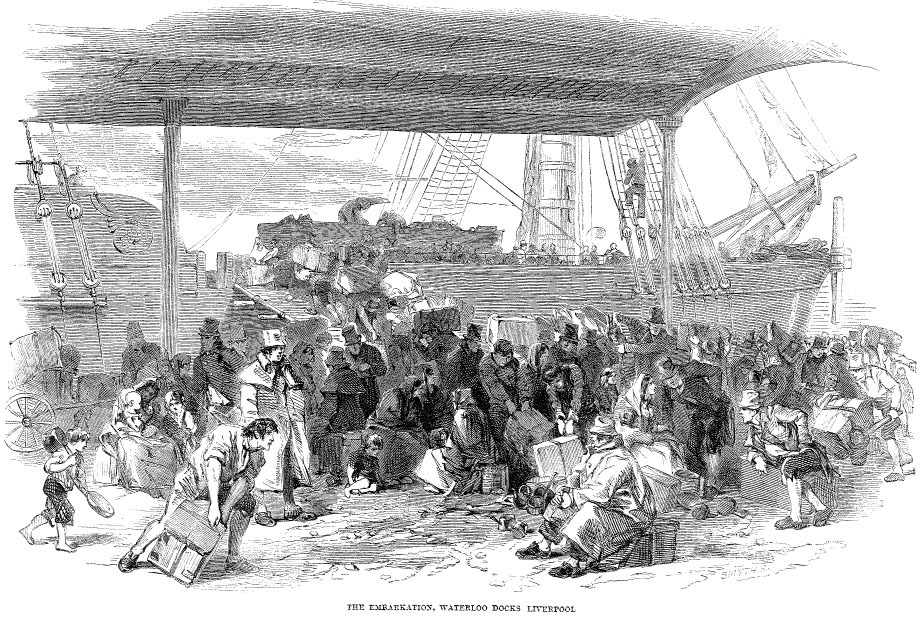
While the exact year and point of emigration are not yet known for the parents of Wesley White, it is likely that his parents experienced a scene much like the one depicted in “The Embarkation,” The London Illustrated, 6 July 1850 (public domain).
His story is the quintessential American success story. A son of Irish immigrants who made a new home for themselves in the heartland of Pennsylvania, Wesley M. White enlisted in the army as a teenager and blazed a new trail for himself and his family as a homesteader and hard-working farmer in Nebraska, before finally achieving success as a prosperous businessman in California.
His descendants and siblings would go on to make their own mark on the states of Idaho, Kansas, Nebraska, Utah, and Washington, as well as in Mexico and South America.
But first, he would need to survive the darkest period in American history.
Formative Years
A first-generation American who was born in Perry County, Pennsylvania in May 1847, Wesley M. White was a son of John White (1815-1886) and Elizabeth (Byrnes) White (1821-1902), who had both emigrated from Ireland sometime during or before the 1840s.
In 1850, he resided in Oliver Township, Perry County with his parents and younger sister, Martha White, who had been born circa 1849. According to baptismal records of the Asbury Methodist Church in Duncannon, the Whites lived in the community of Wheatfield during the late 1850s.

Even in the early 1900s, Duncannon, Pennsylvania retained its rural character (view from Orchard Hill, public domain).
By 1860, the White family’s standard of living was likely a good one for the time because Wesley White’s father was employed as a foreman for the Pennsylvania Railroad Company (PRR). That year, Wesley resided in Duncannon, Penn Township with his parents and siblings: Martha White; Margaret J. White, who had been born circa 1852; John H. White (1854-1921), who had been born in August 1854 (alternate birth year: 1853) and would later wed Ada Virginia Snodgrass (1852-1921); James A. White (circa 1858-1930), who had been born in 1858 and would later wed Kittie A. Smith (1866-1960); and Joseph Byrnes White (1859-1940), who had been born in Duncannon on 26 November 1859 (alternate birth year: 1857), was baptized at the Asbury Methodist Church in Duncannon on 14 February 1869 and would grow up to become a yardmaster with the Union Pacific Railroad and Idaho resident. Another sibling — Elizabeth Rachel White (1862-1939) — was born at the White home in January 1862. Known to family and friends as “Lizzie,” she would later go on to marry Alanson Coltrin (1845-1912), who was a native of Berea, Ohio.
Throughout many of those formative years, Wesley White was a student in Perry County’s public schools who helped his family by doing regular chores at home when he wasn’t in class or watching neighbors march off to war, hoping that somehow, the raging conflict would finally be brought to a halt.
American Civil War
Eligible to enlist in the Army of the United States (and finally able to convince his parents that is was the right path for him to follow), eighteen-year-old Wesley M. White enrolled for military service in Duncannon, Perry County on 1 February 1861. He then officially mustered in for duty as a private with Company D of the 47th Pennsylvania Volunteer Infantry at Camp Curtin in Harrisburg, Dauphin County on 11 February 1864.*
* Note: The entry for Wesley M. White in the Civil War Veterans’ Card File at the Pennsylvania State Archives indicates that he joined the service from a recruiting depot on 17 April 1864.
He was assigned to a battle-hardened regiment that was in the process of making history as the only regiment from the Commonwealth of Pennsylvania involved in the Union’s 1864 Red River Campaign across Louisiana. Military records described him as being five feet, five inches tall with light hair, gray eyes and a light complexion.
Red River Campaign

“Passage of the Fleet of Gunboats Over the Falls at Alexandria, Louisiana, May 1864 (Frank Leslie’s Illustrated Newspaper, July 16, 1864, U.S. Library of Congress, public domain; click to enlarge).
Although state and federal military records indicate that Private Wesley M. White missed the two most intense battles of the Red River Campaign (Sabine Cross Roads and Pleasant Hill from 8-9 April), and possibly also the Battle of Cane River (near Monett’s Ferry on 23 April), he was able to connect with his regiment in time to still see action in Louisiana, most likely reaching the 47th Pennsylvania Volunteer Infantry’s encampment at Alexandria while the 47th Pennsylvania was engaged in building Bailey’s Dam. According to Company C Musician Henry D. Wharton:
We were at Alexandria seventeen days, during which time the men were kept busy at throwing up earthworks, foraging and three times went out some distance to meet the enemy, but they did not make their appearance in numbers large enough for an engagement. The water in the Red river had fallen so much that it prevented the gun boats from operating with us, and kept our transports from supplying the troops with rations, (and you know soldiers, like other people will eat), so Banks was compelled to relinquish his designs on Shreveport and fall back to the Mississippi. To do this a large dam had to be built on the falls at Alexandria to get the iron clads down the river. After a great deal of labor this was accomplished and by the morning of May 13th the last one was through the shute [sic, chute], when we bade adieu to Alexandria, marching through the town with banners flying and keeping step to the music of ‘Rally around the flag,’ and ‘When this cruel war is over.’ The next morning, at our camping place, the fleet of boats passed us, when we were informed that Alexandria had been destroyed by fire – the act of a dissatisfied citizen and several negroes. Incendiary acts were strictly forbidden in a general order before we left the place, and a cavalry guard was left in the rear to see the order enforced. After marching a few miles skirmishing commenced in front between the cavalry and the enemy in riflepits on the bank of the river, but they were easily driven away. When we came up we discovered their pits and places where there had been batteries planted. At this point the John Warren, an unarmed transport, on which were sick soldiers and women, was fired into and sunk, killing many and those that were not drowned taken prisoners. A tin-clad gun boat was destroyed at the same place, by which we lost a large mail. Many letters and directed envelopes were found on the bank – thrown there after the contents had been read by the unprincipled scoundrels. The inhumanity of Guerrilla bands in this department is beyond belief, and if one did not know the truth of it or saw some of their barbarities, he would write it down as the story of a ‘reliable gentleman’ or as told by an ‘intelligent contraband.’ Not satisfied with his murderous intent on unarmed transports he fires into the Hospital steamer Laurel Hill, with four hundred sick on board. This boat had the usual hospital signal floating fore and aft, yet, notwithstanding all this, and the customs of war, they fired on them, proving by this act that they are more hardened than the Indians on the frontier.
Ordered to move south after that construction job was finished, the 47th Pennsylvania Volunteers quickly packed up their equipment and personal belongings and marched for Avoyelles Parish. According to Wharton:
On Sunday, May 15th, we left the river road and took a short route through the woods, saving considerable distance. The windings of the Red river are so numerous that it resembles the tape-worm railroad where with the politicians frightened the dear people during the administration of Ritner and Stevens. – We stopped several hours in the woods to leave cavalry pass, when we moved forward and by four o’clock emerged into a large open plain where we formed in line of battle, expecting a regular engagement. The enemy, however, retired, and we advanced ’till dark, when the forces halted for the night with orders to rest on their arms. – ‘Twas here that Banks rode through our regiment, amidst the cheers of the boys, and gave the pleasant news that Grant had defeated Lee.

“Sleeping on Their Arms” by Winslow Homer (Harper’s Weekly, 21 May 1864).
“Resting on their arms,” (half-dozing, without pitching their tents, and with their rifles right beside them), Private Wesley White and his fellow 47th Pennsylvania Volunteers were now positioned just outside of Marksville, on the eve of the 16 May 1864 Battle of Mansura, which unfolded as follows, according to Wharton:
Early next morning we marched through Marksville into a prairie nine miles long and six wide where every preparation was made for a fight. The whole of our force was formed in line, in support of artillery in front, who commenced operations on the enemy driving him gradually from the prairie into the woods. As the enemy retreated before the heavy fire of our artillery, they reached Missoula [sic, Mansura], where they formed in column, taking the whole field in an attempt to flank the enemy, but their running qualities were so good that we were foiled. The maneuvring [sic, maneuvering] of the troops was handsomely done, and the movements was [sic, were] one of the finest things of the war. The fight of artillery was a steady one of five miles. The enemy merely stood that they might cover the retreat of their infantry and train under cover of their artillery. Our loss was slight. Of the rebels we could not ascertain correctly, but learned from citizens who had secreted themselves during the fight, that they had many killed and wounded, who threw them into wagons, promiscuously, and drove them off so that we could not learn their casualties. The next day we moved to Simmsport [sic, Simmesport] on the Achafalaya [sic, Atchafalaya] river, where a bridge was made by putting the transports side by side, which enabled the troops and train to pass safely over. – The day before we crossed the rebels attacked Smith, thinking it was but the rear guard, in which they, the graybacks, were awfully cut up, and four hundred prisoners fell into our hands. Our loss in killed and wounded was ninety. This fight was the last one of the expedition. The whole of the force is safe on the Mississippi, gunboats, transports and trains. The 16th and 17th have gone to their old commands.
It is amusing to read the statements of correspondents to papers North, concerning our movements and the losses of the army. I have it from the best source that the Federal loss from Franklin to Mansfield, and from their [sic, there] to this point does not exceed thirty-five hundred in killed, wounded and missing, while that of the rebels is over eight thousand.
Resuming their march after that battle, the 47th Pennsylvania Volunteer Infantry headed for Simmesport and then Morganza, where they made camp again. While stationed there, the nine formerly enslaved Black men who had enlisted with the regiment in Beaufort, South Carolina (October 1862) and Natchitoches, Louisiana (April 1864) were officially mustered into the regiment between 20-24 June 1864.
The regiment then moved on again, arriving in New Orleans in late June. On 4 July, the 47th Pennsylvania Volunteers received orders to return to the East Coast. Three days later, they began loading their men onto ships, a process that unfolded in two stages. Companies A, C, D, E, F, H, and I boarded the U.S. Steamer McClellan on 7 July and steamed away that day, while the members of Companies B, G and K remained behind, awaiting transport. (The latter group subsequently departed aboard the Blackstone, weighing anchor and sailing forth at the end of that month.)
As a result of that twist of fate, Private Wesley White and his fellow “early travelers” had the good fortune to have a memorable encounter with President Abraham Lincoln on 12 July 1864. They then took part in the mid-July Battle of Cool Spring near Snicker’s Gap, Virginia.
Sheridan’s 1864 Shenandoah Valley Campaign
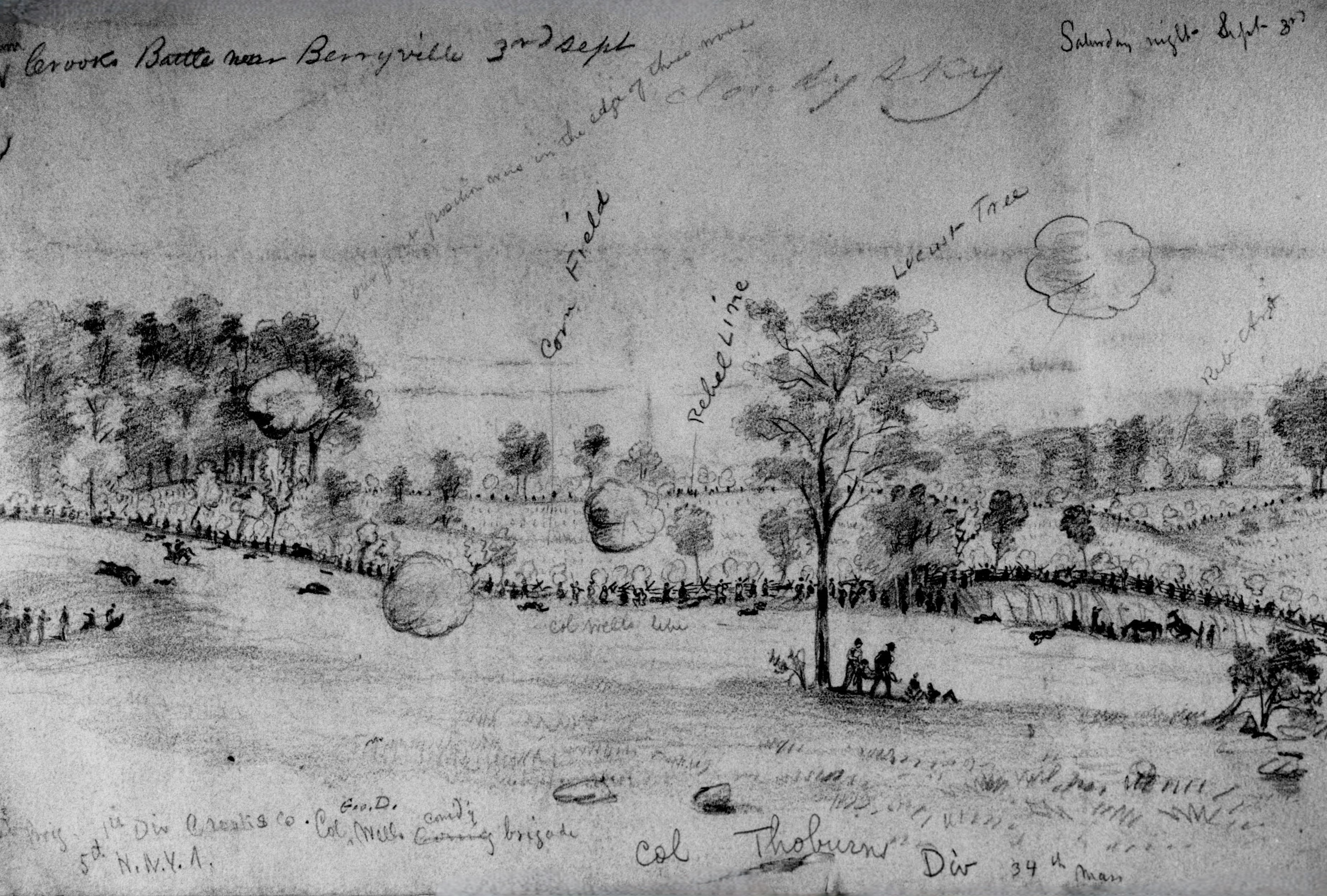
General Crook’s Battle Near Berryville, Virginia, September 3, 1864 (James E. Taylor, public domain).
Attached to the Middle Military Division, Army of the Shenandoah beginning in August, the 47th Pennsylvania Volunteer Infantry was assigned to defensive duties in and around Halltown, Virginia during the opening days of that month, and then engaged in a series of back-and-forth movements over the next several weeks between Halltown, Berryville, Middletown, Charlestown, and Winchester as part of the war being waged by the Union forces of Major-General Philip H. Sheridan against those commanded by Confederate Lieutenant-General Jubal Early.
From 3-4 September, Private Wesley White and the 47th Pennsylvania Volunteers took on Early’s Confederates again — this time in the Battle of Berryville. But that month also saw the departure of several 47th Pennsylvania Volunteers who had served honorably, including Company D’s Captain Henry Woodruff, First Lieutenant Samuel Auchmuty, Sergeants Henry Heikel and Alex Wilson, and Corporals Cornelius Stewart and Samuel A. M. Reed — many of whom mustered out on 18 September 1864, upon expiration of their respective service terms.
Those members of the 47th who remained on duty, like Private White, were about to engage in their regiment’s greatest moments of valor.
Battles of Opequan and Fisher’s Hill, September 1864

Battle of Opequan (aka Third Winchester), Virginia, 19 September 1864 (public domain).
Together with other regiments under the command of Union Major-General Philip H. (“Little Phil”) Sheridan and Brigadier-General William H. Emory, commander of the 19th Corps, the members of Company D and their fellow 47th Pennsylvania Volunteers helped to inflict heavy casualties on Lieutenant-General Jubal Early’s Confederate forces at Opequan (also spelled as “Opequon” and referred to as “Third Winchester”). The battle is still considered by many historians to be one of the most important during Sheridan’s 1864 campaign; the Union’s victory here helped to ensure the reelection of President Abraham Lincoln.
The 47th Pennsylvania’s march toward destiny at Opequan began at 2 a.m. on 19 September 1864 as the regiment left camp and joined up with others in the Union’s 19th Corps. After advancing slowly from Berryville toward Winchester, the 19th Corps became bogged down for several hours by the massive movement of Union troops and supply wagons, enabling Early’s men to dig in. As they reached the Opequan Creek, Sheridan’s men came face to face with the Confederate Army commanded by Early. The fighting, which began in earnest at noon, was long and brutal. The Union’s left flank (6th Corps) took a beating from Confederate artillery stationed on high ground.

Victory of Philip Sheridan’s Union Army over Jubal Early’s Confederate forces, Battle of Opequan, 19 September 1864 (Kurz & Allison, circa 1893, U.S. Library of Congress, public domain).
Meanwhile, the 47th Pennsylvania and the 19th Corps were directed by Brigadier-General William Emory to attack and pursue Major-General John B. Gordon’s Confederate forces. Some success was achieved, but casualties mounted as another Confederate artillery group opened fire on Union troops trying to cross a clearing. When a nearly fatal gap began to open between the 6th and 19th Corps, Sheridan sent in units led by Brigadier-Generals Emory Upton and David A. Russell. Russell, hit twice — once in the chest, was mortally wounded. During this phase of the battle, the 47th Pennsylvania Volunteers opened their lines long enough to enable the Union cavalry under William Woods Averell and the foot soldiers of General George Crook to charge the Confederates’ left flank.
Afterward, the 47th Pennsylvanians were sent out on skirmishing parties before making camp at Cedar Creek. Moving forward, they would continue to distinguish themselves in battle, but would do so without two more of their respected commanders: Colonel Tilghman Good, founder of the 47th Pennsylvania Volunteers; and Good’s second-in-command, Lieutenant-Colonel George Alexander, who mustered out from 23-24 September upon the expiration of their respective terms of service.
Fortunately, they were replaced by others equally admired both for their temperament and their front line experience: John Peter Shindel Gobin, Charles W. Abbott and Levi Stuber, who ultimately became the three most senior leaders of the regiment.
Battle of Cedar Creek, October 1864

Alfred Waud’s 1864 sketch, “Surprise at Cedar Creek,” captured the flanking attack on the rear of Union Brigadier-General William Emory’s 19th Corps by Lieutenant-General Jubal Early’s Confederate army, and the subsequent resistance by Emory’s troops from their Union rifle-pit positions, 19 October 1864 (public domain).
It was during the fall of 1864 that Major-General Philip Sheridan began the first of the Union’s true “scorched earth” campaigns, starving the enemy into submission by destroying Virginia’s crops and farming infrastructure. Viewed through today’s lens of history as inhumane, the strategy claimed many innocents — civilians whose lives were cut short by their inability to find food. This same strategy, however, almost certainly contributed to the further turning of the war’s tide in the Union’s favor during the Battle of Cedar Creek on 19 October 1864. Successful throughout most of their engagement with Union forces at Cedar Creek, Early’s Confederate troops began peeling off in ever growing numbers to forage for food, thus enabling the 47th Pennsylvania and others under Sheridan’s command to rally.
From a military standpoint, it was another impressive, but heartrending day. During the morning of 19 October, Early launched a surprise attack directly on Sheridan’s Cedar Creek-encamped forces. Early’s men were able to capture Union weapons while freeing a number of Confederates who had been taken prisoner during previous battles — all while pushing seven Union divisions back. According to Bates:
When the Army of West Virginia, under Crook, was surprised and driven from its works, the Second Brigade, with the Forty-seventh on the right, was thrown into the breach to arrest the retreat…. Scarcely was it in position before the enemy came suddenly upon it, under the cover of fog. The right of the regiment was thrown back until it was almost a semi-circle. The brigade, only fifteen hundred strong, was contending against Gordon’s entire division, and was forced to retire, but, in comparative good order, exposed, as it was, to raking fire. Repeatedly forming, as it was pushed back, and making a stand at every available point, it finally succeeded in checking the enemy’s onset, when General Sheridan suddenly appeared upon the field, who ‘met his crest-fallen, shattered battalions, without a word of reproach, but joyously swinging his cap, shouted to the stragglers, as he road rapidly past them – “Face the other way, boys! We are going back to our camp! We are going to lick them out of their boots!’”

Sheridan Rallying His Troops, Battle of Cedar Creek, Virginia, 19 October 1864 (U.S. Library of Congress, public domain).
The Union’s counterattack punched Early’s forces into submission, and the men of the 47th were commended for their heroism by General Stephen Thomas who, in 1892, was awarded the Medal of Honor for his own “distinguished conduct in a desperate hand-to-hand encounter, in which the advance of the enemy was checked” that day. Bates described the 47th’s actions:
When the final grand charge was made, the regiment moved at nearly right angles with the rebel front. The brigade charged gallantly, and the entire line, making a left wheel, came down on his flank, while engaging the Sixth Corps, when he went “whirling up the valley” in confusion. In the pursuit to Fisher’s Hill, the regiment led, and upon its arrival was placed on the skirmish line, where it remained until twelve o’clock noon of the following day. The army was attacked at early dawn…no respite was given to take food until the pursuit was ended.
But this time, the casualties for the 47th Pennsylvania Volunteer Infantry were stunning. Sergeant William Pyers, the C Company man who had so gallantly rescued the flag at Pleasant Hill was cut down in full view of his drummer boy son (Samuel Pyers) and later buried on the battlefield. Corporal Edward Harper of Company D was wounded, but survived, as did Corporal Isaac Baldwin, who had been wounded earlier at Pleasant Hill. Even Perry County resident and Regimental Chaplain William Rodrock of Perry County suffered a near miss as a bullet pierced his cap.
As report after report came in, the casualty figures were revised upward. By the time that the final figures were recorded, it was clear that the 47th Pennsylvania had lost the equivalent of nearly two full companies of men (killed outright in action, mortally wounded and likely to die within days, seriously wounded and likely to survive but unable to continue serving with the regiment due to amputations or other medical complications, wounded but able to return to duty after a period of medical treatment and convalescence, slightly wounded but able to promptly return to duty, still missing in action, or captured by the enemy).
Following those major engagements, the 47th Pennsylvanians were ordered to Camp Russell near Winchester, where they remained from November through most of December. On 14 November, D Company’s Second Lieutenant George Stroop was promoted to the rank of captain.

Charlestown West Virginia, circa 1863 (public domain).
Rested and somewhat healed, Private Wesley White and his fellow 47th Pennsylvanians were then ordered to outpost and railroad guard duties at Camp Fairview in Charlestown, West Virginia — five days before Christmas.
1865 — 1866
Still stationed at Camp Fairview in West Virginia as the New Year of 1865 dawned, members of the regiment continued to patrol and guard key Union railroad lines in the vicinity of Charlestown, while other 47th Pennsylvanians chased down Confederate guerrillas who had made repeated attempts to disrupt railroad operations and kill soldiers from multiple Union regiments.
Assigned in February 1865 to the Provisional Division of the 2nd Brigade of the U.S. Army of the Shenandoah, the 47th Pennsylvania Volunteers continued to perform their guerrilla-fighting duties until late March, when they were ordered to head back to Washington, D.C., by way of Winchester and Kernstown, Virginia.
Joyous News and Then Tragedy

Spectators gather for the Grand Review of the Armies, 23-24 May 1865, beside the crepe-draped U.S. Capitol, flag at half-staff after the assassination of President Abraham Lincoln (Matthew Brady, U.S. Library of Congress, public domain).
As April of 1865 opened, the battles between the Army of the United States and the Confederate States Army intensified, finally reaching the decisive moment when the Confederate troops of General Robert E. Lee surrendered to Union General Ulysses S. Grant at Appomattox on 9 April.
The long war, it seemed, was finally over. Less than a week later, however, the fragile peace was threatened when an assassin’s bullet ended the life of President Abraham Lincoln. Shot while attending an evening performance of Our American Cousin at Ford’s Theatre on 14 April 1865, he had died from his head wound at 7:22 a.m. the next morning.
Shocked and devastated by the news, which was received at their Fort Stevens encampment, the 47th Pennsylvania Volunteers were given little time to mourn their beloved commander-in-chief before they were ordered to grab their weapons and move into the regiment’s assigned position, from which it helped to thwart any attempt by Confederate soldiers and their sympathizers to re-ignite the flames of civil war that had finally been stamped out.
So key was their assignment that the 47th Pennsylvanians were not even allowed to march in the funeral procession of their slain leader. Instead, they took part in a memorial service with other members of their brigade that was officiated by the 47th Pennsylvania’s regimental chaplain, the Reverend William D. C. Rodrock.
Present-day researchers who read letters sent by 47th Pennsylvania Volunteers to family and friends back home in Pennsylvania during this period, or post-war interviews conducted by newspaper reporters with veterans of the regiment in later years, will learn that the 47th Pennsylvania Volunteers were collectively heartbroken by Lincoln’s death and deeply angry at those whose actions had culminated in his murder. Researchers will also learn that at least one member of the regiment, C Company Drummer Samuel Hunter Pyers, was given the high honor of guarding President Lincoln’s funeral train, while other members of the regiment were assigned to guard duty at the prison where the key assassination conspirators were being held during the early days of their imprisonment and trial, which began on 9 May 1865. (The regiment was headquartered at Camp Brightwood during this period.)
Attached to Dwight’s Division of the 2nd Brigade of the Department of Washington’s 22nd Corps, the 47th Pennsylvania Volunteers were permitted to march in the Union’s Grand Review of the National Armies, which took place in Washington, D.C. on 23 May.
Reconstruction
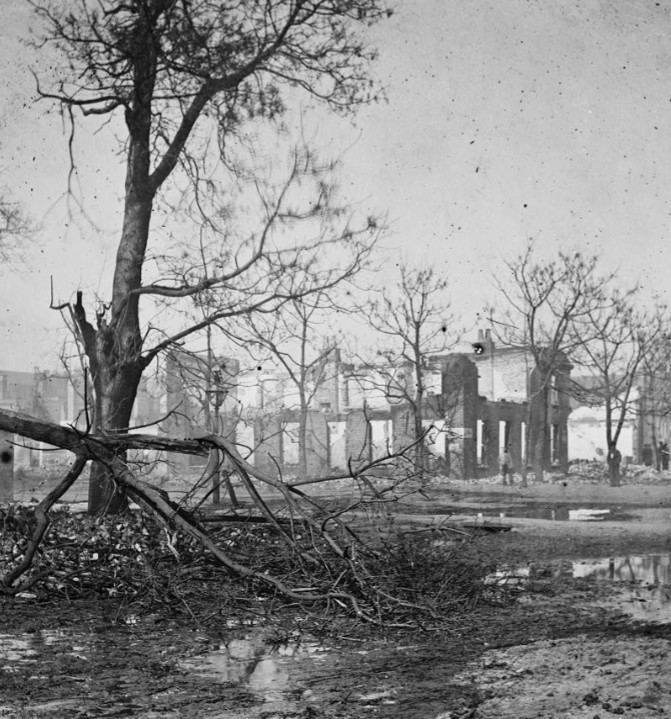
War-damaged houses in Savannah, Georgia, 1865 (Sam Cooley, U.S. Army, U.S. Library of Congress, public domain).
After their triumphant march through the streets of the nation’s capital, Private Wesley White and his fellow 47th Pennsylvanians were ordered to America’s Deep South. Stationed in Savannah, Georgia in early June, they were assigned again to Dwight’s Division, but this time, they were attached to the 3rd Brigade, U.S. Department of the South.
Subsequently ordered to relieve the 165th New York Volunteers in Charleston, South Carolina in July 1865, they were quartered in the former mansion of the Confederate Secretary of the Treasury.
Beginning on Christmas day of that same year, the majority of 47th Pennsylvania Volunteer Infantrymen, including Private Wesley M. White, began to honorably muster out in Charleston — a process which continued through early January 1866.
Following a stormy voyage home, the weary 47th Pennsylvanians disembarked in New York City and were then transported to Philadelphia by train where, at Camp Cadwalader on 9 January 1866, they were officially given their honorable discharge papers.
Return to Civilian Life
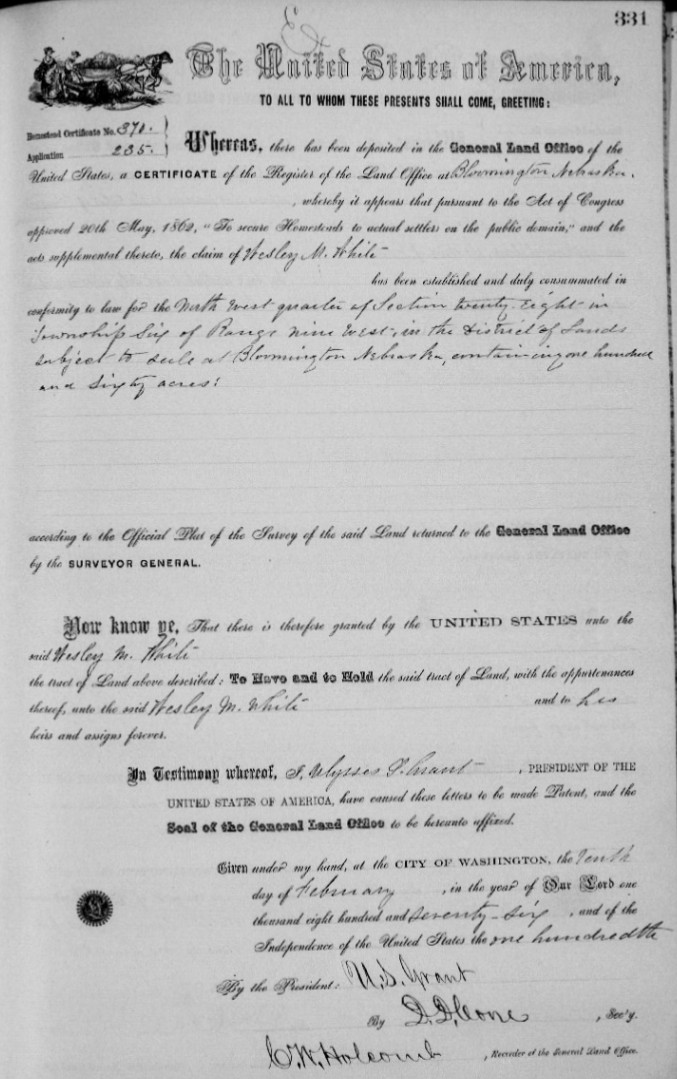
U.S. government patent transferring one hundred and sixty acres of land in Nebraska to 47th Pennsylvania veteran Wesley M. White on 10 February 1876, under the U.S. Homestead Act of 1862 (U.S. National Archives and Records Administration, public domain; click to enlarge).
Following his honorable discharge from the military, Wesley M. White returned home to Pennsylvania, where he wed Amanda Flora Abrams (1855-1927) sometime during the early 1870s. A native of New Bloomfield, she had been born on 12 April 1855 (alternate birth year: 1853).
They subsequently resided in the Perry County community of Aqueduct. Another major change for the White family the unfolded in 1872, when Wesley White’s parents, John and Eliza White, made the decision to migrate west. After relocating to Nebraska, they settled in Adams County with Wesley’s siblings: John, James, Joseph, and Lizzie White. Remaining behind in Perry County were Wesley White and his wife, as well as Wesley White’s sisters, Martha and Margaret White.
By 1875, Wesley White had made up his mind to join his family on their western adventure. Applying for land in Nebraska under the U.S. Homestead Act of 1862, he learned that his request was approved by the register of the U.S. Land Office in Bloomington, Nebraska on 10 February 1876. On that day, he was issued a patent for one hundred and sixty acres in the “North West quarter of Section Twenty-eight in Township Six of Range Nine West in the District of Lands subject to sale at Bloomington, Nebraska.”
The acres that he acquired had previously been part home to Pawnee men, women and children.
Armed with that land patent, he and his wife Amanda subsequently boarded a train, began their own migration west and ultimately became one of the most successful farming families in the city of Hastings, Adams County, according to the Hastings Daily Tribune. Before that decade ended, they were welcoming the birth of a son, Roy Abrams White (1879-1950), who opened his eyes at their Adams County farmhouse on 6 October 1879.
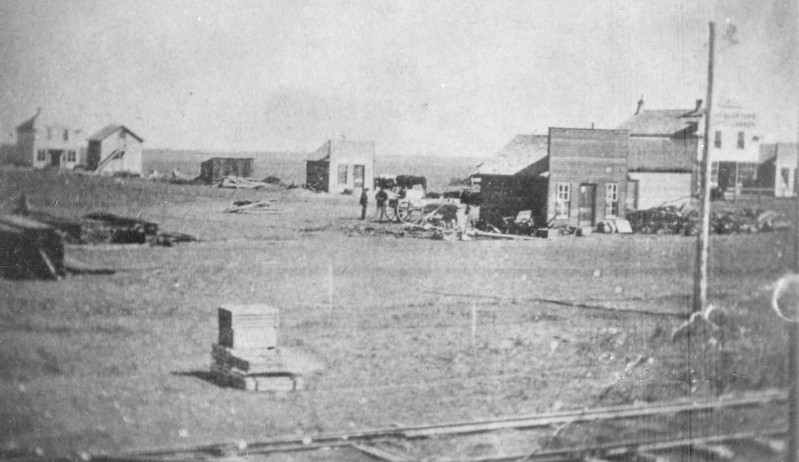
First known photo of the town of Hastings in Adams County, Nebraska (circa 1800s, public domain; click to enlarge).
By the time that a federal census enumerator arrived at Wesley White’s homestead in Little Blue Township, Adams County in early June 1880, he had already built a successful farming operation that included one milk cow, three horses, twenty-six pigs, and fifty chickens. Records for that period show that his one hundred and sixty-acre farm with livestock was valued at nearly four thousand dollars (the equivalent of more than one hundred and twenty-five thousand U.S. dollars in 2025), and had produced thirty dozen eggs and one hundred and fifty pounds of cheese in 1879, which had earned him more than seven hundred dollars (the equivalent of more than twenty-two thousand U.S. dollars in 2025).
Later that same year, Wesley White’s parents, John and Eliza White, were documented as homesteaders; his father had been awarded one hundred and sixty acres of land in North Adams County, Nebraska by the federal government on 1 October 1880.
An active member of the Masons throughout his life, Wesley White was a charter member of the Masonic Lodge in Hastings. He was also a believer that community schools and university educators were forces for good, and ensured that his son, Roy A. White, was well taught. (Roy graduated from Hastings College in Nebraska in 1900.)
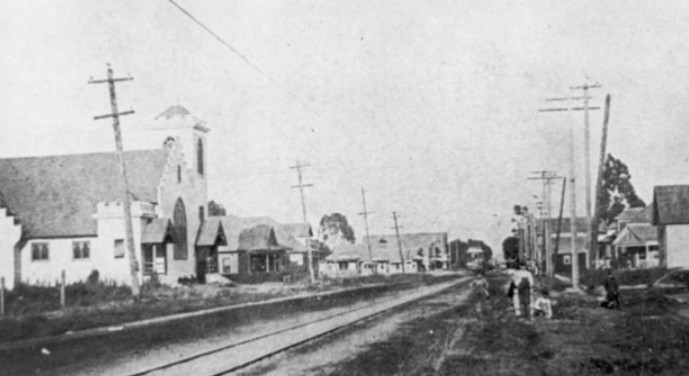
Looking east on Gardena Boulevard in the town of Gardena, Los Angeles County, California, 1900 (public domain; click to enlarge).
Not content to rest on his laurels, Wesley White decided to uproot his wife and son and move them farther west — to California — shortly after the dawn of a new century. They began their new adventure by boarding the B. & M. train No. 3 on 23 February 1903, which took them to southern California and the community of Gardena — a farming and real estate boom town in Los Angeles County.
Three years later, his son, Roy A. White, moved out of the family’s Gardena home to begin his own life’s journey. Traveling to South America, he was employed there between April and October 1906. He then wed Bertha C. Wright in Manhattan, New York City, New York on 15 September 1909. By April of 1910, Roy and his wife of sixth months were living in the Fifth Ward of Salt Lake City in Utah, where he was employed as a stenographer for the American Smelting and Refining Company (ASARCO).
Death and Interment
Ailing with heart disease in his final years, 47th Pennsylvania Infantry veteran Wesley M. White still managed to get out and about to spend time with friends and neighbors during the winter of 1913. While visiting his friend J. D. Green at the Green funeral parlor in Gardena on the day after Christmas that year, he told Green that he was suddenly feeling unusually tired, and if truth be told, completely exhausted. According to a report by the Los Angeles Sunday Times:
It was more than that, and Undertaker Green, recognizing symptoms of illness, called in Dr. J. F. Spencer. Before the physician could diagnose the case White had died of heart failure….
His son, a railroad man of Salt Lake City, is hurrying home to comfort his mother, the only other near relative left by the deceased.
Eighty-six years old on that fateful day (26 December 1913), Wesley M. White was subsequently laid to rest at the Woodlawn Memorial Park in the community of Compton, Los Angeles County.
What Happened to Wesley White’s Widow and Son?
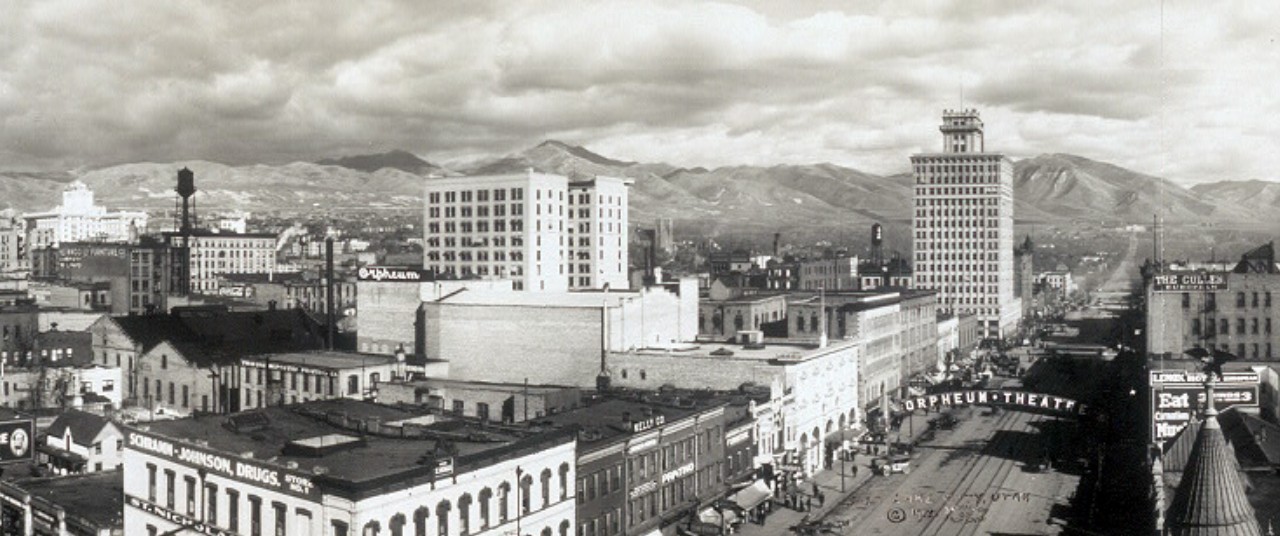
Salt Lake City, Utah, circa 1915 (public domain; click to enlarge).
Following the death of Wesley White in 1913, his widow, Amanda Flora (Abrams) White, continued to reside in Gardena, California for several more years. In 1921, she relocated to Salt Lake City, Utah, where she lived out the remainder of her years as a resident of her son’s home. Ailing with heart and kidney disease during those final years, she fell ill with pneumonia during the spring of 1927 and died at her son’s home on 13 April 1927. Seventy-four years old at the time of her passing, according to her obituary, her remains were subsequently transported to California for burial beside her husband at the Woodlawn Memorial Park in Compton.
Still employed as a clerk by the American Smelting and Refining Company (ASARCO) in Utah, when his daughter, Mary M. White (1914-1970), was born in Salt Lake City on 24 October 1914, Roy A. White continued to reside there with his family for a number of years. His mother moved into his home in 1921.
During the summer of that same year, Roy A. White filed for a new U.S. Passport that enabled him to travel to Mexico on behalf of his employer, ASARCO. Informing U.S. immigration officials that he planned to return within six months, he departed from a train depot in Texas late August of that year.
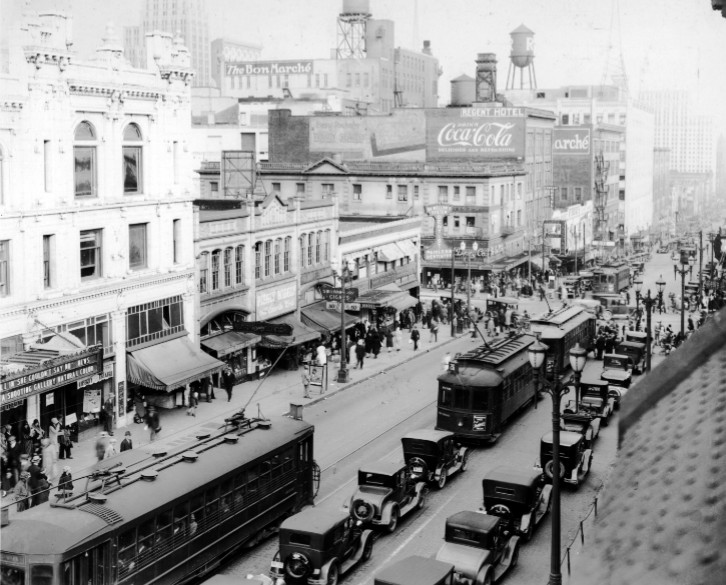
First and Pike Streets, Seattle, Washington, 1930 (public domain).
By 1930, he had moved his wife and daughter from Salt Lake City, Utah to the City of Seattle in King County, Washington, where he was employed as a customs officer with the U.S. Department of the Treasury’s Bureau of Customs. Still living in Seattle with his wife and daughter as of 1940, he had returned to employment with a smelting company by that time, and was employed as a safety expert. The next year (1941), his daughter, Mary, wed Robert A. Polachek (alternate spelling: “Polechek”).
Still living in Seattle and working there as of April 1950, when a federal census enumerator knocked on his front door, Roy White informed the enumerator that he was a storekeeper at a manufacturing firm. Sadly, that would be the last time that he or his wife would ever speak to a census taker.
On 18 October 1950, Roy A. White became a widower when his wife Bertha passed away in Seattle. Bereft, he followed her in death just over a week later, when he died in Seattle on 27 October 1850. Researchers have not yet determined where they were buried.
What Happened to Wesley White’s Siblings?
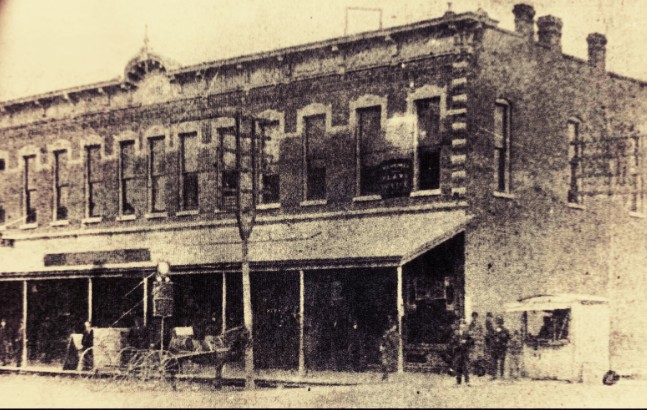
The Chilcote Building at the northeast corner of 1st and Hastings streets in Hastings, Adams County, Nebraska, shown here in 1881, was the first site of Hastings College (public domain).
Very little is presently known about what happened to Wesley White’s sisters, Martha and Margaret, after federal census enumerators recorded their Perry County, Pennsylvania residency in 1860; however, the lives of other White siblings were well documented.
Following his marriage to Ada Virginia Snodgrass on 21 October 1875, Wesley White’s brother, John H. White, initially settled with her in Adams County, Nebraska, where he was employed as a farmer. While there, they welcomed the births of: William Ernest White, who was born circa 1875, was known to family and friends as “Ernest” or “Ernie” and later settled in Kansas City, Missouri; and Maggie White, who was born circa 1877. In 1880, John H. White was a farmer in Little Blue Township, Adams County, where he resided with his wife and children, Ernie and Maggie. They then welcomed the births of two more children: Arthur J. White, who was born in May 1882 and would later settle in Howe, Nebraska; and Florence M. White (1884-1930), who was born in July 1884 and would later wed Carl Lester Whaley (1876-1948) before settling with him in Hiawatha and Atchison, Kansas. Sadly, their daughter Maggie did not survive her early childhood, according to the 1885 Nebraska State Census, which noted that John H. White and his wife, Ada, were living in Hastings, Adams County with their children Earnest, Arthur and Florence (but not Maggie). More children soon followed, however, including: John H. White, Jr., who was born in July 1886 and would later live in Kansas City, Missouri; Hazel J. White, who was born in July 1891 and would later wed Ed Steinhauer and settle with him in Redding, California; and Belle White, who was born in October 1893 and would later adopt the married surname of Smith and settle in Kansas City, Missouri.
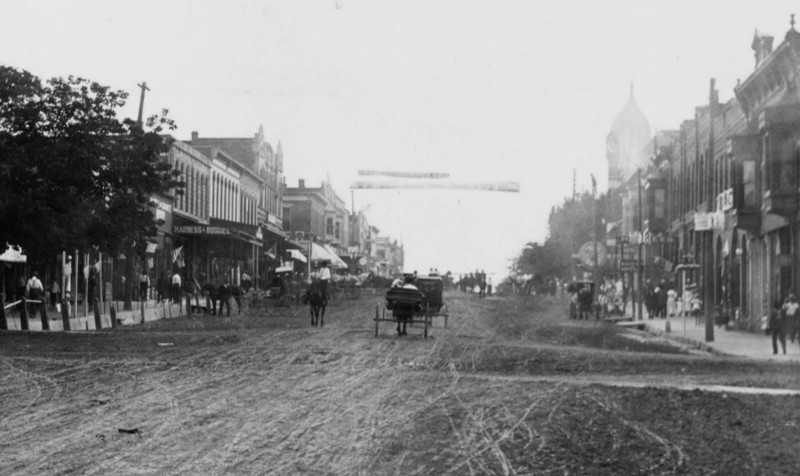
Main Street, looking east, Hiawatha, Kansas, circa late 1890s to early 1900s (public domain; click to enlarge).
It was sometime during this phase of his life (during the mid to late 1880s or early 1890s) that John H. White was hired as a laborer by the Missouri Pacific Railroad, marking the start of a nearly forty-year career with the company. A resident who lived with his family in the community of Hiawatha in Brown County, Kansas by the early 1890s, according to Ruley’s City Directory for that year, he and his family were still living in Hiawatha at the time that a federal census enumerator arrived on their doorstep in June 1900. Having worked his way up the ranks to become a section foreman with the Missouri Pacific by 1910, he continued to reside in Hiawatha with his wife and their daughters, Florence, Hazel and Belle. By 1920, however, he and his wife were “empty nesters” in Hiawatha, where he was still employed as a section foreman for Missouri, Pacific.
* Note: Although an obituary for John H. White that was published in the Semi-Weekly Searchlight in Redding, California reported that he had been employed as a teamster by the Westbrook company in Shasta County, California and that he had resided in Redding, Shasta County for “many years” before leaving there sometime around 1918 in order to relocate to Kansas, that data appears to have been incorrect. Researchers for 47th Pennsylvania Volunteers: One Civil War Regiment’s Story have not been able to locate any other sources to document those statements.
Injured twice on the job while working for the Missouri Pacific Railroad, John H. White was still employed as a section foreman at the time of his death during or after an injury-related operation at St. Mary’s Hospital in Nebraska on 29 June 1921. Following funeral services, he was laid to rest at the Hiawatha Cemetery in Hiawatha, Brown County, Kansas.
After his marriage to Kittie A. Smith, Wesley White’s brother, James A. White and wife were also “empty nesters,” having suffered the death of their only child. Residents of Hanover Township, Adams County, Nebraska in June of 1900, he and his,wife later lived on a farm near Pauline, Nebraska for a number of years before migrating farther west to California sometime prior to the federal census of 1910. Settlers in Gardena, Los Angeles County, they initially farmed the land. By 1920, however, he was employed as a laborer at a rubber production factory; but when a federal census enumerator knocked on the front door of his San Pedro Street home in Gardena in April of 1930, he and his wife were documented as retirees. Following his passing in Gardena on 3 July of that same year, he was laid to rest at the Woodlawn Cemetery in Compton, Los Angeles County.
Following her marriage to Alanson Coltrin on 6 September 1882, Wesley White’s sister, Elizabeth Rachel (White) Coltrin, who was known to family and friends as “Lizzie” or “Liza,” settled with him in Hanover Township, Adams County, Nebraska, where they welcomed the arrivals of: Ray Coltrin (1883-1949), who was born on 8 October 1883; Mae L. Coltrin (1890-1972), who was born on 3 May 1890 and grew up to become a nurse in the United States military during World War I, before pursuing a long career as a registered nurse at a hospital in Los Angeles County, California; Blanche Coltrin (1892-1963), who was born on 6 March 1892; and Fred Coltrin (1894-1975), who was born on 19 September 1894.
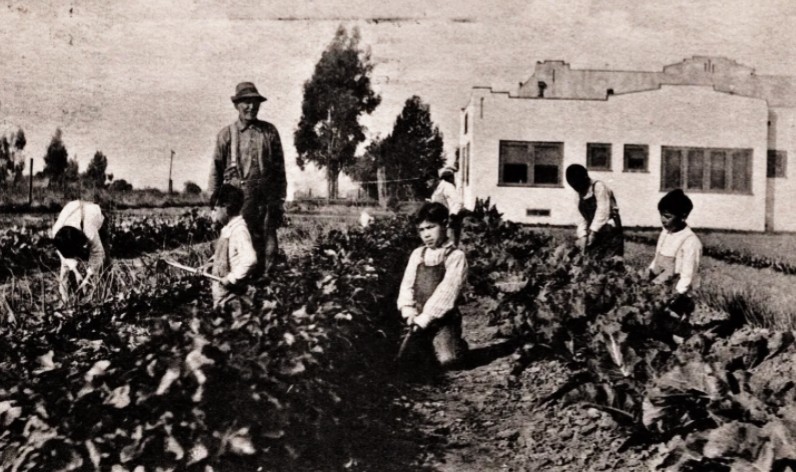
Students of the Methodist-run Spanish-American Institute in Gardena, California worked as farm laborers in Gardena during the 1920s (public domain; click to enlarge).
In 1898, a major change was underway as Lizzie and her husband loaded their family and belongings onto a covered wagon and headed west for California. By 1900, she and her farmer-husband were residents of Gardena in Los Angeles County, along with their children, Ray, Mae, Blanche, and Fred — and Lizzie’s seventy-seven-year-old mother, Elizabeth (Byrnes) White, who passed away two years later. Widowed by her husband in 1912, Lizzie resided alone in 1920. Her daughter, Mae, who had served as a military nurse during World War I and had found work, post-war, as a registered nurse at a hospital, was living in Alhambra.
Sadly, the life of her daughter, Blanche, had taken a far darker turn. Mentally ill, she was confined to the Patton State Hospital, a psychiatric facility in San Bernardino, California that was later found to be severely understaffed and unable to provide adequate patient care. During the summer of 1916, Blanche reportedly assaulted a fellow patient so severely that the patient later died from her injuries. Ultimately, the district attorney chose not to prosecute her due to the severity of her mental illness.
Still residing in Gardena as of 1930, Lizzie (White) Coltrin now had the company of her daughter, Mae Coltrin, who was supporting Lizzie on her registered nurse wages. That arrangement would last for years. On 6 January 1939, Lizzie passed away in Los Angeles County and was buried at the Woodlawn Cemetery in Compton. Lizzie’s daughter, Blanche, who had battled mental illness for much of her life, reportedly died at the Norwalk State Hospital in Los Angeles County, according to one source. Following her death at the age of seventy-one on 27 June 1963, she was also buried at the Woodlawn Cemetery.
Wesley M. White’s brother, Joseph Byrnes White, who was known to family and friends as “Joe,” relocated to Omaha, Nebraska sometime after the federal census of 1880. In 1886, he wed Indiana native Helen A. Jones (1862-1934). Together, they welcomed the birth of Pearl Hazel White (1888-1975), who was born in Omaha on 17 July 1888 and would later wed Dr. James G. Atterbury, a dentist in the U.S. Army, in 1917.
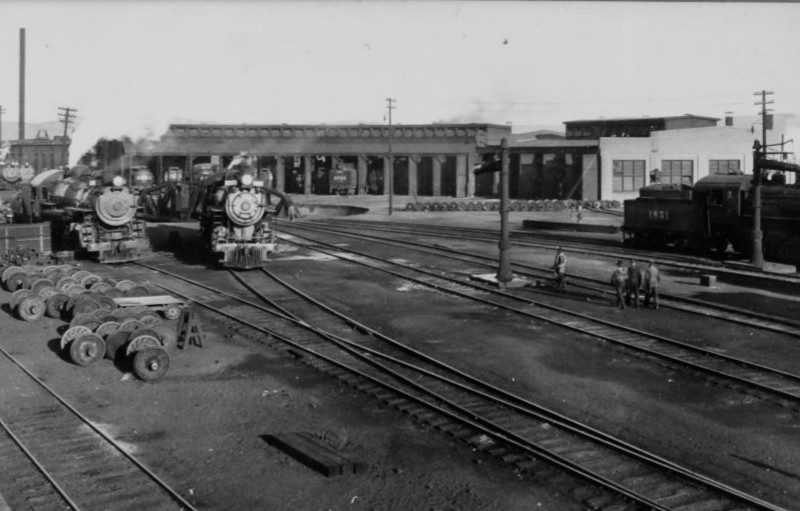
Roundhouse, Glenns Ferry, Idaho, circa 1915 (public domain).
In 1890, Joseph B. White migrated north with his wife and daughter to Idaho, where he was employed by the Union Pacific Railroad as a yardmaster in Pocatello. Two more children soon followed: Fern Jessie White (1893-1973), who was born on 29 January 1893 and later wed Samuel Jasper Wylie (1878-1942); and Joseph Davey White (1897-1935), who was born in November 1897, according to the 1900 federal census. Transferred by Union Pacific to Glenns Ferry in Elmore County, Idaho in 1914, Joseph B. White continued to work there as a yardmaster until his retirement in 1929. Predeceased by his wife, Helen, in 1934 and ailing with heart disease in his final years, Joseph Byrnes White died in Glenns Ferry on 19 May 1940. Eighty years old at the time of his passing, he was subsequently laid to rest at the Glenn Rest Cemetery in Glenns Ferry.
Sources:
- Amanda Flora White, in Death Certificates (state board of health file no.: 692, date of death: 13 April 1927). Salt Lake City, Utah: Utah State Board of Health.
- Bates, Samuel P. History of Pennsylvania Volunteers, 1861-5, vol. 1. Harrisburg, Pennsylvania: B. Singerly, State Printer, 1869.
- Coltrin, Alanson, Lizzie (Wesley M. White’s sister) and Ray, in Nebraska State Census (Hanover Township, Adams County, Nebraska, 1885). Lincoln, Nebraska: Nebraska State Library and Archives.
- Coltrin, Alanson, Lizzie (Wesley M. White’s sister), Ray, May, Blanche, and Fred; and White, Eliza (the mother of Wesley M. White and Lizie Coltrin), in U.S. Census (Gardena, Los Angeles County, California, 1900). Washington, D.C.: U.S. National Archives and Records Administration.
- Coltrin, Alanson, Lizzie (Wesley M. White’s sister), Ray, May, Blanche, and Fred, in U.S. Census (Gardena, Los Angeles County, California, 1910). Washington, D.C.: U.S. National Archives and Records Administration.
- “Culture — Pawnee Nation.” Pawnee, Oklahoma: Pawnee Nation of Oklahoma, retrieved online 30 June 2025.
- “Died” (obituary of Wesley M. White’s father, John White). Hastings, Nebraska: Adams County Democrat, 6 March 1886.
- “Heritage Club Traces Events From ’80s to Present Time” (article mentions Wesley M. White’s niece, Mae Coltrin, and the Coltrin family’s westward migration to California by covered wagon in 1898). Gardena, California: The Gardena Valley News, 9 August 1964.
- James A. White (death and burial news for James A. White, a brother of Wesley M. White), in “Pauline News.” Blue Hill, Nebraska: The Blue Hill Leader, 25 July 1930.
- “John H. White, Former Local Man, Passes Away in Kansas” (obituary of Wesley M. White’s brother). Redding, California: Semi-Weekly Searchlight, 1 July 1921.
- Joseph B. White (a brother of Wesley M. White), in Birth and Baptismal Records, 1857-1859. Duncannon, Pennsylvania: Asbury Methodist Church.
- “Joseph B. White” (obituary of a brother of Wesley M. White). Boise, Idaho: The Idaho Statesman, 21 May 1940.
- Joseph Byrnes White (a brother of Wesley M. White), in Death Certificates (state file no.: 119353, date of death: 19 May 1940). Boise, Idaho: State of Idaho, Bureau of Vital Records and Health Statistics.
- “Kittie White” (obituary of Kittie (Smith) White, the wife of Wesley M. White’s brother, James A. White). Gardena, California: The Gardena Valley News, 14 April 1960.
- “Marries a Lieutenant” (marriage announcement of Pearl Hazel White, a niece of Wesley M. White and a daughter of Joseph Byrnes White). Spokane, Washington: The Spokesman-Review, 21 August 1917.
- Mary M. Polechek (a granddaughter of Wesley M. White and a daughter of Roy A. White), in Death Certificates (state file no.: 4372, date of death: 20 February 1970). Olympia, Washington: State of Washington, Department of Health.
- Mr. and Mrs. Wesley White (notice of the couple’s relocation to California). Hastings, Nebraska: Hastings Republican, 24 February 1903.
- “Mrs. Amanda White Dies at Home of Son” (obituary of Wesley M. White’s widow). Salt Lake City, Utah: The Salt Lake Tribune, 14 April 1927.
- “Pawnee,” in The Encyclopedia of Oklahoma History and Culture. Oklahoma City, Oklahoma: Oklahoma Historical Society, retrieved online 30 June 2025.
- Robert E. Polachek and Mary M. White (a granddaughter of Wesley M. White and a daughter of Roy A. White), in “Marriage Licenses,” in “Pulse of Seattle.” Seattle, Washington: The Seattle Star, 8 March 1941.
- “Roster of the 47th P. V. Inf.” Allentown, Pennsylvania: The Morning Call, 26 October 1930.
- Roy A. White (college graduation and engagement announcement of the son of Wesley M. White), in “Society.” Hastings, Nebraska: Hastings Weekly Tribune, 24 September 1909.
- Roy A. White (the son of Wesley M. White), in U.S. Passport Applications (no. 76989, date: 16 August 1921). Washington, D.C.: U.S. National Archives and Records Administration.
- Schmidt, Lewis. A Civil War History of the 47th Regiment of Pennsylvania Veteran Volunteers. Allentown, Pennsylvania: Self-published, 1986.
- Spitzzeri, Paul R. “‘Dear American Brothers: The Spanish-American Institute, Gardena 1913-1930,” in “The Homestead Blog.” City of Industry, California: Homestead Museum, 7 September 2020.
- “State’s Greed Takes a Life: ‘Economy’ Cause of Woman’s Death in Asylum” (report about the mental health issues of Blanche Coltrin, a niece of Wesley M. White and a daughter of Elizabeth “White” Coltrin). Los Angeles, California: The Los Angeles Times, 1 August 1916.
- “The History of the Forty-Seventh Regt. P. V.” Allentown, Pennsylvania: The Lehigh Register, 20 July 1870.
- “The Railroad in Pennsylvania,” in “Stories from PA History.” Harrisburg, Pennsylvania: Pennsylvania Historical and Museum Commission, 2025.
- “Veteran’s Quick Call: Visits Friend at Undertaking Parlors and Expires Before Case Could Be Fully Diagnosed.” Los Angeles, California: Los Angeles Daily Times, 28 December 1913.
- “Wesley M. White Died Yesterday.” Hastings, Nebraska: The Hastings Daily Republican, 27 December 1913.
- Wesley White (on personal mentions page). Hastings, Nebraska: Hastings Daily Tribune, 7 October 1910.
- “White” (death notice of Wesley M. White), in “Died.” Newport, Pennsylvania: The News, 9 January 1914.
- White, James (Wesley M. White’s brother) and Kity [sic, “Kittie”], in U.S. Census (Hanover Township, Adams County, Nebraska, 1900). Washington, D.C.: U.S. National Archives and Records Administration.
- White, James (Wesley M. White’s brother) and Kittie, in U.S. Census (Gardena, Los Angeles County, California, 1910, 1920). Washington, D.C.: U.S. National Archives and Records Administration.
- White, John, Eliza, Westley [sic, Wesley], and Martha, in U.S. Census (Oliver Township, Perry County, Pennsylvania, 1850). Washington, D.C.: U.S. National Archives and Records Administration.
- White, John, Eliza, Westley [sic, Wesley], Martha, Margaret J., John H., James A., and Joseph, in U.S. Census (Duncannon, Penn Township, Perry County, Pennsylvania, 1860). Washington, D.C.: U.S. National Archives and Records Administration.
- White, John H. (obituary of Wesley M. White’s brother). Kansas City, Missouri: The Kansas City Times, 30 June 1921.
- White, John H. (Wesley M. White’s brother), Ada, Earny, and Maggie, in U.S. Census (Little Blue Township, Adams County, Nebraska, 1880). Washington, D.C.: U.S. National Archives and Records Administration.
- White, John H. (Wesley M. White’s brother), Ada, Earnest, Arthur, and Florence, in Nebraska State Census (Hastings, Adams County, Nebraska, 1885). Lincoln, Nebraska: Nebraska State Library and Archives.
- White, John H. (Wesley M. White’s brother), Ada, Arthur, Florence M., John H. Jr., Hazel, and Belle, in U.S. Census (Hiawatha, Brown County, Kansas, 1900). Washington, D.C.: U.S. National Archives and Records Administration.
- White, John H. (Wesley M. White’s brother), Ada, Florence M., Hazel, and Carrie Belle, in U.S. Census (Hiawatha, Brown County, Kansas, 1910). Washington, D.C.: U.S. National Archives and Records Administration.
- White, John H. (Wesley M. White’s brother) and Ada, in U.S. Census (Hiawatha, Brown County, Kansas, 1920). Washington, D.C.: U.S. National Archives and Records Administration.
- White, Bertha C. and Roy A. (the daughter-in-law and son of Wesley M. White), in Death Records (Seattle, King County, Washington, dates of death: 18 October 1950 and 27 October 1950). Olympia, Washington: State of Washington: Department of Health.
- White, Roy A. (the son of Wesley M. White) and Wright, Bertha C., in Marriage Records (Manhattan, New York City, New York, 15 September 1909). New York, New York: New York City Municipal Archives.
- White, Roy A. and Bertha C., in U.S. Census (Salt Lake City, Fifth Ward, Salt Lake County, Utah, 1910). Washington, D.C.: U.S. National Archives and Records Administration.
- White, Roy, Bertha C. and Mary M., in U.S. Census (Salt Lake City, Fifth Ward, Salt Lake County, Utah, 1920). Washington, D.C.: U.S. National Archives and Records Administration.
- White, Roy A., Bertha C. and Mary M., in U.S. Census (Seattle, King County, Washington, 1930). Washington, D.C.: U.S. National Archives and Records Administration.
- White, Roy A., Bertha C. and Mary M., in U.S. Census (Seattle, King County, Washington, 1940). Washington, D.C.: U.S. National Archives and Records Administration.
- White, Roy and Bertha, in U.S. Census (Seattle, King County, Washington, 1950). Washington, D.C.: U.S. National Archives and Records Administration.
- White, W. M. [sic, Wesley M. White], in U.S. Census (“Schedule 2. — Productions of Agriculture in Little Blue in the County of Adams, State of Nebraska,” 1880). Washington, D.C.: U.S. National Archives and Records Administration.
- White, Wesley M, in Civil War Muster Rolls (Company D, 47th Pennsylvania Infantry). Harrisburg, Pennsylvania: Pennsylvania State Archives.
- White, Wesley M., in Civil War Veterans’ Card File, 1861-1866 (Company D, 47th Pennsylvania Infantry). Harrisburg, Pennsylvania: Pennsylvania State Archives.
- White, John in Homestead Act Land Patents (Bloomington, Nebraska, 1 October 1880). Washington, D.C.: Bureau of Land Management, U.S. Department of the Interior and U.S. National Archives and Records Administration.
- White, Wesley M., in Homestead Act Land Patents (Bloomington, Nebraska, 10 February 1876). Washington, D.C.: Bureau of Land Management, U.S. Department of the Interior and U.S. National Archives and Records Administration.
 47th Pennsylvania Volunteers
You must be logged in to post a comment.