Alternate Spellings of Surname: Heikel, Heikle
Born in Dauphin County, Pennsylvania on 16 June 1828, Henry Heikel lived in Reed Township, Dauphin County in 1850 with his mother, Mary (a Pennsylvania native born sometime around 1790), and his brother, Joseph (born in Pennsylvania circa 1831). Sarah Earles, aged sixteen, also lived with the family at this time.
According to a listing of boatmen in the History of Perry County, Pennsylvania penned by Harry Harrison Hain:
From Montgomery’s Ferry came the three Fortney brothers, Charles, William, and Jacob; Valentine Arndt and Farmer Bair. The island (Duncan’s) contributed Henry Heikel, David Miller, John Briner, John Lukens, and others.
Civil War Military Service
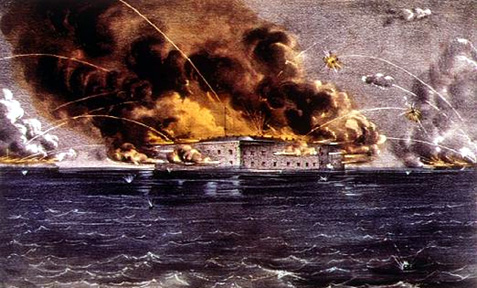
The bombardment of Fort Sumter 12-14 April 1861 (Currier & Ives, public domain).
During the fateful year of 1861, Henry Heikel became one of his county’s earliest residents to enlist in the United States military in response to President Abraham Lincoln’s call for seventy-five thousand troops to help defend the nation’s capital, following the fall of Fort Sumter. Joining Company E of the 1st Pennsylvania Volunteer Infantry on 18 April, he served as a private before mustering out on 24 July 1861 after having completed his Three Months’ Service.
As with many of Pennsylvania’s earliest responders, he then opted to re-enlist, this time re-enrolling for military service at Bloomfield in Perry County, Pennsylvania on 20 August 1861 before mustering in again at Camp Curtin in Harrisburg, Dauphin County as a sergeant under Captain Henry Durant Woodruff of Company D of the newly established 47th Regiment, Pennsylvania Volunteer Infantry.
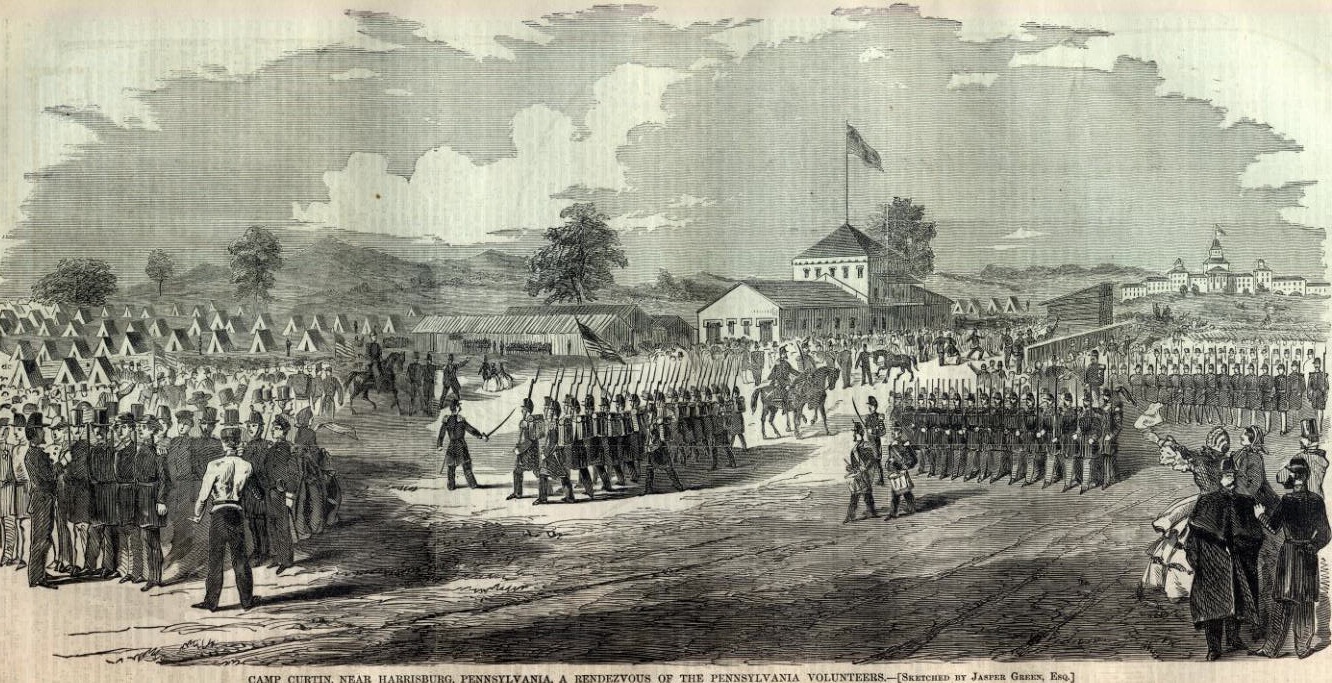
Camp Curtin (Harper’s Weekly, 1861, public domain).
Military records at the time described him as being a thirty-three-year-old boatman residing in Benvenue, Dauphin County. Following a brief training period in light infantry tactics at Camp Curtin, Sergeant Heikel and his fellow Company D soldiers were sent by train with their 47th Pennsylvania comrades to Washington, D.C., where they were stationed at “Camp Kalorama” on the Kalorama Heights near Georgetown, roughly two miles from the White House, beginning 21 September. The next day, Company C Musician Henry D. Wharton penned the following update for the Sunbury American, his hometown newspaper:
After a tedious ride we have, at last, safely arrived at the City of ‘magnificent distances.’ We left Harrisburg on Friday last at 1 o’clock A.M. and reached this camp yesterday (Saturday) at 4 P.M., as tired and worn out a sett [sic] of mortals as can possibly exist. On arriving at Washington we were marched to the ‘Soldiers Retreat,’ a building purposely erected for the benefit of the soldier, where every comfort is extended to him and the wants of the ‘inner man’ supplied.
After partaking of refreshments we were ordered into line and marched, about three miles, to this camp. So tired were the men, that on marching out, some gave out, and had to leave the ranks, but J. Boulton Young, our ‘little Zouave,’ stood it bravely, and acted like a veteran. So small a drummer is scarcely seen in the army, and on the march through Washington he was twice the recipient of three cheers.

Chain Bridge across the Potomac above Georgetown looking toward Virginia, 1861 (The Illustrated London News, public domain).
Acclimated somewhat to their new life, the soldiers of the 47th Pennsylvania Volunteer Infantry finally became part of the Army of the United States when they were officially mustered into federal service on 24 September. Three days later, they were assigned to the 3rd Brigade of Brigadier-General Isaac Ingalls Stevens, which also included the 33rd, 49th and 79th New York regiments. By that afternoon, the 47th Pennsylvania Volunteers were on the move again.
Ordered onward by Brigadier-General Silas Casey, the Mississippi rifle-armed 47th Pennsylvania infantrymen marched behind their Regimental Band until reaching Camp Lyon, Maryland on the Potomac River’s eastern shore. At 5 p.m., they joined the 46th Pennsylvania in moving double-quick (one hundred and sixty five steps per minute using thirty-three-inch steps) across the “Chain Bridge” marked on federal maps, and continued on for roughly another mile before being ordered to make camp.
The next morning, they broke camp and moved again. Marching toward Falls Church, Virginia, they arrived at Camp Advance around dusk. There, about two miles from the bridge they had crossed a day earlier, they re-pitched their tents in a deep ravine near a new federal fort under construction (Fort Ethan Allen). They had completed a roughly eight-mile trek, were situated close to the headquarters of Brigadier-General William Farrar Smith (also known as “Baldy”) and were now part of the massive U.S. Army of the Potomac (“Mr. Lincoln’s Army”). Under Smith’s leadership, their regiment and brigade would help to defend the nation’s capital from the time of their arrival through late January when the men of the 47th Pennsylvania would be shipped south.
Once again, Company C Musician Henry Wharton recalled the regiment’s activities, noting, via his 29 September letter to the Sunbury American:
On Friday last we left Camp Kalorama, and the same night encamped about one mile from the Chain Bridge on the opposite side of the Potomac from Washington. The next morning, Saturday, we were ordered to this camp [Camp Advance near Fort Ethan Allen, Virginia], one and a half miles from the one we occupied the night previous. I should have mentioned that we halted on a high hill (on our march here) at the Chain Bridge, called Camp Lyon, but were immediately ordered on this side of the river. On the route from Kalorama we were for two hours exposed to the harrdest rain I ever experienced. Whew, it was a whopper; but the fellows stood it well – not a murmur – and they waited in their wet clothes until nine o’clock at night for their supper. Our Camp adjoins that of the N.Y. 79th (Highlanders.)….
We had not been in this Camp more than six hours before our boys were supplied with twenty rounds of ball and cartridge, and ordered to march and meet the enemy; they were out all night and got back to Camp at nine o’clock this morning, without having a fight. They are now in their tents taking a snooze preparatory to another march the morning…. I don’t know how long the boys will be gone, but the orders are to cook two days’ rations and take it with them in their haversacks….
There was a nice little affair came off at Lavensville [sic, Lewinsville], a few miles from here on Wednesday last; our troops surprised a party of rebels (much larger than our own.) killing ten, took a Major prisoner, and captured a large number of horses, sheep and cattle, besides a large quantity of corn and potatoes, and about ninety six tons of hay. A nice day’s work. The boys are well, in fact, there is no sickness of any consequence at all in our Regiment….

The Big Chestnut Tree, Camp Griffin, Langley, Virginia, 1861 (U.S. Library of Congress, public domain).
Sometime during this phase of duty, as part of the 3rd Brigade, the 47th Pennsylvanians were moved to a site they initially christened “Camp Big Chestnut,” in reference to a large chestnut tree growing there. The site would eventually become known to them as “Camp Griffin,” and was located roughly ten miles from Washington, D.C.
On 11 October, the 47th Pennsylvania Volunteers marched in the Grand Review at Bailey’s Cross Roads after having been ordered with the 3rd Brigade to Camp Griffin. In a letter home in mid-October, Captain John Peter Shindel Gobin (the leader of C Company who would be promoted in 1864 to lead the entire 47th Regiment) reported that companies D, A, C, F and I (the 47th Pennsylvania’s right wing) were ordered to picket duty after the left-wing companies (B, G, K, E, and H) had been forced to return to camp by Confederate troops.
In his letter of 13 October, Musician Henry Wharton described the duties of the average 47th Pennsylvanian, as well as the regiment’s new home:
The location of our new camp is fine and the scenery would be splendid if the view was not obstructed by heavy thickets of pine and innumerable chesnut [sic, chestnut] trees. The country around us is excellent for the Rebel scouts to display their bravery; that is, to lurk in the dense woods and pick off one of our unsuspecting pickets. Last night, however, they (the Rebels) calculated wide of their mark; some of the New York 33d boys were out on picket; some fourteen or fifteen shots were exchanged, when our side succeeded in bringing to the dust, (or rather mud,) an officer and two privates of the enemy’s mounted pickets. The officer was shot by a Lieutenant in Company H [?], of the 33d.
Our own boys have seen hard service since we have been on the ‘sacred soil.’ One day and night on picket, next day working on entrenchments at the Fort (Ethan Allen.) another on guard, next on march and so on continually, but the hardest was on picket from last Thursday morning ’till Saturday morning – all the time four miles from camp, and both of the nights the rain poured in torrents, so much so that their clothes were completely saturated with the rain. They stood it nobly – not one complaining; but from the size of their haversacks on their return, it is no wonder that they were satisfied and are so eager to go again tomorrow. I heard one of them say ‘there was such nice cabbage, sweet and Irish potatoes, turnips, &c., out where their duty called them, and then there was a likelihood of a Rebel sheep or young porker advancing over our lines and then he could take take them as ‘contraband’ and have them for his own use.’ When they were out they saw about a dozen of the Rebel cavalry and would have had a bout with them, had it not been for … unlucky circumstance – one of the men caught the hammer of his rifle in the strap of his knapsack and caused his gun to fire; the Rebels heard the report and scampered in quick time….

Unknown regiment, Camp Griffin, Virginia, fall 1861 (U.S. Library of Congress, public domain).
On Friday morning, 22 October 1861, the 47th engaged in a divisional review, described by historian Lewis Schmidt as massing “about 10,000 infantry, 1000 cavalry, and twenty pieces of artillery all in one big open field.”
In his letter of 17 November, Musician Henry Wharton revealed still more details about life at Camp Griffin:
This morning our brigade was out for inspection; arms, accoutrements, clothing, knapsacks, etc., all were out through a through examination, and if I must say it myself, our company [Company C] stood best, A No. 1, for cleanliness. We have a new commander to our brigade, Brigadier General Brannon [sic, Brannan], of the U.S. Army, and if looks are any criterion, I think he is a strict disciplinarian and one who will be as able to get his men out of danger as he is willing to lead them to battle….
The boys have plenty of work to do, such as piquet [sic, picket] duty, standing guard, wood-chopping, police duty and day drill; but then they have the most substantial food; our rations consist of fresh beef (three times a week), pickled pork, pickled beef, smoked pork, fresh bread, daily, which is baked by our own bakers, the Quartermaster having procured portable ovens for that purpose, potatoes, split peas, beans, occasionally molasses and plenty of good coffee, so you see Uncle Sam supplies us plentifully….
A few nights ago our Company was out on piquet [sic, picket]; it was a terrible night, raining very hard the whole night, and what made it worse, the boys had to stand well to their work and dare not leave to look for shelter. Some of them consider they are well paid for their exposure, as they captured two ancient muskets belonging to Secessia. One of them is of English manufacture, and the other has the Virginia militia mark on it. They are both in a dilapidated condition, but the boys hold them in high estimation as they are trophies from the enemy, and besides they were taken from the house of Mrs. Stewart, sister to the rebel Jackson who assassinated the lamented Ellsworth at Alexandria. The honorable lady, Mrs. Stewart, is now a prisoner at Washington and her house is the headquarters of the command of the piquets [sic, pickets]….
Since the success of the secret expedition, we have all kinds of rumors in camp. One is that our brigade will be sent to the relief of Gen. Sherman, in South Carolina. The boys all desire it and if the news in the ‘Press’ is correct, that a large force is to be sent there, I think their wish will be gratified.
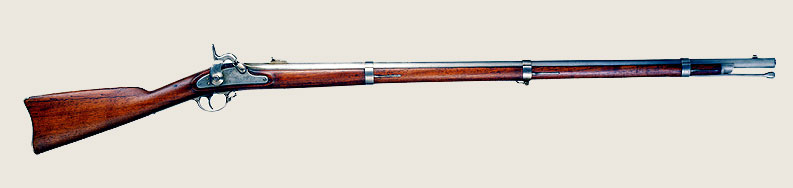
Springfield rifle, 1861 model (public domain).
On 21 November, the 47th participated in a morning divisional headquarters review that was monitored by the regiment’s founder and commanding officer, Colonel Tilghman H. Good, followed by brigade and division drills all afternoon. According to Schmidt, “each man was supplied with ten blank cartridges.” Afterward, “Gen. Smith requested Gen. Brannan to inform Col. Good that the 47th was the best regiment in the whole division.”
As a reward for their performance that—in preparation for the even bigger events which were yet to come, Brigadier-General John Milton Brannan ordered his subordinates to ensure that brand new Springfield rifles were purchased for every member of the 47th Pennsylvania Volunteers.
1862

Rendering of Fort Taylor, Key West, Florida (Harper’s Weekly, 1864, public domain).
Ordered to move from their Virginia encampment back to Maryland, the 47th Pennsylvania Volunteers left Camp Griffin at 8:30 a.m. on Wednesday, 22 January 1862, marching through deep mud with their equipment for three miles in order to reach the railroad station at Falls Church. Sent by rail to Alexandria, they then sailed the Potomac via the steamship City of Richmond to the Washington Arsenal, where they were reequipped before they were marched off for dinner and rest at the Soldiers’ Retreat in Washington, D.C. The next afternoon, the 47th Pennsylvanians hopped railcars on the Baltimore & Ohio Railroad, and headed for Annapolis, Maryland. Arriving around 10 p.m., they were assigned quarters in barracks at the United States Naval Academy. They then spent that Friday through Monday (24-27 January 1862) loading their equipment and other supplies onto the steamship Oriental.
By the afternoon of Monday, 27 January 1862, the 47th Pennsylvania Volunteers had commenced boarding the Oriental. Ferried to the big steamship by smaller steamers, the enlisted men boarded first, followed by their superior officers. Then, per the directive of Brigadier-General Brannan, the Oriental steamed away for the Deep South at 4 p.m. They were headed for Florida which, despite its secession from the Union, remained strategically important to the Union due to the presence of Forts Taylor and Jefferson in Key West and the Dry Tortugas.
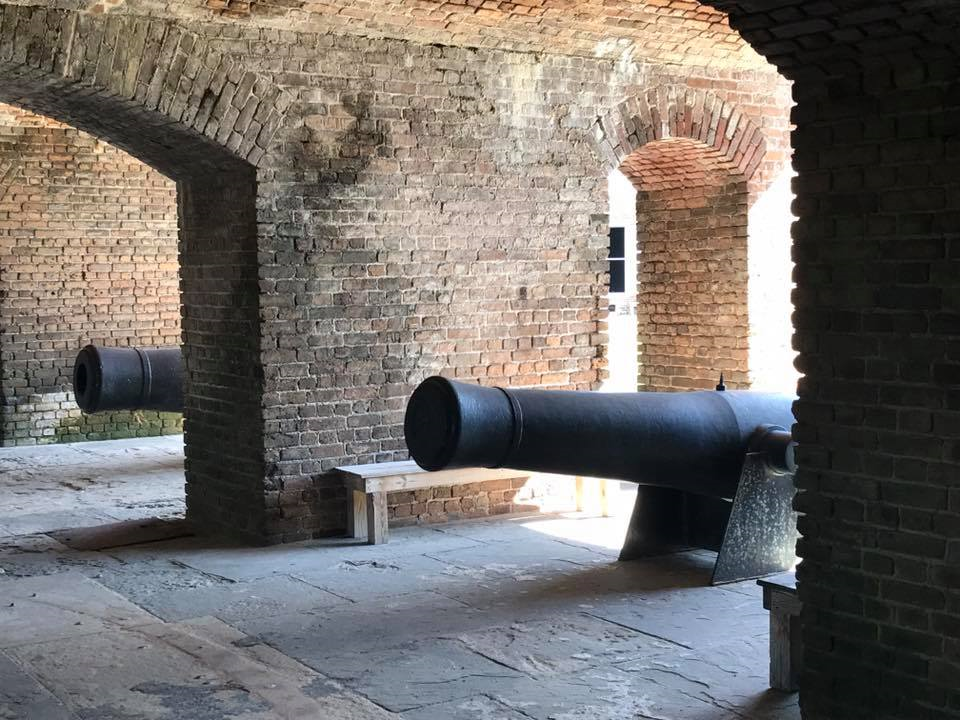
Artillery, Fort Taylor, Key West, Florida (Phil Spaugy, 2017, photo used with permission).
In early February 1862, Sergeant Henry Heikel and his fellow members of the 47th Pennsylvania arrived in Key West, Florida where they were assigned to garrison Fort Taylor and drilled daily in heavy artillery tactics and other military strategies. On 14 February, the regiment made itself known to area residents via a parade through the city’s streets.
Among the lighter moments, the regiment commemorated the birthday of President George Washington with a parade, a special ceremony involving the reading of Washington’s farewell address to the nation (first delivered in 1796), the firing of cannon at the fort, and a sack race and other games on 22 February. The festivities resumed two days later when the Regimental Band hosted an officers’ ball at which “all parties enjoyed themselves, for three o’clock of the morning sounded on their ears before any motion was made to move homewards,” according to Musician Henry Wharton. This was then followed by a concert by the regimental band on Wednesday evening, 26 February.
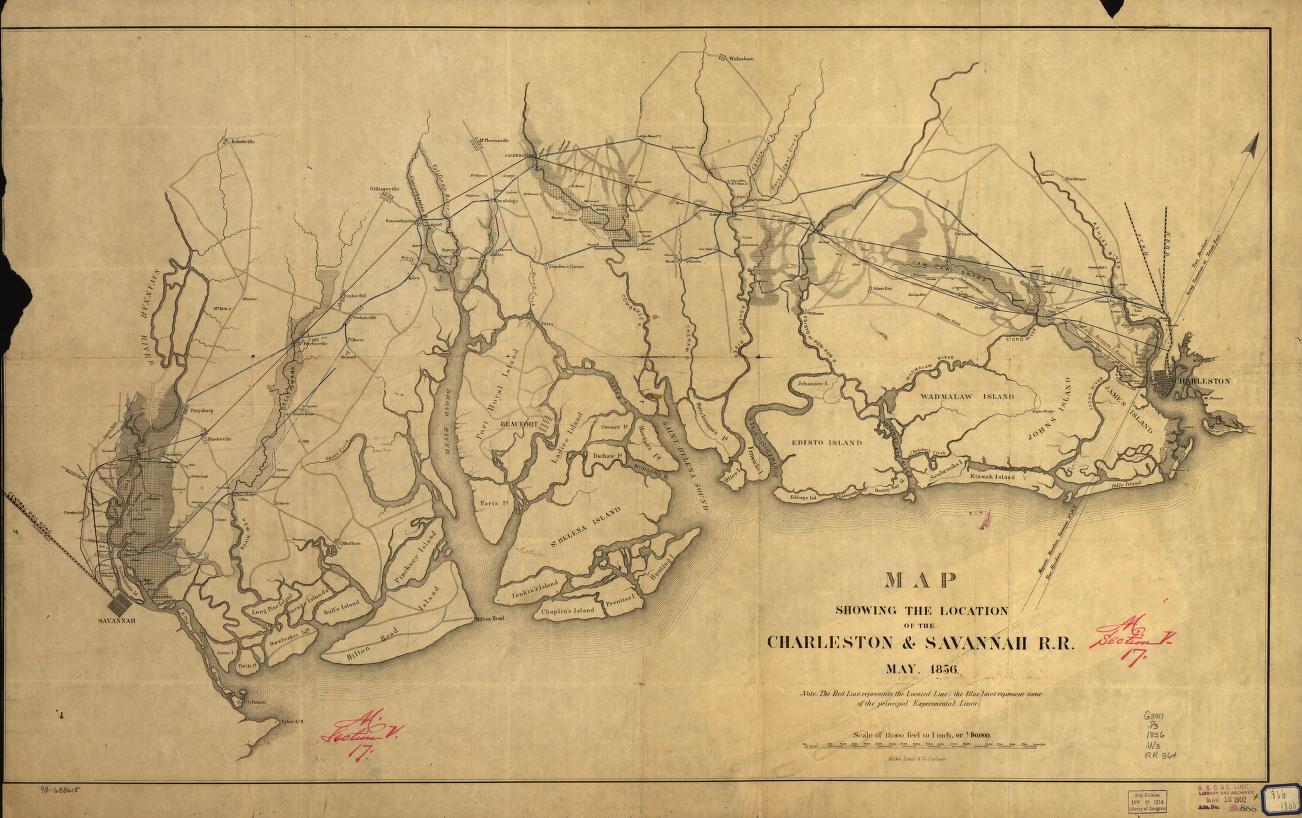
This 1856 map of the Charleston & Savannah Railroad shows the island of Hilton Head, South Carolina in relation to the towns of Beaufort and Pocotaligo (U.S. Library of Congress, public domain).
Next ordered to Hilton Head, South Carolina, from early June through July, the 47th Pennsylvania Volunteers camped near Fort Walker before relocating roughly thirty-five miles away in the Beaufort District in the U.S. Army’s Department of the South. Frequently assigned to hazardous picket duty north of their main camp, they faced an increased risk of enemy sniper fire. Despite this danger, though, the men of the 47th Pennsylvania “received the highest commendation from Generals Hunter and Brannan” for their “attention to duty, discipline and soldierly bearing,” according to historian Samuel P. Bates.
Detachments from the regiment were also assigned to the Expedition to Fenwick Island (9 July) and the Demonstration against Pocotaligo (10 July).
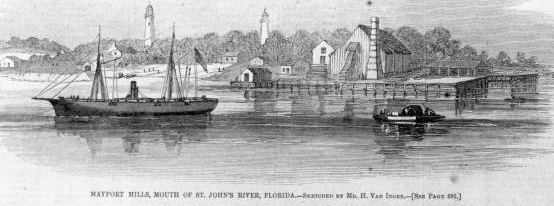
Illustration of the Union Navy’s base of operations, Mayport Mills, circa 1862 (public domain).
Sent on a return expedition to Florida, Company D saw its first truly intense moments when it participated with the 47th Pennsylvania and other Union regiments in the capture of Saint John’s Bluff from 1 to 3 October. Led by Brigadier-General Brannan, a fifteen-hundred-plus Union force disembarked at Mayport Mills and Mount Pleasant Creek from troop carriers guarded by Union gunboats. Taking point, the 47th led the 3rd Brigade through twenty-five miles of dense, pine forested swamps populated with deadly snakes and alligators. By the time the expedition ended, the brigade had forced the Confederate Army to abandon its artillery battery atop Saint John’s Bluff, and had paved the way for the Union to occupy the town of Jacksonville, Florida.
Integration of the Regiment
Meanwhile, back at its South Carolina base of operations, the 47th Pennsylvania was making history as it became an integrated regiment. On 5 and 15 October, the regiment added to its rosters several young Black men who had endured plantation enslavement near Beaufort and other areas of South Carolina, including Bristor Gethers, Abraham Jassum and Edward Jassum.
Battle of Pocotaligo, South Carolina

Highlighted version of the U.S. Army map of the Coosawhatchie-Pocotaligo Expedition, 22 October 1862 (public domain).
From 21-23 October, under the brigade and regimental commands of Colonel Tilghman H. Good and Lieutenant-Colonel George W. Alexander, the 47th engaged Confederate forces in and around Pocotaligo, South Carolina. Landing at Mackay’s Point, the men of the 47th were placed on point once again, but they and the 3rd Brigade were less fortunate this time.
Harried by snipers en route to the Pocotaligo Bridge, they met resistance from an entrenched, heavily fortified Confederate battery which opened fire on the Union troops as they entered an open cotton field. Those headed toward higher ground at the Frampton Plantation fared no better as they encountered artillery and infantry fire from the surrounding forests.
The Union soldiers grappled with the Confederates where they found them, pursuing the Rebels for four miles as they retreated to the bridge. There, the 47th relieved the 7th Connecticut. But the enemy was just too well armed. After two hours of intense fighting in an attempt to take the ravine and bridge, depleted ammunition forced the 47th to withdraw to Mackay’s Point.
Losses for the 47th were significant. Two officers and eighteen enlisted men died; two officers and another one hundred and fourteen enlisted men were wounded. Several resting places for men from the 47th still remain unidentified, the information lost to the sloppy records of Army Quartermaster and hospital personnel, or to the trauma-impaired memories of soldiers who hastily buried or were forced to leave behind the bodies of comrades upon receiving orders to retreat.
On 23 October, the 47th Pennsylvania returned to Hilton Head, where it served as the funeral Honor Guard for Major-General Ormsby M. Mitchel, the commander of the U.S. Army’s 10th Corps and Department of the South who had succumbed to yellow fever on 30 October. The Mountains of Mitchel, a part of Mars’ South Pole discovered by Mitchel in 1846 while working as a University of Cincinnati astronomer, and Mitchelville, the first Freedmen’s town created after the Civil War, were both later named for him. Men from the 47th Pennsylvania were given the honor of firing the salute over his grave.
1863
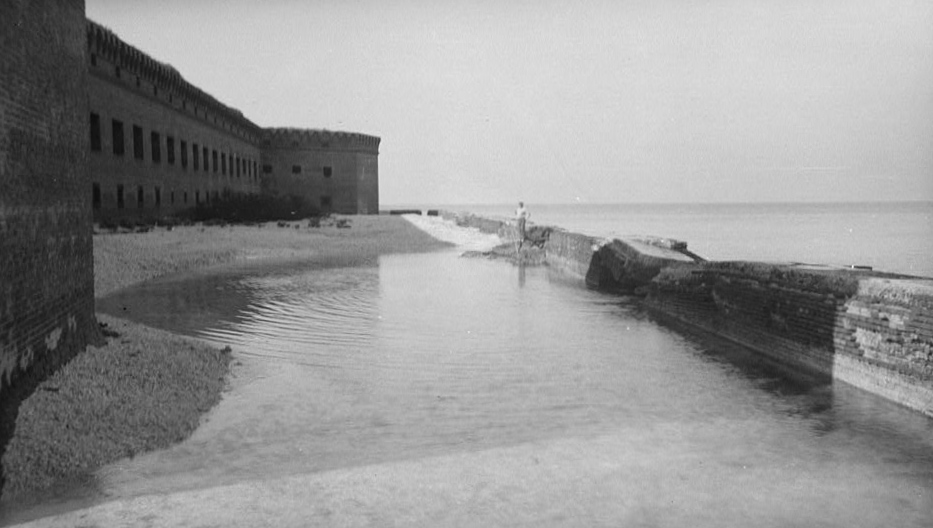
Fort Jefferson’s moat and wall, circa 1934, Dry Tortugas, Florida (C. E. Peterson, U.S. Library of Congress, public domain).
By 1863, Captain Woodruff and the men of D Company were once again based with the 47th Pennsylvania in Florida. Having been ordered back to Key West on 15 November of 1862, much of 1863 was spent guarding federal installations in Florida as part of the 10th Corps, Department of the South. Companies A, B, C, E, G, and I garrisoned Fort Taylor in Key West while Companies D, F, H, and K garrisoned Fort Jefferson in Florida’s Dry Tortugas. Men from the 47th were also sent on skirmishes and to Fort Myers, which had been abandoned in 1858 after the third U.S. war with the Seminole Indians. (Note: The members of Company would remain at Fort Jefferson for just over five months. On 16 May, they were marched to the wharf at Fort Jefferson, where they climbed aboard yet another ship—this time to return to Fort Taylor, where they resumed garrison duties under the command of Colonel Tilghman H. Good.)
As before, disease was a constant companion and foe.
The time spent here by the men of Company D and their fellow Union soldiers was notable also for the men’s commitment to preserving the Union. Many who could have returned home chose instead to re-enlist in order to finish the fight.
1864
In early January 1864, the 47th Pennsylvania Volunteers experienced yet another significant change when members of the regiment were ordered to expand the Union’s reach by sending part of the regiment north to retake possession of Fort Myers, a federal installation that had been abandoned in 1858, following the federal government’s third war with the Seminole Indians. In response, A Company Captain Richard Graeffe and a group of soldiers from Company A traveled north, captured the fort and began conducting cattle raids to provide food for the growing Union troop presence across Florida. They subsequently turned the fort not only into their base of operations, but into a shelter for pro-union supporters, escaped slaves, Confederate deserters, and others fleeing Rebel troops.
Red River Campaign
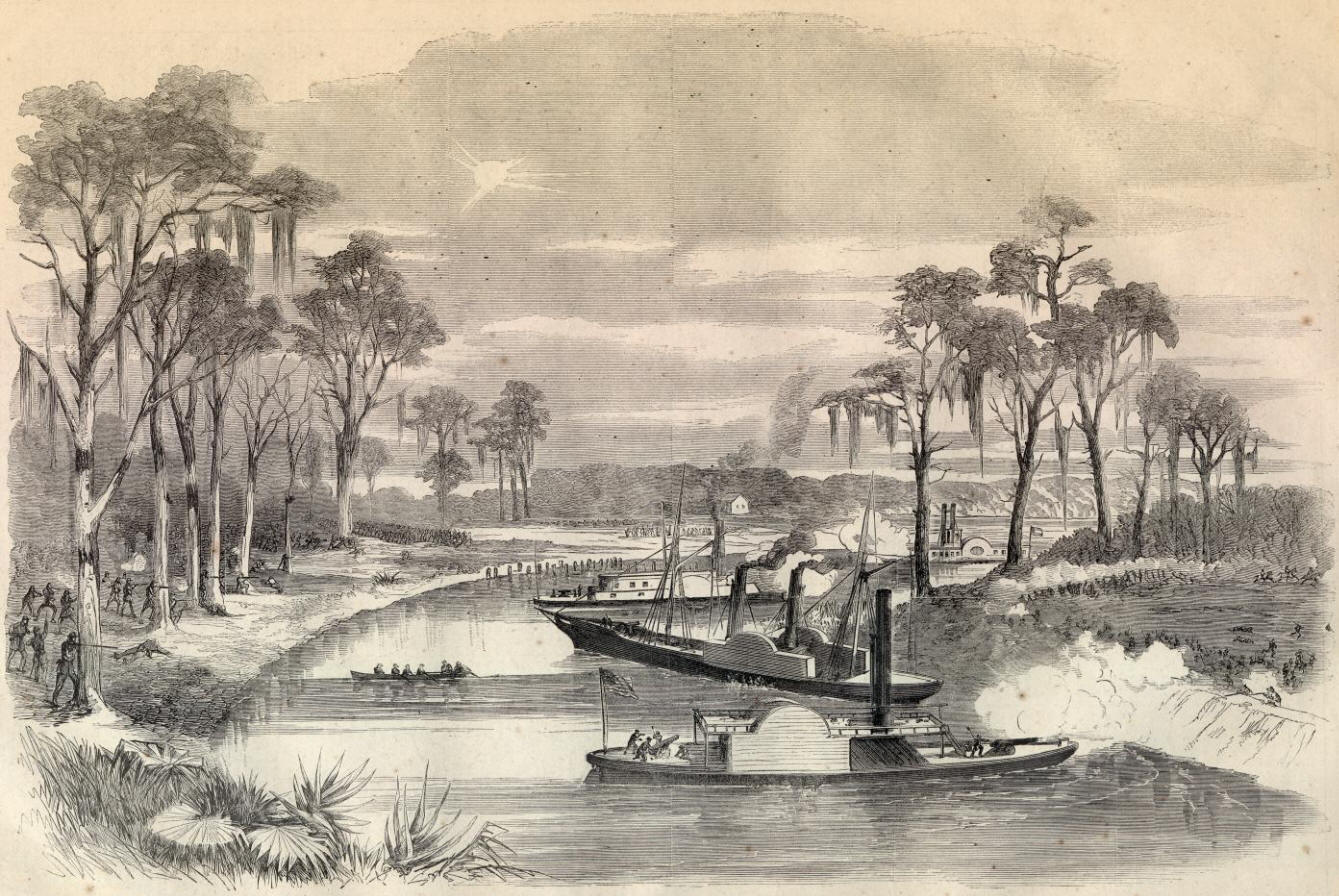
Bayou Teche, Louisiana (Harper’s Weekly, 14 February 1863, public domain).
Meanwhile, all of the other companies of the 47th Pennsylvania Volunteer Infantry had begun preparing for the regiment’s history-making journey to Louisiana. Boarding yet another steamer, the Charles Thomas, the men from Companies B, C, D, I, and K headed for Algiers, Louisiana (across the river from New Orleans), followed on 1 March by the men from Companies E, F, G, and H.
Upon the second group’s arrival, the now almost-fully-reunited regiment moved by train to Brashear City (now Morgan City, Louisiana) before heading to Franklin by steamer through the Bayou Teche. There, the 47th Pennsylvania Infantry joined the 2nd Brigade, 1st Division of the Department of the Gulf’s 19th Army Corps (XIX Corps), and became the only Pennsylvania regiment to serve in the Red River Campaign of Union Major-General Nathaniel P. Banks. (Unable to reach Louisiana until 23 March, the soldiers from Company A were assigned to detached duty while awaiting transport that enabled them to reconnect with their regiment at Alexandria, Louisiana on 9 April).
The early days on the ground quickly woke the 47th Pennsylvania Volunteers up to just how grueling their new phase of duty would be. From 14-26 March, most members of the 47th marched for Alexandria and Natchitoches, near the top of the L-shaped state. Among the towns that the 47th Pennsylvanians passed through during their long marches were New Iberia, Vermilionville (now part of Lafayette), Opelousas, and Washington.
From 4-5 April 1864, the regiment added to its roster of young Black soldiers when Aaron Bullard (later known as Aaron French), JamesBullard, John Bullard, Samuel Jones, and Hamilton Blanchard (also known as John Hamilton) enrolled for military service with the 47th Pennsylvania at Natchitoches. According to their respective entries in the Civil War Veterans’ Card File at the Pennsylvania State Archives and on regimental muster rolls, the men were officially mustered in for duty on 22 June at Morganza, Louisiana. Several of their entries noted that they were assigned the rank of “Colored Cook” while others were given the rank of “Under Cook.”
Often short on food and water throughout their long, harsh-climate trek, the 47th Pennsylvania Volunteers encamped briefly at Pleasant Hill (now the Village of Pleasant Hill) the night of 7 April before continuing on the next day.
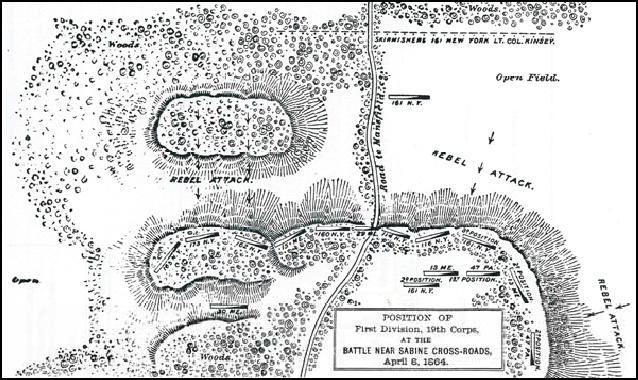
19th U.S. Army Map, Phase 3, Battle of Sabine Cross Roads/Mansfield (8 April 1864, public domain).
Rushed into battle ahead of other regiments in the second division, sixty members of the 47th Pennsylvania Volunteer Infantry were cut down on 8 April 1864 during the intense volley of fire unleashed in the Battle of Sabine Cross Roads (also known as the Battle of Mansfield due to its proximity to the town of Mansfield). The fighting waned only when darkness fell. The exhausted, but uninjured collapsed beside the gravely wounded and dead. After midnight, the surviving Union troops withdrew to Pleasant Hill.
The next day, the 47th Pennsylvania Volunteers were ordered into a critically important defensive position at the far right of the Union lines, their right flank spreading up onto a high bluff. By 3 p.m., after enduring a midday charge by the troops of Confederate Major-General Richard Taylor (a plantation owner who was the son of Zachary Taylor, former president of the United States), the brutal fighting still showed no signs of ending. Suddenly, just as the 47th was shifting to the left side of the Union force, the men of the 47th Pennsylvania were forced to bolster the 165th New York’s buckling lines by blocking another Confederate assault, during what has since become known as the Battle of Pleasant Hill.
Casualties were once again severe. Lieutenant-Colonel Alexander was nearly killed, and the regiment’s two color bearers, both from Company C, were also wounded while preventing the regimental flag from falling into enemy hands. Private Ephraim Clouser of Company D was shot in his right knee and captured by Confederate troops. Corporal Isaac Baldwin was also wounded, but avoided a similar fate.
Others from the 47th who were captured, like Private Clouser, were force marched roughly one hundred and twenty-five miles southwest to Tyler, Texas, where they were confined to Camp Ford, the largest Confederate prison camp west of the Mississippi River. Held there as prisoners of war (POWs), several members of the 47th died. Others somehow managed to survive the camp’s deteriorating conditions until they were released during prisoner exchanges, beginning in July.
Following what some historians have called a rout by Confederates at Pleasant Hill and others have labeled a technical victory for the Union or a draw for both sides, the 47th fell back to Grand Ecore, where they resupplied and regrouped until 22 April, when they retreated to Alexandria.

Christened “Bailey’s Dam” in reference to the Union officer who oversaw its construction, Lieutenant-Colonel Joseph Bailey, this timber dam built by the Union Army on the Red River in Alexandria, Louisiana in May 1864 was designed to facilitate passage of Union gunboats to and from the Mississippi River (public domain).
On 23 April, the 47th and their fellow brigade members engaged in the Battle of Cane River near Monett’s Ferry and, under the command of Lieutenant-Colonel Joseph Bailey, helped to build a dam from 30 April through 10 May, to enable federal gunboats to easily navigate the Red River’s fluctuating water levels.
Resuming their march south, the 47th Pennsylvania Volunteers headed toward Avoyelles Parish. According to Wharton:
On Sunday, May 15th, we left the river road and took a short route through the woods, saving considerable distance. The windings of the Red river are so numerous that it resembles the tape-worm railroad where with the politicians frightened the dear people during the administration of Ritner and Stevens. – We stopped several hours in the woods to leave cavalry pass, when we moved forward and by four o’clock emerged into a large open plain where we formed in line of battle, expecting a regular engagement. The enemy, however, retired, and we advanced ’till dark, when the forces halted for the night with orders to rest on their arms. – ‘Twas here that Banks rode through our regiment, amidst the cheers of the boys, and gave the pleasant news that Grant had defeated Lee.
“Resting on their arms,” (half-dozing, without pitching their tents, and with their rifles right beside them), they were now positioned just outside of Marksville, on the eve of the 16 May 1864 Battle of Mansura, which unfolded as follows, according to Wharton:
Early next morning we marched through Marksville into a prairie nine miles long and six wide where every preparation was made for a fight. The whole of our force was formed in line, in support of artillery in front, who commenced operations on the enemy driving him gradually from the prairie into the woods. As the enemy retreated before the heavy fire of our artillery, they reached Missoula [sic, Mansura], where they formed in column, taking the whole field in an attempt to flank the enemy, but their running qualities were so good that we were foiled. The maneuvring [sic, maneuvering] of the troops was handsomely done, and the movements was [sic, were] one of the finest things of the war. The fight of artillery was a steady one of five miles. The enemy merely stood that they might cover the retreat of their infantry and train under cover of their artillery. Our loss was slight. Of the rebels we could not ascertain correctly, but learned from citizens who had secreted themselves during the fight, that they had many killed and wounded, who threw them into wagons, promiscuously, and drove them off so that we could not learn their casualties. The next day we moved to Simmsport [sic, Simmesport] on the Achafalaya [sic, Atchafalaya] river, where a bridge was made by putting the transports side by side, which enabled the troops and train to pass safely over. – The day before we crossed the rebels attacked Smith, thinking it was but the rear guard, in which they, the graybacks, were awfully cut up, and four hundred prisoners fell into our hands. Our loss in killed and wounded was ninety. This fight was the last one of the expedition. The whole of the force is safe on the Mississippi, gunboats, transports and trains. The 16th and 17th have gone to their old commands.
It is amusing to read the statements of correspondents to papers North, concerning our movements and the losses of the army. I have it from the best source that the Federal loss from Franklin to Mansfield, and from their [sic, there] to this point does not exceed thirty-five hundred in killed, wounded and missing, while that of the rebels is over eight thousand.

Union Army base at Morganza Bend, Louisiana, circa 1863-1865 (U.S. Library of Congress, public domain).
Continuing on, the surviving members of the 47th Pennsylvania Volunteer Infantry marched for Simmesport and then Morganza, where they made camp again. While encamped there, the nine formerly enslaved Black men who had enlisted with the regiment in Beaufort, South Carolina (October 1862) and Natchitoches, Louisiana (April 1864) were officially mustered into the regiment between 20-24 June 1864.
The regiment then moved on again and arrived in New Orleans in late June. On 4 July, the 47th Pennsylvania Volunteers received orders to return to the East Coast. Three days later, they began loading their men onto ships, a process that unfolded in two stages. Companies A, C, D, E, F, H, and I boarded the U.S. Steamer McClellan on 7 July and steamed away that day, while the members of Companies B, G and K remained behind, awaiting transport.
Following their arrival in Virginia and a memorable encounter with President Abraham Lincoln, the first group joined Major-General David Hunter’s forces in the fighting at Snicker’s Gap and assisted in defending Washington, D.C. while also helping to drive Confederate troops from Maryland. (The second group of 47th Pennsylvanians subsequently departed from Louisiana aboard the Blackstone, weighing anchor and sailing forth at the end of that month. Arriving in Virginia on 28 July, the second group reconnected with the first group at Monocacy.)
Sheridan’s 1864 Shenandoah Valley Campaign
Attached to the Middle Military Division, U.S. Army of the Shenandoah later that summer, the 47th Pennsylvania next engaged Confederate forces in the Battle of Berryville, from 3-4 September. September’s opening weeks also became a time of departure for multiple 47th Pennsylvania Volunteers who had served honorably, including Company D’s Captain Henry Woodruff, First Lieutenant Samuel Auchmuty, Corporal Cornelius Stewart, and Sergeants Alex Wilson and Henry Heikel. All mustered out at Berryville, Virginia on 18 September 1864 upon expiration of their respective service terms.
At least one of those departures—that of Sergeant Henry Heikel—might have been prevented had senior military leaders been more responsive to regimental advancement requests. According to historian Lewis Schmidt:
On Tuesday [9 August 1864], the 47th prepared to resume its march, this time from Halltown back to Middletown where the regiment arrived on Friday. Letters from both Col. Good and Capt. Gobin to the Governor and the Adjutant General of Pa. were written regarding promotions on this date from ‘In the field near Halltown’. In Company D, 54 of the non-commissioned officers and Privates signed a letter to the Governor’s office requesting that Sgt. Henry Heikel be promoted to Captain and Cpl. George W. Clay to Lieutenant. They were unsuccessful at this time, and other more senior men would be promoted to these positions. Sgt. Heikel would muster out the following month at the expiration of his term, and Cpl. Clay would eventually attained the rank of 1st Lieutenant on June 2, 1865.
After the War
Returning home after the war, Henry Heikel operated a hotel in Fisherville, Reed Township, Dauphin County, Pennsylvania in 1870 with his wife, Martha (Berly Miller) Heikel. Living with them were sons, Christian B. Heikel (born about 1868) and Henry J. Heikel (born August 1870). Henry’s stepson, David E. Miller (born about 1861), was also living with Henry and Martha at the time. (Note: Both Christian and Henry are listed as Henry’s stepsons on the 1880 census, and were listed with the same surname—“Miller”—as their brother, David.) Others living with the family in 1870 included 15-year-old Mary Siders and 12-year-old Alda Michael, servants; and Jacob Fletcher, Jacob Holman, and Lorenzo Michaels, laborers who were lodging at the hotel.
By 1880, Henry was working as a Retail Grocer and living in Reed Township with Martha, David, Thomas, and Henry. He remained in Reed Township with Martha until his death in 1893, and was interred at the Presbyterian Cemetery in Duncannon.
Described by the Harrisburg Telegraph in a brief notice of his death as “an old Susquehanna boatman,” Henry Heikel passed away at Duncan’s Island on 1 October 1893.
He was interred at the Duncannon Presbyterian Cemetery in Duncannon, Perry County, Pennsyvania.
Sources:
- Bates, Samuel P. History of Pennsylvania Volunteers, 1861-5, vol. 1. Harrisburg, Pennsylvania: B. Singerly, State Printer 1869.
- Hain, Harry Harrison. History of Perry County, Pennsylvania. Including Descriptions of Indians and Pioneer Life from the Time of Earliest Settlement. Harrisburg, Pennsylvania: Hain-Moore Company, 1922.
- Heikel death notice. Harrisburg, Pennsylvania: Harrisburg Telegraph, 2 October 1893.
- Pennsylvania Veteran’s Burial Index Card. Harrisburg, Pennsylvania: Pennsylvania Department of Veterans Affairs.
- Schmidt, Lewis. A Civil War History of the 47th Regiment of Pennsylvania Veteran Volunteers. Allentown, Pennsylvania: Self-published, 1986.
- U.S. Census (1850, 1880) and U.S. Veterans’ Schedule (1890). Washington, D.C.: U.S. National Archives and Records Administration.
 47th Pennsylvania Volunteers
You must be logged in to post a comment.