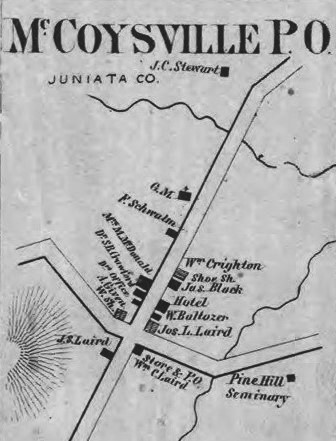
This 1863 map shows the location of Alexander Given’s home in McCoysville, Pennsylvania (public domain).
Son. Husband. Father. Craftsman. Alexander Given was all of these. Sadly, he was also one of the many American Civil War-era soldiers whose life was forever altered by the trajectory of a single bullet.
Formative Years
Born in Pennsylvania circa 1821, Alexander Given was a son of John Given and Isabella McCoy Given. A cabinetmaker who resided in Tuscarora Township, Juniata County, Pennsylvania during the mid-nineteenth century, Alexander and his first wife, Jane, became the parents of five children: Elizabeth, who was born circa 1841; Isabella, who was born circa 1848; John, who was born circa 1850; Nancy Jane, who was born on 9 October 1852 (alternate birth year: 1862); and Margaret, who was born on 11 October 1854.
Following the death of his first wife, Alexander Given wed Nancy (Barton) Williamson, who was a daughter of John and Elizabeth (Williams) Barton. Alexander and Nancy’s wedding ceremony was held in Juniata County on 9 September 1856, and was officiated by the Rev. Andrew Jardine.
By 1860, Alexander Given’s Tuscarora Township household included his second wife, Nancy, and their blended families’ offspring: Elizabeth, Isabella, John, Nancy Jane, Margaret, and James (1858-1916), who was born on 20 November 1858 (alternate birth date: 7 November 1858). Also residing at the Given home at this time were Nancy’s seventeen-year-old daughter, Sarah Williamson, who was described on that year’s census as a housekeeper; son Andrew Jardine Williamson (1842-1905), and daughters Mary (aged fourteen), and Elizabeth (aged twelve).
James Given was Alexander and Nancy’s first child together. The birth of another child followed later that year when their daughter, Rachel Marie Given, (1860-1918), opened her eyes in McCoysville for the first time on 15 September 1860 (alternate birth dates: 14 September 1860 or 20 October 1860).
Civil War
Alexander Given enrolled for Civil War military service in Harrisburg on 24 February 1864 and officially mustered in for duty the next day as a private with Company C of the 47th Pennsylvania Volunteer Infantry. Military records at the time described him as being a forty-three-year-old cabinetmaker residing in Tuscarora Township, Juniata County, Pennsylvania, who was five feet, eleven-and-one-half inches tall with dark hair, gray eyes and a dark complexion.
He was joining a combat-hardened regiment that had already experienced intense action during the Battle of Pocotaligo, South Carolina in October 1862, and was now making history as the only regiment from Pennsylvania to be assigned to the 1864 Red River Campaign of Union Major General Nathaniel Banks.
Red River Campaign

Natchitoches, Louisiana (Frank Leslie’s Illustrated Newspaper, 7 May 1864, U.S. Library of Congress, public domain).
Transported via ship to Louisiana, Private Alexander Given connected with his regiment while it was on the move toward the top of the L-shaped state. From 14-26 March, the 47th Pennsylvania Volunteers had headed out from Algiers, Louisiana (now part of New Orleans) and marched toward Alexandria and Natchitoches, by way of New Iberia, Vermilionville (now part of Lafayette), Opelousas, and Washington.
From 4-5 April 1864, the regiment added to its roster of young Black soldiers when Aaron Bullard (later known as Aaron French), James Bullard, John Bullard, Samuel Jones, and Hamilton Blanchard (also known as John Hamilton) enrolled for military service with the 47th Pennsylvania at Natchitoches. According to their respective entries in the Civil War Veterans’ Card File at the Pennsylvania State Archives and on regimental muster rolls, the men were then officially mustered in for duty on 22 June at Morganza. Several of their entries noted that they were assigned the rank of “(Colored) Cook” while others were given the rank of “Under Cook.”
Often short on food and water throughout their long, harsh-climate trek through enemy territory, the 47th Pennsylvania encamped briefly at Pleasant Hill (now the Village of Pleasant Hill) on the night of 7 April.
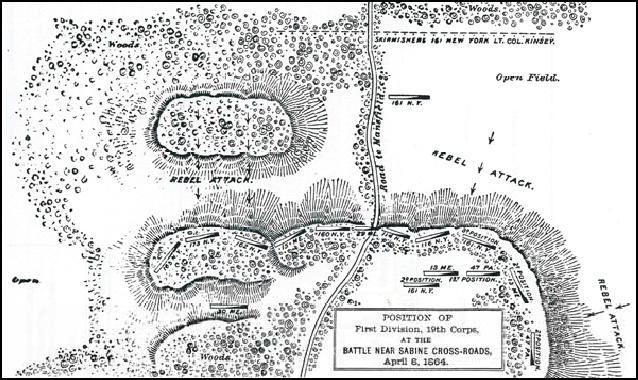
19th U.S. Army Map, Phase 3, Battle of Sabine Cross Roads/Mansfield (8 April 1864, public domain).
Rushed into battle ahead of other regiments in the 2nd Division, sixty members of the 47th were cut down on 8 April during the volley of fire unleashed in the Battle of Sabine Cross Roads. The fighting waned only when darkness fell as those who were uninjured collapsed beside the gravely wounded. Finally, after midnight, the surviving Union troops were ordered to withdraw to Pleasant Hill.
The next day, the 47th Pennsylvania Volunteers were ordered into a critically important defensive position at the far right of the Union lines, their right flank spreading up onto a high bluff. By 3 p.m., after enduring a midday charge by the troops of Confederate Major-General Richard Taylor (a plantation owner and son of Zachary Taylor, former president of the United States), the brutal fighting still showed no signs of ending. Suddenly, just as the 47th was shifting to the left side of the massed Union forces, the men of the 47th Pennsylvania were forced to bolster the 165th New York’s buckling lines by blocking another Confederate assault during what later became known as the Battle of Pleasant Hill.
During this engagement, the 47th Pennsylvania recaptured a Massachusetts artillery battery that had been lost during an earlier Confederate assault. While he was mounting the 47th Pennsylvania’s colors on one of the recaptured Massachusetts caissons, C Company Color-Sergeant Benjamin Walls was shot in the left shoulder. As Walls fell, C Company Sergeant William Pyers was then also shot while preventing the American flag from falling into enemy hands. Both men survived their wounds and continued to fight on, but others from the 47th were less fortunate, including Private John C. Sterner (killed at Pleasant Hill), and Privates Cornelius Kramer, George Miller, and Thomas Nipple (wounded). In addition, the regiment nearly lost its second-in-command, Lieutenant-Colonel G. W. Alexander, who had been severely wounded in both legs.
Still others from the 47th were captured, marched roughly one hundred and twenty-five miles to Camp Ford, a Confederate Army prison camp near Tyler, Texas, and held there as prisoners of war (POWs) until released during prisoner exchanges beginning 22 July 1864. At least two men from the 47th never made it out of that camp alive; another member of the regiment died while being treated at the Confederate Army hospital in Shreveport, Louisiana.
Following what some historians have called a rout by Confederates at Pleasant Hill and others have labeled a technical victory for the Union or a draw for both sides, the 47th fell back to Grand Ecore, where the men engaged in the hard labor of strengthening regimental and brigade fortifications. After eleven days at Grand Ecore, they then moved back to Natchitoches Parish on 22 April. Marching forty-five miles that day, they arrived in Cloutierville at 10 p.m. While en route, they were attacked again—this time at the rear of their brigade, but they were able to quickly end the encounter and continue on.

The 47th Pennsylvania Volunteers were stationed just to the left of the “Thick Woods” with Emory’s 2nd Brigade, 1st Division as shown on this map of Union troop positions for the Battle of Cane River Crossing at Monett’s Ferry, Louisiana, 23 April 1864 (Major-General Nathaniel Banks’ official Red River Campaign Report, public domain).
The next morning (23 April 1864), episodic skirmishing quickly roared into the flames of a robust fight. As part of the advance party led by Union Brigadier-General William Emory, the 47th Pennsylvanians took on the Confederate cavalry of Brigadier-General Hamilton P. Bee in the Battle of Cane River (also known as “the Affair at Monett’s Ferry” or the “Cane River Crossing”).
Responding to a barrage from the Confederate artillery’s twenty-pound Parrott guns and raking fire from enemy troops situated near a bayou and on a bluff, Brigadier-General Emory directed one of his brigades to keep Bee’s Confederates busy while sending the other two brigades to find a safe spot where his Union troops could ford the Cane River. As part of the “beekeepers,” the 47th Pennsylvania supported Emory’s artillery.
Meanwhile, other troops in Emory’s command worked their way across the Cane River, attacked Bee’s flank, forced a Rebel retreat, and erected a series of pontoon bridges, enabling the 47th and other remaining Union troops to make the Cane River Crossing by the next day. As the Confederates retreated, they torched their own food stores, as well as the cotton supplies of their fellow southerners.
In a letter written from Morganza, Louisiana to the editor of the Sunbury American newspaper in Pennsylvania on 29 May, C Company soldier Henry Wharton described what had happened to the 47th Pennsylvanians during and immediately after making camp at Grand Ecore:
Our sojourn at Grand Ecore was for eleven days, during which time our position was well fortified by entrenchments for a length of five miles, made of heavy logs, five feet high and six feet wide, filled in with dirt. In front of this, trees were felled for a distance of two hundred yards, so that if the enemy attacked we had an open space before us which would enable our forces to repel them and follow if necessary. But our labor seemed to the men as useless, for on the morning of 22d April, the army abandoned these works and started for Alexandria. From our scouts it was ascertained that the enemy had passed some miles to our left with the intention of making a stand against our right at Bayou Cane, where there is a high bluff and dense woods, and at the same attack Smith’s forces who were bringing up the rear. This first day was a hard one on the boys, for by ten o’clock at night they made Cloutierville, a distance of forty-five miles. On that day the rear was attacked which caused our forces to reverse their front and form in line of battle, expecting too, to go back to the relief of Smith, but he needed no assistance, sending word to the front that he had ‘whipped them, and could do it again.’ It was well that Banks made so long a march on that day, for on the next we found the enemy prepared to carry out their design of attacking us front and rear. Skirmishing commenced early in the morning and as our columns advanced he fell back towards the bayou, when we soon discovered the position of their batteries on the bluff. There was then an artillery duel by the smaller pieces, and some sharp fighting by the cavalry, when the ‘mule battery,’ twenty pound Parrott guns, opened a heavy fire, which soon dislodged them, forcing the chivalry to flee in a manner not at all suitable to their boasted courage. Before this one cavalry, the 3d Brigade of the 1st Div., and Birges’ brigade of the second, had crossed the bayou and were doing good service, which, with the other work, made the enemy show their heels. The 3d brigade done some daring deeds in this fight, as also did the cavalry. In one instance the 3d charged up a hill almost perpendicular, driving the enemy back by the bayonet without firing a gun. The woods on this bluff was so thick that the cavalry had to dismount and fight on foot. During the whole of the day, our brigade, the 2d was supporting artillery, under fire all the time, and could not give Mr. Reb a return shot.
While we were fighting in front, Smith was engaged some miles in the rear, but he done his part well and drove them back. The rebel commanders thought by attacking us in the rear, and having a large face on the bluffs, they would be able to capture our train and take us all prisoners, but in this they were mistaken, for our march was so rapid that we were on them before they had thrown up the necessary earthworks. Besides they underrated the amount of our artillery, calculating from the number engaged at Pleasant Hill. The rebel prisoners say it ‘seems as though the Yankees manufacture, on short notice, artillery to order, and the men are furnished with wings when they wish to make a certain point.
The damage done to the Confederate cause by the burning of cotton was immense. On the night of the 22d our route was lighted up for miles and millions of dollars worth of this production was destroyed. This loss will be felt more by Davis & Co., than several defeats in this region, for the basis of the loan in England was on the cotton of Western Louisiana.
After the rebels had fled from the bluff the negro troops put down the pontoons, and by ten that night we were six miles beyond the bayou safely encamped. The next morning we moved forward and in two days were in Alexandria. Johnnys followed Smith’s forces, keeping out of range of his guns, except when he had gained the eminence across the bayou, when he punished them (the rebs) severely.

Christened “Bailey’s Dam” in reference to the Union officer who oversaw its construction, Lieutenant-Colonel Joseph Bailey, this timber dam built by the Union Army on the Red River near Alexandria, Louisiana in May 1864 facilitated Union gunboat passage (public domain).
Having finally reached Alexandria on 26 April, the 47th Pennsylvanians learned they would remain at their latest new camp for at least two weeks. Placed temporarily under the command of Lieutenant-Colonel Joseph Bailey, they were assigned to the hard labor of fortification work, helping to erect “Bailey’s Dam,” a timber structure that enabled Union gunboats to more easily make their way back down the Red River. While stationed in Rapides Parish in late April and early May, according to Wharton:
We were at Alexandria seventeen days, during which time the men were kept busy at throwing up earthworks, foraging and three times went out some distance to meet the enemy, but they did not make their appearance in numbers large enough for an engagement. The water in the Red river had fallen so much that it prevented the gunboats from operating with us, and kept our transports from supplying the troops with rations, (and you know soldiers, like other people, will eat) so Banks was compelled to relinquish his designs on Shreveport and fall back to the Mississippi. To do this a large dam had to be built on the falls at Alexandria to get the ironclads down the river. After a great deal of labor this was accomplished and by the morning of May 13th the last one was through the shute [sic], when we bade adieu to Alexandria, marching through the town with banners flying and keeping step to the music of ‘Rally around the flag,’ and ‘When this cruel war is over.’ The next morning, at our camping place, the fleet of boats passed us, when we were informed that Alexandria had been destroyed by fire – the act of a dissatisfied citizen and several negroes. Incendiary acts were strictly forbidden in a general order the day before we left the place, and a cavalry guard was left in the rear to see the order enforced. After marching a few miles skirmishing commenced in front between the cavalry and the enemy in riflepits [sic] on the bank of the river, but they were easily driven away. When we came up we discovered their pits and places where there had been batteries planted. At this point the John Warren, an unarmed transport, on which were sick soldiers and women, was fired into and sunk, killing many and those that were not drowned taken prisoners. A tin-clad gunboat was destroyed at the same place, by which we lost a large mail. Many letters and directed envelopes were found on the bank – thrown there after the contents had been read by the unprincipled scoundrels. The inhumanity of Guerrilla bands in this department is beyond belief, and if one did not know the truth of it or saw some of their barbarities, he would write it down as the story of a ‘reliable gentleman’ or as told by an ‘intelligent contraband.’ Not satisfied with his murderous intent on unarmed transports he fires into the Hospital steamer Laurel Hill, with four hundred sick on board. This boat had the usual hospital signal floating fore and aft, yet, notwithstanding all this, and the customs of war, they fired on them, proving by this act that they are more hardened than the Indians on the frontier.
On Sunday, May 15, we left the river road and took a short route through the woods, saving considerable distance. The windings of Red river are so numerous that it resembles the tape-worm railroad wherewith the politicians frightened the dear people during the administration of Ritner and Stevens. – We stopped several hours in the woods to leave cavalry pass, when we moved forward and by four o’clock emerged into a large open plain where we formed in line of battle, expecting a regular engagement. The enemy, however, retired and we advanced ‘till dark, when the forces halted for the night, with orders to rest on their arms. – ‘Twas here that Banks rode through our regiment, amidst the cheers of the boys, and gave the pleasant news that Grant had defeated Lee.

“Sleeping on Their Arms” by Winslow Homer (Harper’s Weekly, 21 May 1864).
Having entered Avoyelles Parish, they “rested on their arms” for the night, half-dozing without pitching their tents, but with their rifles right beside them. They were now positioned just outside of Marksville, Louisiana on the eve of the 16 May 1864 Battle of Mansura, which unfolded as follows, according to Wharton:
Early next morning we marched through Marksville into a prairie nine miles long and six wide where every preparation was made for a fight. The whole of our force was formed in line, in support of artillery in front, who commenced operations on the enemy driving him gradually from the prairie into the woods. As the enemy retreated before the heavy fire of our artillery, the infantry advanced in line until they reached Mousoula [sic], where they formed in column, taking the whole field in an attempt to flank the enemy, but their running qualities were so good that we were foiled. The maneuvring [sic] of the troops was handsomely done, and the movements was [sic] one of the finest things of the war. The fight of artillery was a steady one of five miles. The enemy merely stood that they might cover the retreat of their infantry and train under cover of their artillery. Our loss was slight. Of the rebels we could not ascertain correctly, but learned from citizens who had secreted themselves during the fight, that they had many killed and wounded, who threw them into wagons, promiscuously, and drove them off so that we could not learn their casualties. The next day we moved to Simmsport [sic, Simmesport] on the Achafalaya [sic, Atchafalaya] river, where a bridge was made by putting the transports side by side, which enabled the troops and train to pass safely over. – The day before we crossed the rebels attacked Smith, thinking it was but the rear guard, in which they, the graybacks, were awfully cut up, and four hundred prisoners fell into our hands. Our loss in killed and wounded was ninety. This fight was the last one of the expedition. The whole of the force is safe on the Mississippi, gunboats, transports and trains. The 16th and 17th have gone to their old commands.
It is amusing to read the statements of correspondents to papers North, concerning our movements and the losses of our army. I have it from the best source that the Federal loss from Franklin to Mansfield, and from their [sic] to this point does not exceed thirty-five hundred in killed, wounded and missing, while that of the rebels is over eight thousand.
Continuing on, the surviving members of the 47th marched for Simmesport and then Morganza, where they made camp again. While encamped there, nine formerly enslaved Black men who had enlisted with the 47th Pennsylvania in Beaufort, South Carolina (1862) and Natchitoches, Louisiana (April 1864) were officially mustered into the regiment between 20-24 June 1864.
The regiment then moved on once again and arrived in New Orleans in late June.
As they did during their tour through the Carolinas and Florida, the men of the 47th had battled the elements and disease, as well as the Confederate Army, in order to continue to defend their nation.

U.S. Steamer McClellan (Alfred Waud, circa 1860-1865, U.S. Library of Congress, public domain).
Ironically, on the Fourth of July—“Independence Day”—Private Alex Given learned from his superior officers that his independence from military life would not be happening anytime soon because the 47th Pennsylvania Volunteers had received new orders to return to the Eastern Theater of the war.
On 7 July 1864, he was among the first members of his regiment to depart Bayou Country. Boarding the U.S. Steamer McClellan, he sailed out of the harbor at New Orleans with his fellow C Company soldiers, along with the members of Companies A, D, E, F, H, and I.
An Encounter with Lincoln and Snicker’s Gap
Following their arrival in Virginia and a memorable encounter with President Abraham Lincoln on 12 July, they joined up with Major-General David Hunter’s forces at Snicker’s Gap in mid-July 1864. There, they fought in the Battle of Cool Spring and assisted in defending Washington, D.C. while also helping to drive Confederate troops from Maryland.
On 24 July 1864, Captain John Peter Shindel Gobin was promoted from leadership of Company C to the 47th Pennsylvania’s central regimental command staff and was also awarded the rank of major.
Sheridan’s 1864 Shenandoah Valley Campaign

Halltown Ridge, looking west with “old ruin of 123 on left,” where Union troops were entrenched after Major-General Philip Sheridan took command of the Middle Military Division, 7 August 1864 (photo/caption: Thomas Dwight Biscoe, 2 August 1884, courtesy of Southern Methodist University; click to enlarge).
Attached to the Middle Military Division, U.S. Army of the Shenandoah from August through November of 1864, it was at this time and place, under the leadership of legendary Union Major-General Philip H. Sheridan and Brigadier-General William H. Emory, that the members of the 47th Pennsylvania would engage in their greatest moments of valor. Of the experience, Company C’s Samuel Pyers said it was “our hardest engagement.”
Records of the 47th Pennsylvania Volunteers confirm that the regiment was assigned to defensive duties in and around Halltown in early August 1864, and engaged in a series of back-and-forth movements between Halltown, Berryville, Middletown, Charlestown, and Winchester, Virginia as part of a “mimic war” being waged by Sheridan’s Union forces with those commanded by Confederate Lieutenant-General Jubal Early.
On 1 September 1864, First Lieutenant Daniel Oyster was promoted to the rank of captain of Company C. William Hendricks was promoted from second to first lieutenant, Sergeant Christian S. Beard was promoted to second lieutenant, Sergeant William Fry was promoted to the rank of first sergeant, and Private John Bartlow was promoted to the rank of sergeant. Private Timothy M. Snyder was also promoted to the rank of corporal that same day.
From 3-4 September, the 47th Pennsylvania Volunteers fought in the Battle of Berryville and engaged in related post-battle skirmishes with the enemy over subsequent days. On one of those days (5 September 1864), Captain Oyster and a subordinate, Private David Sloan, were wounded at Berryville, Virginia.
Color-Bearer Benjamin Walls, the oldest member of the entire regiment, was mustered out upon expiration of his three-year term of service on 18 September—despite his request that he continued to be allowed to continue his service to the nation. Privates D. W. and Isaac Kemble, David S. Beidler, R. W. Druckemiller, Charles Harp, John H. Heim, former POW Conrad Holman, George Miller, William Pfeil, William Plant, and Alex Ruffaner also mustered out the same day upon expiration of their respective service terms.
Valor and Persistence
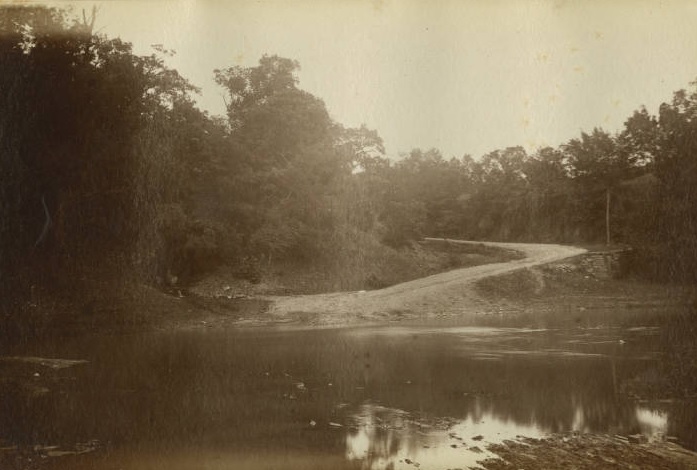
Opequon Crossing, circa 1930s (courtesy of Southern Methodist University).
Inflicting heavy casualties during the Battle of Opequan (also known as “Third Winchester”) on 19 September 1864, Sheridan’s gallant blue jackets forced a stunning retreat of Jubal Early’s grays—first to Fisher’s Hill (21-22 September) and then, following a successful early morning flanking attack, to Waynesboro. These impressive Union victories helped Abraham Lincoln secure his second term as President. Recalling the battle years later, Sheridan noted:
My army moved at 3 o’clock that morning. The plan was for Torbert to advance with Merritt’s division of cavalry from Summit Point, carry the crossings of the Opequon at Stevens’s and Lock’s fords, and form a junction near Stephenson’s depot, with Averell, who was to move south from Darksville by the Valley pike. Meanwhile, Wilson was to strike up the Berryville pike, carry the Berryville crossing of the Opequon, charge through the gorge or cañon on the road west of the stream, and occupy the open ground at the head of this defile. Wilson’s attack was to be supported by the Sixth and Nineteenth corps, which were ordered to the Berryville crossing, and as the cavalry gained the open ground beyond the open gorge, the two infantry corps, under command of General Wright, were expected to press on after and occupy Wilson’s ground, who was then to shift to the south bank of Abraham’s creek and cover my left; Crook’s two divisions, having to march from Summit Point, were to follow the Sixth and Nineteenth corps to the Opequon, and should they arrive before the action began, they were to be held in reserve till the proper moment came, and then, as a turning-column, be thrown over toward the Valley pike, south of Winchester.”

Battle of Opequan (aka Third Winchester), Virginia, 19 September 1864 (public domain).
By dawn on 19 September, the brigade from Wilson’s division headed by McIntosh had succeeded in compelling Confederate pickets to flee their Berryville positions with “Wilson following rapidly through the gorge with the rest of the division, debouched from its western extremity with such suddenness as to capture a small earthwork in front of General Ramseur’s main line.” Although “the Confederate infantry, on recovering from its astonishment, tried hard to dislodge them,” they were unable to do so, according to Sheridan. Wilson’s Union troops were then reinforced by the U.S. 6th Army.
I followed Wilson to select the ground on which to form the infantry. The Sixth Corps began to arrive about 8 o’clock, and taking up the line Wilson had been holding, just beyond the head of the narrow ravine, the cavalry was transferred to the south side of Abraham’s Creek.
The Confederate line lay along some elevated ground about two miles east of Winchester, and extended from Abraham’s Creek north across the Berryville pike, the left being hidden in the heavy timber on Red Bud Run. Between this line and mine, especially on my right, clumps of woods and patches of underbrush occurred here and there, but the undulating ground consisted mainly of open fields, many of which were covered with standing corn that had already ripened.
“The 6th Corps formed across the Berryville Road” while the “19th Corps prolonged the line to the Red Bud on the right with the troops of the Second Division.” According to Irwin, the:
First Division’s First and Second Brigades, under Beal and McMillan, formed in the rear of the Second Division and on the right flank. Beal’s First Brigade was on the right of the division’s position, and McMillan’s Second Brigade deployed on the left and rear of Beal; in order of the 47th Pennsylvania, 8th Vermont, 160th New York, and 12th Connecticut, with five companies of the 47th Pennsylvania deployed to cover the whole right flank of his brigade and to move forward with it by the flank left in front. By this time, the Army of West Virginia had crossed the ford and was massed on the left of the west bank.
While the ground in front of the 6th Corps was for the most part open, the 19th Corps found itself in a dense wood, restricting its vision of both the enemy and its own forces.
“Much time was lost in getting all of the Sixth and Nineteenth corps through the narrow defile,” Sheridan observed, adding that, because Grover’s division was “greatly delayed there by a train of ammunition wagons … it was not until late in the forenoon that the troops intended for the attack could be got into line ready to advance.” As a result:
General Early was not slow to avail himself of the advantages thus offered him, and my chances of striking him in detail were growing less every moment, for Gordon and Rodes were hurrying their divisions from Stephenson’s depot across-country on a line that would place Gordon in the woods south of Red Bud Run, and bring Rodes into the interval between Gordon and Ramseur.
When the two corps had all got through the cañon they were formed with Getty’s division of the Sixth to the left of the Berryville pike, Rickett’s division to the right of the pike, and Russell’s division in reserve in rear of the other two. Grover’s division of the Nineteenth Corps came next on the right of Rickett’s, with Dwight to its rear in reserve, while Crook was to begin massing near the Opequon crossing about the time Wright and Emory [including the 47th Pennsylvania Volunteers] were ready to attack.

Victory of Philip Sheridan’s Union Army over Jubal Early’s Confederate forces, Battle of Opequan, 19 September 1864 (Kurz & Allison, circa 1893, U.S. Library of Congress, public domain).
More than a quarter of a century after the clash, Irwin conjured the spirit of the battle’s beginning:
About a quarter before twelve o’clock, at the sound of Sheridan’s bugle, repeated from corps, division, and brigade headquarters, the whole line moved forward with great spirit, and instantly became engaged. Wilson pushed back Lomax, Wright drove in Ramseur, while Emory, advancing his infantry [including the 47th Pennsylvania Volunteers] rapidly through the wood, where he was unable to use his artillery, attacked Gordon with great vigor. Birge, charging with bayonets fixed, fell upon the brigade of Evans, forming the extreme left of Gordon, and without a halt drove it in confusion through the wood and across the open ground beyond to the support of Braxton’s artillery, posted by Gordon to secure his flank on the Red Bud road. In this brilliant charge, led by Birge in person, his lines naturally became disordered….
Sharpe, advancing simultaneously on Birge’s left, tried in vain to keep the alignment with Ricketts and with Birge…. At first the order of battle formed a right angle with the road, but the bend once reached, in the effort to keep closed upon it, at every step Ricketts was taking ground more and more to the left, while the point of direction for Birge, and equally for Sharpe, was the enemy in their front, standing almost in the exact prolongation of the defile, from which line, still plainly marked by Ash Hollow, the road … was steadily diverging.
As the battle continued to unfold, the disorganization affected the lines on both sides of the conflict. According to Irwin:
The 19th Corps Second Division was initially successful, but in its charge became disorganized; and the troops on the left in following the less obstructed area of the road which veared [sic] slightly left, soon opened up a gap on their right; while the remainder of the Union forces were moving straight ahead as they engaged the Confederates. This gap eventually reached 400 yards in width, an opportunity the Confederates soon exploited. Fortunately the Confederates were soon themselves disorganized by their advance, and encountering fresh Union troops on their right flank were halted. The Confederate attack on the right flank also achieved initial success, until halted by Beal’s first brigade.
McMillan had been ordered to move forward at the same time as Beal, and to form on his left. The five companies of the 47th Pennsylvania that had been detached to form a skirmish line on the Red Bud Run to cover McMillan’s right flank, had some how [sic] lost their way on the broken ground among the thickets, and, not finding them in place, McMillan had been obliged to send the remaining companies of the same regiment to do the same duty, and brought the rest of the brigade to the front to restore the line. The line then charged and drove the Confederates back beyond the positions where their attack had started. The initial engagement had lasted barely an hour, and by 1 PM was over. The right flank of the 19th Corps was held by the 47th Pennsylvania and 30th Massachusetts.
According to Sheridan:
Just before noon the line of Getty, Ricketts, and Grover moved forward, and as we advanced, the Confederates, covered by some heavy woods on their right, slight underbrush and corn-fields along their centre [sic], and a large body of timber on their left along the Red Bud, opened fire from their whole front. We gained considerable ground at first, especially on our left but the desperate resistance which the right met with demonstrated that the time we had unavoidably lost in the morning had been of incalculable value to Early, for it was evident that he had been enabled already to so far concentrate his troops as to have the different divisions of his army in a connected line of battle in good shape to resist.
Getty and Ricketts made some progress toward Winchester in connection with Wilson’s cavalry…. Grover in a few minutes broke up Evans’s brigade of Gordon’s division, but his pursuit of Evans destroyed the continuity of my general line, and increased an interval that had already been made by the deflection of Ricketts to the left, in obedience to instructions that had been given him to guide his division on the Berryville pike. As the line pressed forward, Ricketts observed this widening interval and endeavored to fill it with the small brigade of Colonel Keifer, but at this juncture both Gordon and Rodes struck the weak spot where the right of the Sixth Corps and the left of the Nineteenth should have been in conjunction, and succeeded in checking my advance by driving back a part of Ricketts’s division, and the most of Grover’s. As these troops were retiring I ordered Russell’s reserve division to be put into action, and just as the flank of the enemy’s troops in pursuit of Grover was presented, Upton’s brigade, led in person by both Russell and Upton, struck it in a charge so vigorous as to drive the Confederates back … to their original ground.
The success of Russell enabled me to re-establish the right of my line some little distance in advance of the position from which it started in the early morning, and behind Russell’s division (now commanded by Upton) the broken regiments of Ricketts’s division were rallied. Dwight’s division was then brought up on the right, and Grover’s men formed behind it….
No news of Torbert’s progress came … so … I directed Crook to take post on the right of the Nineteenth Corps and, when the action was renewed, to push his command forward as a turning-column in conjunction with Emory. After some delay … Crook got his men up, and posting Colonel Thoburn’s division on the prolongation of the Nineteenth Corps, he formed Colonel Duval’s division to the right of Thoburn. Here I joined Crook, informing him that … Torbert was driving the enemy in confusion along the Martinsburg pike toward Winchester; at the same time I directed him to attack the moment all of Duval’s men were in line. Wright was introduced to advance in concert with Crook, by swinging Emory [including the 47th Pennsylvania and his other 19th Corps’ troops] and the right of the Sixth Corps to the left together in a half-wheel. Then leaving Crook, I rode along the Sixth and Nineteenth corps, the open ground over which they were passing affording a rare opportunity to witness the precision with which the attack was taken up from right to left. Crook’s success began the moment he started to turn the enemy’s left…
Both Emory [including the 47th Pennsylvania] and Wright took up the fight as ordered…. [A]s I reached the Nineteenth Corps the enemy was contesting the ground in its front with great obstinacy; but Emory’s dogged persistence was at length rewarded with success, just as Crook’s command emerged from the morass of the Red Bud Run, and swept around Gordon, toward the right of Breckenridge….”
As “Early tried hard to stem the tide” of the multi-pronged Union assault, “Torbert’s cavalry began passing around his left flank, and as Crook, Emory, and Wright attacked in front, panic took possession of the enemy, his troops, now fugitives and stragglers, seeking escape into and through Winchester,” according to Sheridan.
When this second break occurred, the Sixth and Nineteenth corps were moved over toward the Millwood pike to help Wilson on the left, but the day was so far spent that they could render him no assistance.” The battle winding down, Sheridan headed for Winchester to begin writing his report to Grant.
According to Irwin, although the heat of battle had cooled by 1 p.m., troop movements had continued on both sides throughout the afternoon until “Crook, with a sudden … effective half-wheel to the left, fell vigorously upon Gordon, and Torbert coming on with great impetuosity … the weight was heavier than the attenuated lines of Breckinridge and Gordon Could bear.” As a result, “Early saw his whole left wing give back in disorder, and as Emory [including the 47th Pennsylvania] and Wright pressed hard, Rodes and Ramseur gave way, and the battle was over.”
Early vainly endeavored to reconstruct his shattered lines [near Winchester]. About five o’clock Torbert and Crook, fairly at right angles to the first line of battle, covered Winchester on the north from the rocky ledges that lie to the eastward of the town…. Thence Wright extended the line at right angles with Crook and parallel with the valley road, while Sheridan drew out Emory [including the 47th Pennsylvania] … and sent him to extend Wright’s line to the south….
Sheridan, mindful that his men had been on their feet since two o’clock in the morning … made no attempt to send his infantry after the flying enemy….
Sheridan … openly rejoiced, and catching the enthusiasm of their leader, his men went wild with excitement when, accompanied by his corps commanders, Wright and Emory and Crook, Sheridan rode down the front of his lines. Then went up a mighty cheer that gave new life to the wounded and consoled the last moments of the dying….
Summing up the battle for Lincoln and Grant, Sheridan reported:
My losses in the Battle of Opequon were heavy, amounting to about 4,500 killed, wounded and missing. Among the killed was General Russell, commanding a division, and the wounded included Generals Upton, McIntosh and Chapman, and Colonels Duval and Sharpe. The Confederate loss in killed, wounded, and prisoners equaled about mine. General Rodes being of the killed, while Generals Fitzhugh Lee and York were severely wounded.
We captured five pieces of artillery and nine battle flags. The restoration of the lower valley – from the Potomac to Strasburg – to the control of the Union forces caused great rejoicing in the North, and relieved the Administration from further solicitude for the safety of the Maryland and Pennsylvania borders. The President’s appreciation of the victory was expressed in a despatch [sic] so like Mr. Lincoln I give a fac-simile [sic] of it to the reader. This he supplemented by promoting me to the grade of brigadier-general in the regular army, and assigning me to the permanent command of the Middle Military Department, and following that came warm congratulations from Mr. Stanton and from Generals Grant, Sherman and Meade.
“The losses of the Army of the Shenandoah, according to the revised statements compiled in the War Department, were 5018, including 697 killed, 3983 wounded, 338 missing,” per revised estimates by Irwin. “Of the three infantry corps, the 19th, though in numbers smaller than the 6th, suffered the heaviest loss, the aggregate being 2074 [314 killed, 1554 wounded, 206 missing]. Conversely, Early “lost nearly 4000 in all, including about 200 prisoners; or as other sources reported, anywhere from 5500 to 6850 killed, wounded, and missing or captured.”
Despite the significant number of killed, wounded and missing on both sides of the conflict, casualties within the 47th Pennsylvania Volunteers were surprisingly low. Private Thomas Steffen of Company B was killed in action while F Company Private William H. Jackson’s cause of death was somewhat less clear; he was reported in Bates’ History of Pennsylvania Volunteers, 1861-5 as having died on the same day on which the battle took place.
Among the wounded were C Company Corporal Timothy Matthias Snyder, who was wounded slightly in the knee, and Privates William Adams (E Company), Charles Pfeiffer (B Company), who lost the forefinger of his right hand, J. D. Raubenold (B Company), and Edward Smith (E Company).
As he penned his memoir in 1885 during the final days of his life, President Ulysses S. Grant again made clear the significance of the Battle of Opequan:
Sheridan moved at the time he had fixed upon. He met Early at the crossing of Opequon Creek [September 19], and won a most decisive victory – one which electrified the country. Early had invited this attack himself by his bad generalship and made the victory easy. He had sent G. T. Anderson’s division east of the Blue Ridge [to Lee] before I [Grant] went to Harpers Ferry and about the time I arrived there he started with two other divisions (leaving but two in their camps) to march to Martinsburg for the purpose of destroying the Baltimore and Ohio Railroad at that point. Early here learned that I had been with Sheridan and, supposing there was some movement on foot, started back as soon as he got the information. But his forces were separated and … he was very badly defeated. He fell back to Fisher’s Hill, Sheridan following.
On 23-24 September, the 47th Pennsylvania lost its two most senior officers when Colonel Tilghman Good and Lieutenant-Colonel George W. Alexander mustered out upon expiration of their respective terms of service.
Battle of Cedar Creek, Virginia

Alfred Waud’s 1864 sketch, “Surprise at Cedar Creek,” captured the flanking attack on the rear of Union Brigadier-General William Emory’s 19th Corps by Lieutenant-General Jubal Early’s Confederate army, and the subsequent resistance by Emory’s troops from their Union rifle-pit positions, 19 October 1864 (public domain).
On 19 October 1864, Early’s Confederate forces briefly stunned the Union Army, launching a surprise attack at Cedar Creek, but Sheridan was able to rally his troops. Intense fighting raged for hours and ranged over a broad swath of Virginia farmland. Weakened by hunger wrought by the Union’s earlier destruction of crops, Early’s army gradually peeled off, one by one, to forage for food while Sheridan’s forces fought on, and won the day.
According to Union General Ulysses S. Grant:
On the 18th of October Early was ready to move, and during the night succeeded in getting his troops in the rear of our left flank, which fled precipitately and in great confusion down the valley, losing eighteen pieces of artillery and a thousand or more prisoners [Battle of Cedar Creek]. The right under General Getty maintained a firm and steady front, falling back to Middletown where it took a position and made a stand. The cavalry went to the rear, seized the roads leading to Winchester and held them for the use of our troops in falling back, General Wright having ordered a retreat back to that place.
Sheridan having left Washington on the 18th, reached Winchester that night. The following morning he started to join his command. He had scarcely got out of town, when he met his men returning, in panic from the front and also heard heavy firing to the south. He immediately ordered the cavalry at Winchester to be deployed across the valley to stop the stragglers. Leaving members of his staff to take care of Winchester and the public property there, he set out with a small escort directly for the scene of the battle. As he met the fugitives he ordered them to turn back, reminding them that they were going the wrong way. His presence soon restored confidence. Finding themselves worse frightened than hurt the men did halt and turn back. Many of those who had run ten miles got back in time to redeem their reputation as gallant soldiers before night.
Not provided with adequate intelligence by his staff by that fateful morning, Sheridan began his day at a leisurely pace, clearly unaware of the potential disaster in the making:
Toward 6 o’clock the morning of the 19th, the officer on picket duty at Winchester came to my room, I being yet in bed, and reported artillery firing from the direction of Cedar Creek. I asked him if the firing was continuous or only desultory, to which he replied that it was not a sustained fire, but rather irregular and fitful. I remarked: ‘It’s all right; Grover has gone out this morning to make a reconnaissance, and he is merely feeling the enemy.’ I tried to go to sleep again, but grew so restless that I could not, and soon got up and dressed myself. A little later the picket officer came back and reported that the firing, which could be distinctly heard from his line on the heights outside of Winchester, was still going on. I asked him if it sounded like a battle, and as he again said that it did not, I still inferred that the cannonading was caused by Grover’s division banging away at the enemy simply to find out what he was up to. However, I went down-stairs and requested that breakfast be hurried up, and at the same time ordered the horses to be saddled and in readiness, for I concluded to go to the front before any further examinations were made in regard to the defensive line.
We mounted our horses between half-past 8 and 9, and as we were proceeding up the street which leads directly through Winchester, from the Logan residence, where Edwards was quartered, to the Valley pike, I noticed that there were many women at the windows and doors of the houses, who kept shaking their skirts at us and who were otherwise markedly insolent in their demeanor, but supposing this conduct to be instigated by their well-known and perhaps natural prejudices, I ascribed to it no unusual significance. On reaching the edge of town I halted a moment, and there heard quite distinctly the sound of artillery firing in an unceasing roar. Concluding from this that a battle was in progress, I now felt confident that the women along the street had received intelligence from the battlefield by the ‘grape-vine telegraph,’ and were in raptures over some good news, while I as yet was utterly ignorant of the actual situation. Moving on, I put my head down toward the pommel of my saddle and listened intently, trying to locate and interpret the sound, continuing in this position till we had crossed Mill Creek, about half a mile from Winchester. The result of my efforts in the interval was the conviction that the travel of the sound was increasing too rapidly to be accounted for by my own rate of motion, and that therefore my army must be falling back.
At Mill Creek my escort fell in behind, and we were going ahead at a regular pace, when, just as we made the crest of the rise beyond the stream, there burst upon our view the appalling spectacle of a panic-stricken army – hundreds of slightly wounded men, throngs of others unhurt but utterly demoralized, and baggage-wagons by the score, all pressing to the rear in hopeless confusion, telling only too plainly that a disaster had occurred at the front. On accosting some of the fugitives, they assured me that the army was broken up, in full retreat, and that all was lost; all this with a manner true to that peculiar indifference that takes possession of panic-stricken men. I was greatly disturbed by the sight, but at once sent word to Colonel Edwards, commanding the brigade in Winchester, to stretch his troops across the valley, near Mill Creek, and stop all fugitives, directing also that the transportation be passed through and parked on the north side of the town.
As I continued at a walk a few hundred yards farther, thinking all the time of Longstreet’s telegram to Early, ‘Be ready when I join you, and we will crush Sheridan,’ I was fixing in my mind what I should do. My first thought was to stop the army in the suburbs of Winchester as it came back, form a new line, and fight there; but as the situation was more maturely considered a better conception prevailed. I was sure the troops had confidence in me, for heretofore we had been successful; and as at other times they had seen me present at the slightest sign of trouble or distress, I felt that I ought to try now to restore their broken ranks, or, failing in that, to share their fate because of what they had done hitherto.
About this time Colonel Wood, my chief commissary, arrived from the front and gave me fuller intelligence, reporting that everything was gone, my headquarters captured, and the troops dispersed. When I heard this I took two of my aides-de-camp, Major George A. Forsyth and Captain Joseph O’Keefe, and with twenty men from the escort started for the front, at the same time directing Colonel James W. Forsyth and Colonels Alexander and Thom to remain behind and do what they could to stop the runaways.
For a short distance I traveled on the road, but soon found it so blocked with wagons and wounded men that my progress was impeded, and I was forced to take to the adjoining fields to make haste. When most of the wagons and wounded were past I returned to the road, which was thickly lined with unhurt men, who, having got far enough to the rear to be out of danger, had halted without any organization, and begun cooking coffee, but when they saw me they abandoned their coffee, threw up their hats, shouldered their muskets, and as I passed along turned to follow with enthusiasm and cheers. To acknowledge this exhibition of feeling I took off my hat, and with Forsyth and O’Keefe rode some distance in advance of my escort, while every mounted officer who saw me galloped out on either side of the pike to tell the men at a distance that I had come back. In this way the news was spread to the stragglers off the road, when they, too, turned their faces to the front and marched toward the enemy, changing in a moment from the depths of depression to the extreme of enthusiasm. I already knew that even in the ordinary condition of mind enthusiasm is a potent element with soldiers, but what I saw that day convinced me that if it can be excited from a state of despondency its power is almost irresistible. I said nothing except to remark, as I rode among those on the road: ‘If I had been with you this morning this disaster would not have happened. We must face the other way; we will go back and recover our camp.’
My first halt was made just north of Newtown, where I met a chaplain digging his heels into the sides of his jaded horse, and making for the rear with all possible speed. I drew up for an instant, and inquired of him how matters were going at the front. He replied, ‘Everything is lost; but all will be right when you get there’; yet notwithstanding this expression of confidence in me, the parson at once resumed his breathless pace to the rear. At Newtown I was obliged to make a circuit to the left, to get round the village. I could not pass through it, the streets were so crowded, but meeting on this detour Major McKinley, of Crook’s staff, he spread the news of my return through the motley throng there.
According to Grant, “When Sheridan got to the front he found Getty and Custer still holding their ground firmly between the Confederates and our retreating troops.”
Everything in the rear was now ordered up. Sheridan at once proceeded to intrench [sic] his position; and he awaited an assault from the enemy. This was made with vigor, and was directed principally against Emory’s corps [including the 47th Pennsylvania Volunteers], which had sustained the principal loss in the first attack. By one o’clock the attack was repulsed. Early was so badly damaged that he seemed disinclined to make another attack, but went to work to intrench [sic] himself with a view to holding the position he had already gained….

Sheridan Rallying His Troops, Battle of Cedar Creek, Virginia, 19 October 1864 (U.S. Library of Congress, public domain).
What Sheridan encountered as he approached Newtown and the Valley pike from the south made him urge Rienzi on:
I saw about three-fourths of a mile west of the pike a body of troops, which proved to be Rickett’s and Wheaton’s divisions of the Sixth Corps, and then learned that the Nineteenth Corps [to which the 47th Pennsylvania had been assigned] had halted a little to the right and rear of these; but I did not stop, desiring to get to the extreme front. Continuing on parallel with the pike, about midway between Newtown and Middletown I crossed to the west of it, and a little later came up in rear of Getty’s division of the Sixth Corps. When I arrived, this division and the cavalry were the only troops in the presence of and resisting the enemy; they were apparently acting as a rear guard at a point about three miles north of the line we held at Cedar Creek when the battle began. General Torbert was the first officer to meet me, saying as he rode up, ‘My God! I am glad you’ve come.’ Getty’s division, when I found it, was about a mile north of Middleton, posted on the reverse slope of some slightly rising ground, holding a barricade made with fence-rails, and skirmishing slightly with the enemy’s pickets. Jumping my horse over the line of rails, I rode to the crest of the elevation, and there taking off my hat, the men rose up from behind their barricade with cheers of recognition. An officer of the Vermont brigade, Colonel A. S. Tracy, rode out to the front, and joining me, informed me that General Louis A. Grant was in command there, the regular division commander General Getty, having taken charge of the Sixth Corps in place of Ricketts, wounded early in the action, while temporarily commanding the corps. I then turned back to the rear of Getty’s division, and as I came behind it, a line of regimental flags rose up out of the ground, as it seemed, to welcome me. They were mostly the colors of Crook’s troops, who had been stampeded and scattered in the surprise of the morning. The color-bearers, having withstood the panic, had formed behind the troops of Getty. The line with the colors was largely composed of officers, among whom I recognized Colonel R. B. Hayes, since president of the United States, one of the brigade commanders. At the close of this incident I crossed the little narrow valley, or depression, in rear of Getty’s line, and dismounting on the opposite crest, established that point as my headquarters. In a few minutes some of my staff joined me, and the first directions I gave were to have the Nineteenth Corps [to which the 47th Pennsylvania was attached] and the two divisions of Wright’s corps brought to the front, so they could be formed on Getty’s division prolonged to the right; for I had already decided to attack the enemy from that line as soon as I could get matters in shape to take the offensive. Crook met me at this time, and strongly favored my idea of attacking, but said, however, that most of his troops were gone. General Wright came up a little later, when I saw that he was wounded, a ball having grazed the point of his chin so as to draw the blood plentifully.
Wright gave me a hurried account of the day’s events, and when told that we would fight the enemy on the line which Getty and the cavalry were holding, and that he must go himself and send all his staff to bring up the troops, he zealously fell in with the scheme; and it was then that the Nineteenth Corps [including the 47th Pennsylvania] and two divisions of the Sixth were ordered to the front from where they had been halted to the right and rear of Getty.
After this conversation I rode to the east of the Valley pike and to the left of Getty’s division, to a point from which I could obtain a good view of the front, in the mean time [sic] sending Major Forsyth to communicate with Colonel Lowell (who occupied a position close in toward the suburbs of Middletown and directly in front of Getty’s left) to learn whether he could hold on there. Lowell replied that he could. I then ordered Custer’s division back to the right flank, and returning to the place where my headquarters had been established I met near them Rickett’s division under General Kiefer and General Frank Wheaton’s division, both marching to the front. When the men of these divisions saw me they began cheering and took up the double quick to the front, while I turned back toward Getty’s line to point out where these returning troops should be place. Having done this, I ordered General Wright to resume command of the Sixth Corps, and Getty, who was temporarily in charge of it, to take command of his own division. A little later the Nineteenth Corps [including the 47th Pennsylvania] came up and was posted between the right of the Sixth Corps and Middle Marsh Brook.
All this had consumed a great deal of time, and I concluded to visit again the point to the east of the Valley pike, from where I had first observed the enemy, to see what he was doing. Arrived there, I could plainly seem him getting ready for attack, and Major Forsyth now suggested that it would be well to ride along the line of battle before the enemy assailed us, for although the troops had learned of my return, but few of them had seen me. Following his suggestion I started in behind the men, but when a few paces had been taken I crossed to the front and, hat in hand, passed along the entire length of the infantry line; and it is from this circumstance that many of the officers and men who then received me with such heartiness have since supposed that that was my first appearance on the field. But at least two hours had elapsed since I reached the ground, for it was after mid-day when this incident of riding down the front took place, and I arrived not later, certainly, than half-past 10 o’clock.
After re-arranging the line and preparing to attack I returned again to observe the Confederates, who shortly began to advance on us. The attacking columns did not cover my entire front, and it appeared that their onset would be mainly directed against the Nineteenth Corps [including the 47th Pennsylvania], so, fearing that they might be too strong for Emory on account of his depleted condition (many of his men not having had time to get up from the rear), and Getty’s division being free from assault, I transferred a part of it from the extreme left to the support of the Nineteenth Corps. The assault was quickly repulsed by Emory, however, and as the enemy fell back Getty’s troops were returned to their original place. This repulse of the Confederates made me feel pretty safe from further offensive operations on their part, and I now decided to suspend the fighting till my thin ranks were further strengthened by the men who were continually coming up from the rear, and particularly till Crook’s troops could be assembled on the extreme left.
In consequence of the despatch [sic] already mentioned, ‘Be ready when I join you, and we will crush Sheridan,’ since learned to have been fictitious, I had been supposing all day that Longstreet’s troops were present, but as no definite intelligence on this point had been gathered, I concluded, in the lull that now occurred, to ascertain something positive regarding Longstreet; and Merritt having been transferred to our left in the morning, I directed him to attack an exposed battery then at the edge of Middletown, and capture some prisoners. Merritt soon did this work effectually, concealing his intention till his troops got close in to the enemy, and then by a quick dash gobbling up a number of Confederates. When the prisoners were brought in, I learned from them that the only troops of Longstreet’s in the fight were of Kershaw’s division, which had rejoined Early at Brown’s Gap in the latter part of September, and that the rest of Longstreet’s corps was not on the field. The receipt of this information entirely cleared the way for me to take the offensive, but on the heels of it came information that Longstreet was marching by the Front Royal pike to strike my rear at Winchester, driving Powell’s cavalry in as he advanced. This renewed my uneasiness, and caused me to delay the general attack till after assurances came from Powell, denying utterly the reports as to Longstreet, and confirming the statements of the prisoners.
Launching another advance sometime mid-afternoon during which Sheridan “sent his cavalry by both flanks, and they penetrated to the enemy’s rear,” Grant added:
The contest was close for a time, but at length the left of the enemy broke, and disintegration along the whole line soon followed. Early tried to rally his men, but they were followed so closely that they had to give way very quickly every time they attempted to make a stand. Our cavalry, having pushed on and got in the rear of the Confederates, captured twenty-four pieces of artillery, besides retaking what had been lost in the morning. This victory pretty much closed the campaign in the Valley of Virginia. All the Confederate troops were sent back to Richmond with the exception of one division of infantry and a little cavalry. Wright’s corps was ordered back to the Army of the Potomac, and two other divisions were withdrawn from the valley. Early had lost more men in killed, wounded and captured in the valley than Sheridan had commanded from first to last.
The High Price of Valor

Private Alex Given’s entry in the U.S. Army’s Register of Deaths of Volunteer Soldiers (U.S. National Archives and Records Administration, public domain; click to enlarge).
But it was another extremely costly engagement for Pennsylvania’s native sons. The 47th experienced a total of one hundred and seventy-six casualties during the Battle of Cedar Creek alone, including: Sunbury Guards’ Sergeants John Bartlow and William Pyers, and Privates James Brown (a carpenter), Jasper B. Gardner (a railroad conductor), George W. Keiser (an eighteen-year-old farmer), Joseph Smith, John E. Will, and Theodore Kiehl—all dead.
Among the gravely wounded was Private Alexander Given. Although a newspaper account of the casualties sustained by the 47th Pennsylvania Volunteer Infantry at Cedar Creek indicated that Private Given had been wounded in the abdomen, affidavits filed later by officers of the regiment and by representatives from federal government agencies, including the U.S. Office of the Adjutant General documented that Alexander Given had sustained a gunshot wound (“Vulnus Sclopet”) to his left knee joint while in action during the Battle of Cedar Creek, Virginia on 19 October 1864.

Jarvis General Hospital, Baltimore, Maryland, 1863 (E. Sachse, public domain).
Initially treated by regimental medical personnel near the field of battle, he was subsequently transported to the Union Army’s Jarvis General Hospital in Baltimore, Maryland for more advanced medical care. According to records of the Office of the U.S. Surgeon General, the Confederate projectile that entered Private Given’s left knee, caused a chondral fracture and damaged the head of his tibia, causing sphacelus of his limb.
He subsequently died at Jarvis from battle wound-related complications on 1 November 1864, and was laid to rest at the Loudon Park National Cemetery in Baltimore.
* Note: Ballistic injuries to a knee were often extremely painful and traumatic. According to the editors of Ballistic Trauma: A Practical Guide, “There are three mechanisms whereby a projectile can cause tissue injury:
-
- In a low-energy transfer wound, the projectile crushes and lacerates tissue along the track of the projectile, causing a permanent cavity. In addition, bullet and bone fragments can act as secondary missiles, increasing the volume of tissue crushed.
- In a high-energy transfer wound, the projectile may impel the walls of the wound track [and] radially outwards, causing a temporary cavity lasting 5 to 10 milliseconds before its collapse in addition to the permanent mechanical disruption produced….
- In wounds where the firearm’s muzzle is in contact with the skin at the time of firing, tissues are forced aside by the gases expelled from the barrel of the fire, causing a localized blast injury.”
In Alexander Given’s case, the damage to his knee and leg were compounded by the fact that his wound was caused by a musket or minié ball that was made of lead—a substance known to cause blood poisoning and damage to human tissue and organs—and likely also by surgical procedures that were less than sterile, which resulted in a subsequent infection. His cause of death at the Union Army’s Jarvis Hospital in Baltimore, Maryland—roughly two weeks after he was injured in combat—was “sphacelus”—gangrene and necrosis, according to the Union Army’s Registers of Deaths of Volunteer soldiers.
What Happened to Alexander Given’s Wife and Children?

History of the U.S. Civil War Widow’s and Orphans’ Pension Claims filed by Nancy (Barton Williamson) Given, the widow of Private Alexander Given, 47th Pennsylvania Volunteers (U.S. Civil War Widows’ and Orphans’ Pension Files, U.S. National Archives and Records Administration, public domain; click to enlarge).
Suddenly thrust into the role of a single parent, Nancy (Barton Williamson) Given struggled to make ends meet. So, in order to keep a roof over her head and the heads of her two minor children, James and Rachel, she filed applications for U.S. Civil War Widow’s and Orphans’ Pensions.
She was finally awarded pension support of eight dollars per month in 1869—support that was made retroactive to 1 November 1864—the date of her husband’s death in Maryland from battle wounds.
A resident of McCoysville in Tuscarora Township, Juniata County in 1870, Nancy Given was documented on that year’s federal census as the head of her household—a household that included James and Rachel Given, aged eleven and nine, respectively, and Anna Williamson (aged twenty-nine). By 1880, Nancy Given was residing with her daughter from her first marriage, Sarah (Given) Williamson, in Tuscarora Township. They were the sole residents of the household that year.
Sometime during the late 1800s, Nancy Given’s Civil War Widow’s Pension was increased to twelve dollars per month. She died roughly seventeen years later, on 13 March 1897, according to records of the U.S. Pension Bureau, and was dropped from the bureau’s rolls on 27 May of that year. Researchers for 47th Pennsylvania Volunteers: One Civil War Regiment’s Story have not yet confirmed her burial location.
Alexander and Nancy Givens’ son, James, grew up to become a house painter. Sometime during the 1880s, he wed Annie M. Clark (1861-1926). Together, they welcomed the births of daughter Mae (1887-1939) and son Samuel (1891-1977). Ailing with tuberculosis, his health began to fail during the early 1900s. He subsequently died in Tuscarora Township on 22 February 1916, and was laid to rest at the East Waterford Cemetery in Juniata County on 25 February.
Alexander and Nancy Givens’ daughter, Rachel Marie, also grew up and began a family of her own. On 13 March 1881, she wed William Camden Bartley (1859-1939) in East Waterford, Tuscarora Township. Together, they welcomed the births of: Mettie Olive Bartley (1885-1952), who was born in East Waterford on 24 July 1885, later wed James Timothy Maloney (1875-1950) and subsequently settled in Oklahoma; Maud Rachel Bartley (1887-1869), who was born on 17 September 1887, later wed Oscar Abraham Heckman (1879-1952) and subsequently settled in Kansas; and Francis Given Bartley (1889-1937), who was born on 24 October 1889, later wed Dora M. Estes (1885-1981) and subsequently settled in Montgomery County, Kansas.
Deserted by her first husband, Rachel (Given) Bartley divorced him on 20 September 1904; she then married Samuel Hockenberry in East Waterford, Juniata County on 17 June 1907. By 1915, she had relocated to Kansas to be closer to her daughter, Maud, who was living with her husband and children in Liberty, Montgomery County, and her son, Francis, and his family, who were also residents of that state.
Diagnosed with breast cancer, Rachel Bartley’s health began to decline during the early 1900s. Following her death in Liberty, Kansas on 10 May 1918, she was interred at the Liberty Cemetery. She rests there still.
* To view more of the key U.S. Civil War Military and Pension records related to the Given family, visit our Alexander and Nancy Given Collection.
Sources:
- Bates, Samuel P. History of Pennsylvania Volunteers, 1861-5, vol. 1. Harrisburg, Pennsylvania: B. Singerly, State Printer, 1869.
- Clipson, Riley. “Hospital Gangrene in the Civil War.” Frederick, Maryland: National Museum of Civil War Medicine, 19 July 2023.
- Giffen, Alexander, Nancy, Isabella, John, Nancy (daughter), and Margaret; Williamson, Sarah (housekeeper), Jardin, Mary, and Elizabeth; Giffin, James and Elizabeth, in U.S. Census (Tuscarora Township, Juniata County, Pennsylvania, 1860). Washington, D.C.: U.S. National Archives and Records Administration.
- Giffen, Nancy, James and Rachel, and Williamson, Anna, in U.S. Census (McCoysville, Tuscarora Township, Juniata County, Pennsylvania, 1870). Washington, D.C.: U.S. National Archives and Records Administration.
- Given, Alexander, in Civil War Veterans’ Card File, 1861-1866 (Co. C, 47th Pennsylvania Infantry). Harrisburg, Pennsylvania: Pennsylvania State Archives.
- Given, Alexander, in Roll of Honor. Names of Soldiers Who Died in Defence of the American Union, vol. XIX. Washington, D.C.: U.S. Quartermaster General’s Office and Government Printing Office, 1867.
- Given, Alexander, in Registers of Deaths of U.S. Volunteers. Washington, D.C.: U.S. National Archives and Records Administration.
- Given, James, in Death Certificates (file no.: 16725, registered no.: 10; date of death: 22 February 1916). Harrisburg, Pennsylvania: Commonwealth of Pennsylvania, Department of Health, Bureau of Vital Statistics.
- Given, Nancy, in U.S. Census (Tuscarora Township, Juniata County, Pennsylvania, 1880). Washington, D.C.: U.S. National Archives and Records Administration.
- Given, Alexander and Nancy, in U.S. Civil War Widows’ Pension Files. Washington, D.C.: U.S. National Archives and Records Administration.
- Gobin, John Peter Shindel. Personal Letters, 1861-1865. Northumberland, Pennsylvania: Personal Collection of John Deppen.
- James T. Maloney and Mettie Olive Barkley, in Marriage License Applications (East Waterford, Juniata County, Pennsylvania, 16 May 1905). Mifflintown, Pennsylvania: Clerk of the Orphans’ Court, Juniata County, Pennsylvania.
- “Lead Toxicity: Biological Fate,” in “Environmental Health and Medicine.” Atlanta, Georgia: Agency for Toxic Substances and Disease Registry, United States Centers for Disease Control, May 2023.
- Mahoney, Peter F., James Ryan, et. al. Ballistic Trauma: A Practical Guide, Second Edition, pp. 31-66, 91-121, 168-179, 356-395, 445-464, 535-540, 596-605. London, England: Springer-Verlag London Limited, 2005.
- “Mrs. Hockenberry Dies at Liberty.” Coffeyville, Kansas: The Sun, 11 May 1918.
- Reimer, Terry. “Wounds, Ammunition, and Amputation.” Frederick, Maryland: National Museum of Civil War Medicine, 2007.
- Rachel M. Hockenberry, in Death Certificates (registered ward no.: 73; date of death: 10 May 1918). Topeka, Kansas: State Board of Health, Office of Vital Statistics.
- Samuel S. Hockenberry, Jacob and Beckie Hockenberry, Rachel M. Bartley, and Alexander and Nancy Given, in Marriage License Applications (East Waterford, Juniata County, Pennsylvania; 17 June 1907). Mifflintown, Pennsylvania: Clerk of the Orphans’ Court, Juniata County, Pennsylvania.
- Schmidt, Lewis. A Civil War History of the 47th Regiment of Pennsylvania Veteran Volunteers. Allentown, Pennsylvania: Self-published, 1986.
- Wharton, Henry D. Letters from the Sunbury Guards. Sunbury, Pennsylvania: Sunbury American, 1861-1868.
 47th Pennsylvania Volunteers
You must be logged in to post a comment.