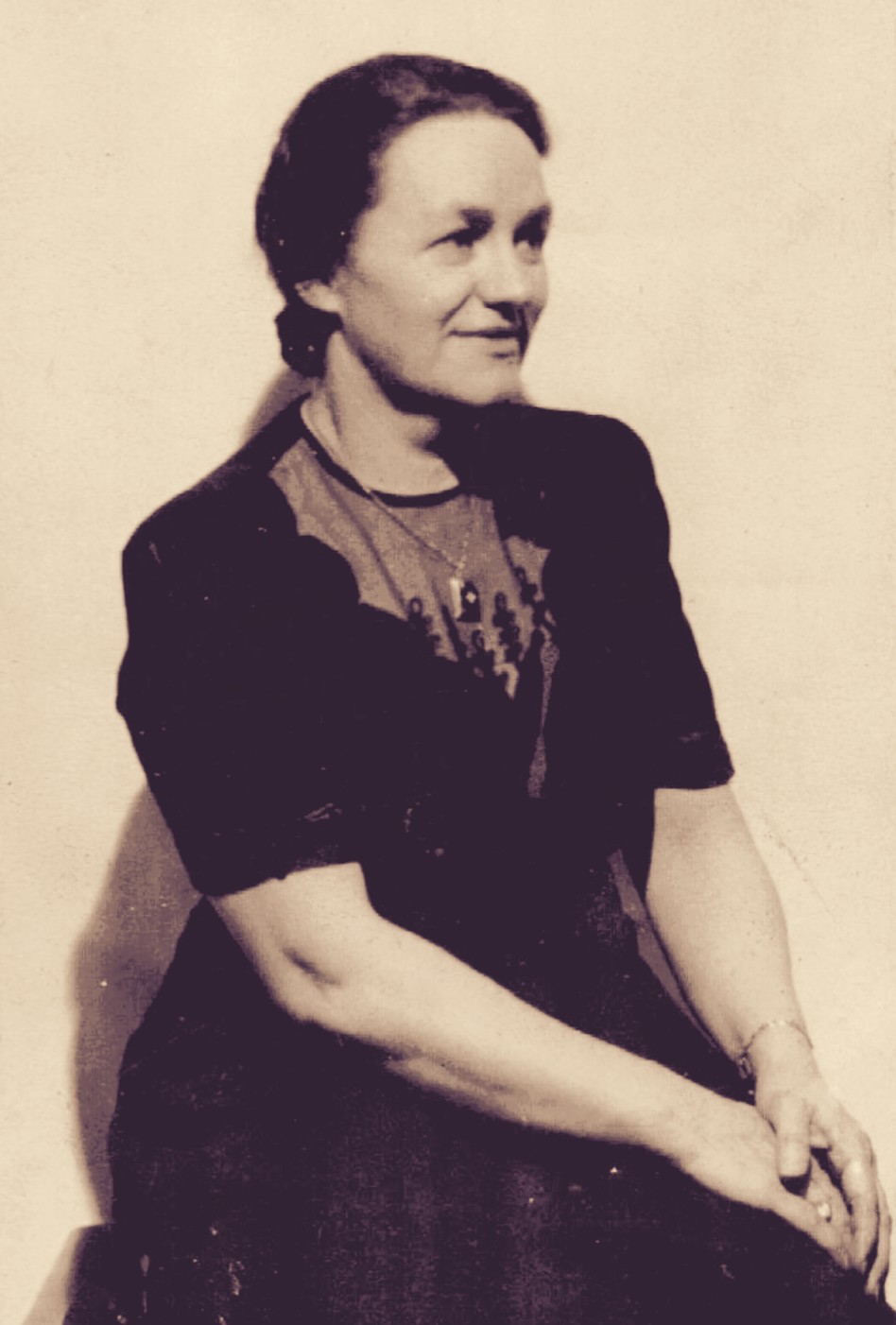
Nona Mae (Snyder) Albert, shown here during the 1940s-early 1950s, became a fashion advocate as a young woman before marrying her husband Allen Albert, owner of Albert’s clothing store in Pine Grove, Pennsylvania. (© Snyder Family Archives. All rights reserved.)
A granddaughter of a twice-wounded veteran of the American Civil War and the first-born daughter of a pioneer in the American telephone industry, Nona Mae (Snyder) Albert was a twentieth-century success story.
Born shortly after the dawn of a new century, she arrived during an era in which medical care providers across the United States routinely failed to address the dangers faced by women during pregnancy and the shockingly high infant mortality rates which persisted well into that new century, and which still, sadly, are failing to be addressed in many parts of America in the twenty-first century. According to the late American demographer Ben Wattenberg, in 1900, “more than one of six American infants … died before the age of one, and mothers were 100 times more likely to die in childbirth than they were” in the year 2000.
But Nona’s mother was a survivor who made sure that her first-born daughter would be a survivor, too. Women of great faith, both were members of the Christ Evangelical Congregational Church in the Village of Lavelle in Schuylkill County, Pennsylvania, where meetings were often held by a local chapter of the Woman’s Christian Temperance Union (WCTU), one of the first organizations in the United States to focus on social justice issues, including the widespread abstention from alcohol and drug use to reduce domestic violence and other forms of violence against women and children, the creation of kindergarten classes in public schools, the establishment of eight-hour work days and a system of equal pay for equal work, health and safety protections for consumers of food, beverages and medicines, and prison reform.
A working woman during a time when women rarely worked outside of their homes, Nona Snyder helped to transform communities across eastern and central Pennsylvania as a “go-to fashion advisor” regarding the latest clothing and accessory trends for men, women and children.
Formative Years
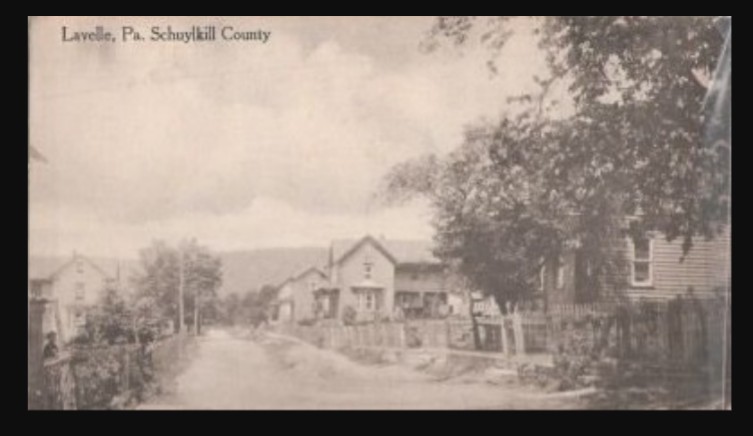
Main Street, Village of Lavelle, Schuylkill County, Pennsylvania, circa 1900 (public domain).
Born in the Village of Lavelle, Schuylkill County, Pennsylvania on 29 January 1900, Nona Mae Snyder was the oldest daughter and second oldest child of John Hartranft Snyder and Minnie Rebecka (Strohecker) Snyder. Her mother, Minnie, was the daughter of Samuel and Annie (Troutman) Strohecker, of Gordon, Schuylkill County. Her father, John, was a son of American Civil War veteran Timothy Matthias Snyder, who had served with the 47th Pennsylvania Volunteer Infantry, and Catharine (Boyer) Snyder.
* Note: Nona Mae Snyder also decended from American Revolutionary War Patriot Johann Nicholas Schneider, according to a membership application that was approved by the National Society of the Sons of the American Revolution during the 1940s by Nona’s younger brother, John Sylvester Snyder.
During the early 1900s, Nona M. Snyder attended the Lavelle School in Lavelle with her older brother, Timothy Peter Snyder (1898-1913). Both had been born at the Snyder family home on Main Street in Lavelle, with Tim having been born roughly two years before the end of the previous century, on 1 May 1898, and Nona having been born shortly after the dawn of the twentieth.
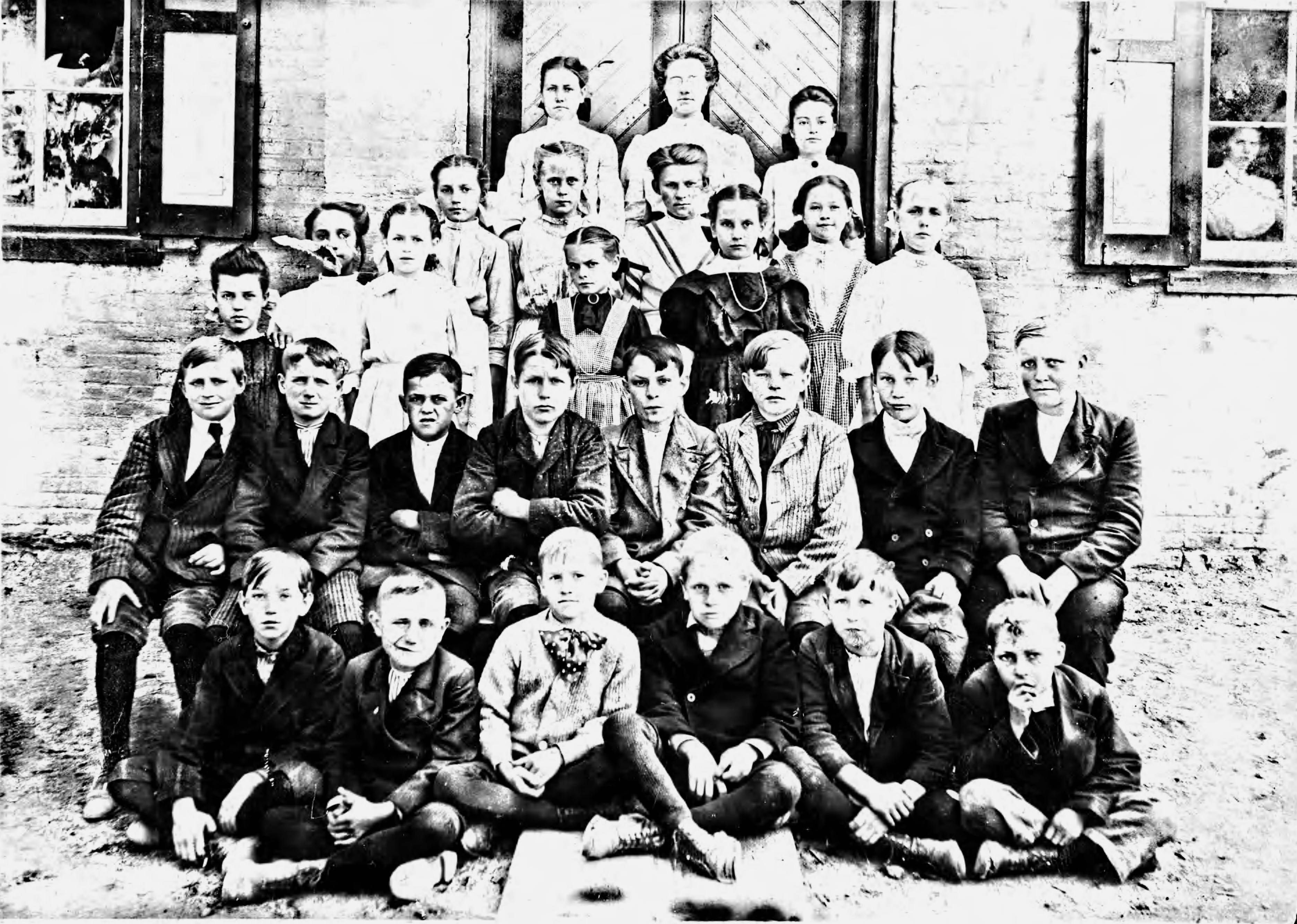
Siblings Timothy P. Snyder (row two, first from left) and Nona M. Snyder (girl in white dress, row three, third from left), Lavelle School, Village of Lavelle, Schuylkill County, Pennsylvania, circa 1908-1910 (U.S. Library of Congress, public domain).
Also attending the Lavelle School with them were their Lavelle-born younger siblings: Helen Corrine Snyder (1901-1988), who was born on 6 September 1901 and would go on to become a bookkeeper with the Jewel Tea Company; John Sylvester Snyder (1904-1969), who was born on 2 May 1904 and would go on to become a construction manager with McKinney Construction in Northumberland County; and Catharine Rebecka Snyder (1906-1995), who was born on 25 August 1906 and would go on to become an executive assistant with the Sperry New Holland Company and marry businessman Charles F. Courtney (1900-1950). A photograph that was taken of Tim and Nona’s class sometime around 1910 has since been preserved by the United States Library of Congress in Washington, D.C.
In 1908, the Snyder siblings welcomed the birth of another sister, Lillian Estelle Snyder (1908-2001), on 30 September 1908. She would go on to become a head nurse at Peter Bent Brigham Hospital in Boston, Massachusetts and a clinical nursing instructor at the Allentown Hospital School of Nursing before working for the pharmaceutical company Merck Sharpe & Dohme in Baltimore, Maryland.
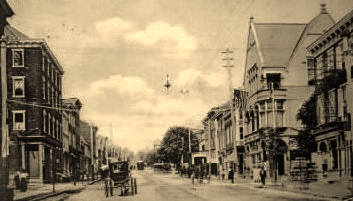
Horse and buggy drivers pass new telephone poles on Ashland, Pennsylvania’s West Centre Street (early 1900s, public domain).
Around this same time, the family’s patriarch, John Hartranft Snyder, co-founded the Lavelle Telegraph and Telephone Company, which was officially incorporated in 1908. John H. Snyder was subsequently credited with installing the first telephone lines in the Lavelle Valley, as well as in rural areas south of the city of Ashland in Schuylkill County. During the firm’s early days, its main communications center was based at the Snyder family home on Main Street in Lavelle.
In addition to John H. Snyder’s involvement with the Lavelle Telegraph and Telephone Company, John Snyder’s wife, Minnie, and their oldest children operated a dry goods store from the ground floor of the Snyder family home in Lavelle, which was located directly across from the Lavelle School.
By 1910, the increasingly prosperous Snyder family was welcoming the arrival of another child–Chester Hartranft Snyder (1910-1983). Born on 17 October 1910, he would ultimately grow up to become an insurance company executive.
But that progress would be abruptly halted when the Snyders experienced the first of two tragedies. In 1911, the Snyder family home in Lavelle was destroyed by fire. The family subsequently rebuilt their home at the same site on Main Street, but were required to relocate to Ashland during the construction. As a result, the family underwent several years of hardship.
A Heartbreaking End
As if that devastating fire had not been tragic enough, Nona’s older brother, Timothy P. Snyder, was critically injured two years later during a coal mining-related accident. Just nine days shy of his fifteenth birthday, he fell from a coal train while working as a laborer at the Potts Colliery in Locustdale, Schuylkill County on 22 April 1913. The train, which was in motion at the time, ran over his legs. His battered body was taken from the colliery to the Ashland Hospital in Ashland, but he died while en route, at 2:30 that same afternoon.
Snyder family records and oral histories confirm that the teenaged Timothy P. Snyder had taken a man-sized job at the colliery to help his family meet ends during the rebuilding of their home following the 1911 fire. He remains at rest with his parents, John Hartranft Snyder and Minnie Rebecka (Strohecker) Snyder, at the Snyder family plot at the Citizens’ Cemetery in Lavelle, Pennsylvania.
Roughly four years later, the final Snyder sibling–Willard Emery Snyder (1917-1972)–was born in Lavelle on 31 July 1917. Like his father before him, Willard E. Snyder would have a long relationship with the telephone industry.
On 8 August 1918, the siblings’ paternal grandmother, Catharine (Boyer) Snyder, the widow of American Civil War veteran Timothy Matthias Snyder, died at her home at 1131 Church Street in Reading, Pennsylvania. In her late sixties at the time of her death from complications related to pulmonary tuberculosis, Catharine’s remains were transported to the Brock Cemetery in Ashland, Schuylkill County, for burial beside her husband on 11 August.
Perseverance in the Face of Adversity
As a chief stockholder and secretary of the Lavelle Telegraph and Telephone Company, Snyder family patriarch John Hartranft Snyder continued to manage the firm’s expansion throughout the teen and early adult years of the older Snyder siblings.
By 1920, Nona Snyder was still residing at home in Lavelle with her parents. Also residing at the Snyders’ home were Nona’s younger siblings: Corrine, John S., Catharine R., Lillian E., Chester H., and Willard E. Snyder. According to that year’s federal census, Nona was a nineteen-year-old “Saleslady” in a “Clothing Store,” and was the only one of her siblings working that year. Their father, John H. Snyder, was described as a “Carpenter” who was employed in the “Coal Mines.” All of the Snyder children, except for Willard (but including Nona), were described as having attended school since the beginning of that school year.
That same year, the Snyder sisters’ mother and aunts, as well as other women across the United States of America who were twenty-one years of age or older, were granted the right to vote, following the ratification of the Nineteenth Amendment to the United States Constitution on 18 August 1920.
By 1926, Nona Snyder’s younger sisters, H. Corrine and Catharine R. Snyder, had moved out of the Snyder family home in Lavelle and had relocated to the city of Reading in neighboring Berks County, Pennsylvania. On 26 August of that year, Reading newspapers were reporting that “Miss Nona Snyder, of Lavelle,” was “spending time with her sisters, Misses Kitty and Corrine, of Bethany Church, Reading.” Both Kitty and Corrine were living together in an apartment at 1037 North 4th Street in Reading. Corrine, who was also known to her family as “Eenie,” was employed as a bookkeeper, while Catharine, who was also known to her family as “Kitty” or “Kit,” worked as a stenographer.
By the winter of 1927, her younger sister, Lillian, had also moved out of the Snyder family home in Lavelle. Enrolled in the Reading Hospital School of Nursing on 5 February 1927, she resided in Reading with her sisters, Corrine and Catharine at their apartment. Following her graduation on 9 May 1929, Lillian then pursued additional training at the same nursing school, and was also appointed to the faculty of the Reading Hospital School of Nursing as a nursing instructor.
And then another unfathomable tragedy struck. On 28 October 1929, the Dow Jones (America’s stock market) suffered a thirteen percent loss, followed by a twelve percent loss the next day, sparking a worldwide financial disaster that would ultimately come to be known as the Great Depression. “By mid-November, the Dow had lost almost half its value,” according to historians at the United States Federal Reserve.
The slide continued through the summer of 1932, when the Dow closed at 41.22, its lowest value of the twentieth century, 89 percent below its peak. The Dow did not return to its pre-crash heights until November 1954.
Still single and still residing with her parents in Lavelle as of 1930, Nona Snyder was described by that year’s federal census enumerator as not working, like so many other Americans, while her younger brother, John Sylvester Snyder, who was also still living at home, was described as a laborer at a lumber company. Their twelve-year-old brother, Willard, who was also living with them, was still a student at a public school in the county. Their father, John H. Snyder, was also still working as a laborer at an area coal mine.
According to historians at the FDR Library & Museum, “By the time that FDR [Franklin Delano Roosevelt] was inaugurated on March 4, 1933, the banking system had collapsed” and “nearly 25% of the labor force was unemployed.”
Factories were shut down, farms and homes were lost to foreclosure, mills and mines were abandoned, and people went hungry. The resulting lower incomes meant the further inability of the people to spend or to save their way out of the crisis, thus perpetuating the economic slowdown in a seemingly never-ending cycle….
In the First Hundred Days of his new administration, FDR pushed through Congress a package of legislation designed to lift the nation out of the Depression. Roosevelt declared a “banking holiday” to end the runs on the banks and created new federal programs by so-called “alphabet agencies.” For example, the AAA (Agricultural Adjustment Administration) stabilized farm prices and thus saved farms. The CCC (Civilian Conservation Corps) provided jobs to unemployed youths while improving the environment. The TVA (Tennessee Valley Authority) provided jobs and brought electricity to rural areas for the first time. The FERA (Federal Emergency Relief Administration) and the WPA (Works Progress Administration) provided jobs to thousands of unemployed Americans in construction and arts projects across the country. The NRA (National Recovery Administration) sought to stabilize consumer goods prices….
Those efforts came to be known as President Roosevelt’s “New Deal for the American People,” and they gave many Americans the hope and confidence they needed to embark upon new paths in life. Among those doing so was Nona Snyder’s younger brother, Chester Hartranft Snyder, who began his own family line on 15 June 1933 by marrying Roma May Haas (1914-2003), a daughter of Palmer C. Haas and Mayme J. (Dietz) Haas of Pitman, Schuylkill County. Their wedding ceremony was held in the parsonage of the Salem Reformed Church in Leck Kill, and was officiated by the Reverand James Beam.
And Nona Snyder was there, before during and after that important day, helping to pull the wedding off in style. According to the Mount Carmel Item:
The costume of the bride was a gown of pink mousseline de sole with white accessories. She carried a bouquet of roses.
Miss Haas was attended by Miss Nona Snyder, a sister of the bridegroom. Miss Snyder’s outfit was of rose chiffon with tan accessories. She carried roses of a corresponding hue.
The interests of the bridegroom were looked after by John S. Snyder, of Mount Carmel, a brother.
The bride is a daughter of Mr. and Mrs. Palmer C. Haas, of Pitman, and is a graduate of the Mount Carmel High School class of 1931. Miss Haas has been residing in Mount Carmel for some time.
The bridegroom is the well known son of Mr. and Mrs. John H. Snyder, of Lavelle. He is a graduate of the Ashland High School class of 1928, and is employed by the Lavelle Telephone Company.
By 1938, the United States Treasury Department was funding large-scale public infrastructure improvements, including the construction of new railroad lines and new housing for Americans who were homeless or living in residential homes or apartments that were unsafe.
Around this same time, Nona Snyder made the decision to move out of the Snyder family home in Lavelle. By 1938, she was making a new life for herself in neighboring Lebanon County.
* Note: Still involved with the Lavelle Telegraph and Telephone Company to some degree over the next few years, Nona Snyder’s father, John H. Snyder, would gradually begin to curtail his business efforts as he fell ill with cancer. The operations of Lavelle Telephone and Telegaph were subsequently connected to those of the Bell Telephone Company’s facility in Ashland. After forty-seven years of transmission, control of the entire firm was transferred to Bell Telephone of Pennsylvania in 1956.
Fashion Career, Death of Parents and Marriage
By 1942, Nona Snyder was employed as a saleswoman by Logan’s Ready-to-Wear Shop, a women’s clothing store that was located at 816 Cumberland Street in the city of Lebanon, and was residing by herself in an apartment in neighboring Myerstown, Lebanon County.
The next two years were also difficult ones for Nona Snyder and her siblings, however, as their father, John H. Snyder, became increasingly frail due to stomach cancer, and was forced to undergo major surgery at the Geisinger Hospital in Danville, Pennsylvania on 22 May 1944. As his condition worsened, Nona’s youngest brother, Willard Snyder, who was stationed with a unit of the United States Navy’s Seabees on Midway Island in the Pacific Theater of World War II, was brought home for a thirty-day leave of absence to visit their dying father.
Although Nona’s father lived to see his youngest son again, their reunion was too brief. As the end of his thirty-day leave approached, Willard bid farewell to his dad, and headed back to the Pacific Theater to help his fellow soldiers and sailors finally end the war.
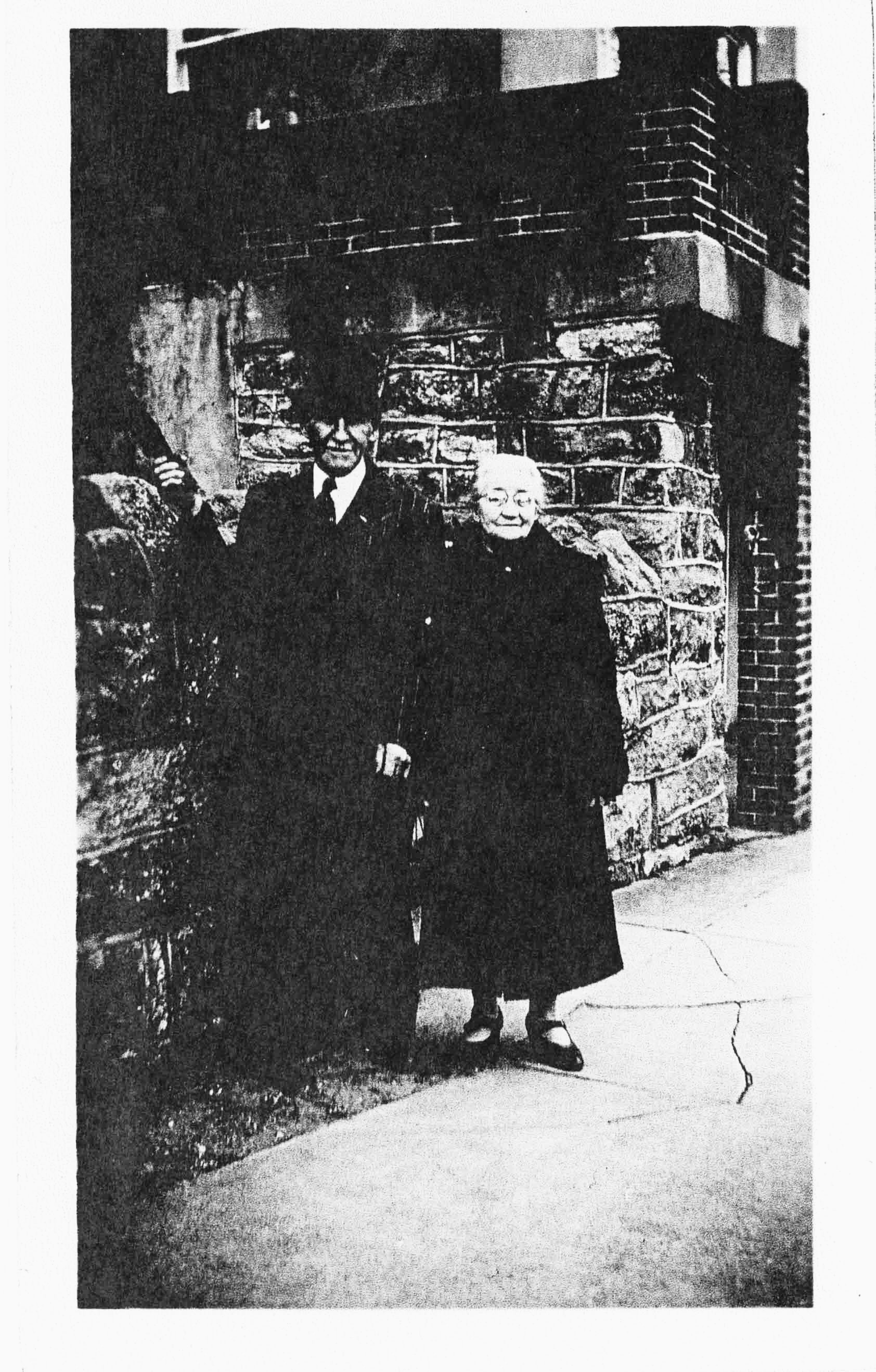
John Hartranft Snyder and Minnie R. Snyder, Snyder Family Home, Main Street, Lavelle, Pennsylvania, circa 1943. The doorway seen behind Minnie’s left shoulder was the entrance to their former dry goods store. (© Snyder Family Archives. All rights reserved.)
On 5 August 1944, John Hartranft Snyder succumbed to cancer-related complications–just weeks after Willard had returned to his duties on Midway Island. Following his passing at the Snyder family home in Lavelle, John H. Snyder was laid to rest at the Citizens’ Cemetery in Lavelle, in the same family plot where Nona’s older brother, Timothy P. Snyder, had been buried following his tragic, fatal accident in 1913.
By 1945, Nona Snyder was residing at 506 Spruce Street in Lebanon, according to that year’s city directory. Still living at 506 Spruce Street in Lebanon five years later when the federal census enumerator arrived on her doorstep on 8 April 1950, Nona Snyder was described as a fifty-year-old “Saleslady” at a “Ladies Apparel Store,” who had worked forty-five hours within the previous week and had never married.
She had come of age during an era in American History in which women had progressed from having limited civil rights (not being able to vote), while dealing with societal pressures that she marry, have multiple children (at great risk to her own health and the health of those potential children) and largely stay at home rearing those children, to one in which she had greater decision-making power regarding her future.
By the mid-twentieth century, she was able to decide for herself whether or not she wanted to work and what types of work she might find fulfilling. Able to decide for herself whether or not she wanted to marry and when, she was also able to choose the person best suited to be her husband. As a result, Nona decided to remain unmarried for the duration of her mother’s life.
Although her mother had been in good health for most of her days, Minnie (Strohecker) Snyder also soon fell ill with cancer. Initially able to continue residing at the Snyder home into the early 1950s, largely thanks to the nursing care she was given by Nona’s unmarried sister, Lillian, who had given up her head nursing job in Boston to care for their mother, Minnie Snyder was ultimately forced by her own declining health to move into the apartment that Lillian shared with her older, unmarried sister, H. Corrine Snyder, who was employed as a bookkeeper by a branch of the Jewel Tea Company in Allentown, Lehigh County. (Lillian was a clinical nursing instructor at the Allentown Hospital’s School of Nursing.)
Following her death at the age of eighty, on 28 April 1952, Minnie R. (Strohecker) Snyder was laid to rest beside her husband and her first-born son, Tim, at the Citizens’ Cemetery in Lavelle, Schuylkill County.
At this juncture of her life, Nona Snyder finally felt free to marry. So, at 8 a.m., on 23 September 1953, she wed Allen Adam Albert (1907-1993) at the First Evangelical Congregational Church in Lebanon, Pennsylvania. A subsequent report by the Lebanon Daily News noted that “Mrs. Albert was attired in a winter navy silk dress with matching accessories,” and “carried a white Bible centered with white roses and streamers.”
The couple was unattended. After a wedding trip to New York State, they will reside at 41 South Main Street, Pine Grove. For traveling, Mrs. Albert wore a charcoal tweed dress with matching accessories.
The bride was employed by Logan’s Ready to Wear Shop. The groom is a well known business man of Pine Grove.

Advertisement, Albert’s Store, Pine Grove, Pennsylvania (West Schuylkill Press and Pine Grove Herald, 23 November 1960, public domain; click to enlarge).
Her husband, Allen A. Albert, was the owner of Albert’s clothing store, which was located in Pine Grove. Schuylkill County, at 41 South Tulpehocken Street (the town’s main street) For the first five years of their marriage, they resided above the store. During their final year there, they oversaw the planning and construction of a new home on ground formerly owned by John Calvin Hikes (on Outwood Road in Pine Grove), while continuing to operate their store. They had purchased the land for twelve hundred dollars.
In late January 1957, Nona Albert traveled to Pennsylvania’s capital city of Harrisburg, where she participated in a three-day “corset training school” that was presented by the Warner Brothers Co. of Bridgeport, Connecticut and was attended by “dealers and store personnel of eastern Pennsylvania,” according to a notice in the Pine Grove Herald.
In January 1958, Nona and Allen Albert moved into their new home on Oak Grove Road in Pine Grove, and expanded their store, resulting in its change of address to 41-43 South Tulpehocken Street.
During the final years of the 1950s, roughly four million workers across the United States were employed in sales-related jobs with retail salespeople making up sixty percent of that segment of the American workforce, according to U.S. Department of Labor statistics, which noted in its OccupationalHandbook of 1959 that the field of retail sales had become “an important source of employment for women.”
In selling large, expensive items, ssuch as furniture, electrical appliances, or some types of wearing apparel, the primary job of the salesman or saleswoman is to give the customer as much assistance as possible in order to create an interest in, and a desire to purchase, the store’s merchandise. The salesperson may spend a large part of his time showing various styles or colors, demonstrating the article, pointing out its desirable features, answering questions about the construction or use of the product, and helping the customer make a selection. Special skills are required to sell certain items….
In addition to their selling duties, most salespeople must make out sales or charge slips. In many stores, they receive cash payments and give change and receipts. Salespersons are usually responsible also for keeping the sales counter, shelves, or floor neat and presentable at all times. In small retail stores, they may assist in ordering merchandise, stocking shelves or racks, marking price tags, taking inventories, preparing attractive merchandise displays, and promoting regular and special sales….
Employers generally prefer to hire high school graduates for most sales jobs. Subjects such as salesmanship, commercial arithmetic, and home economics help to give the student a good background for selling positions. Many high schools have distributive education programs, which include courses in merchandising, principles of retailing, and retail selling, and also provide for part-time work (usually from 15 to 18 hours a week) in a local store….
Salaries for beginning salespersons may range from about $25 to more than $50 a week depending on geographic location, type and size of store, and other factors. According to salary data based on a small number of union contracts with stores in cities and suburban areas, inexperienced salespersons working a 40-hour week generally earned from about $40 to slightly more than $60 in variety, hardware, bakery, drug, jewelry, and apparel stores in mid-1958. Experienced salespersons usually receive from $10 to $25 more than beginners in the same store. The highest earnings, often averaging $100 or more a week, are received by people who sell automobiles, major appliances, and furniture….
As co-owners of Albert’s Store, Nona and Allen Albert were responsible for doing it all–taking regular inventories, ordering merchandise from their various suppliers (both in person, via buying trips to major East Coast cities, and remotely via catalog, mail and telephone contacts with trusted vendors), stocking their store’s shelves and clothing racks, marking price tags, designing and building eye-catching merchandise displays for their store’s front window and interior, promoting the arrival of new items and special sales through newspaper advertisements, greeting and advising customers about apparel styles and colors that would be flattering to them or the most appropriate for special occasions, receiving cash and making change for customer purchases (and, later in their careers, processing credit card transactions), creating sales receipts, making charitable gifts to local schools and community groups, bookkeeping (accounts payable and receivable, payroll and tax preparation), cleaning the store, and managing the saleswomen they occasionally hired over the years during their store’s busiest seasons.
As a result, as co-owners and co-operators of Albert’s Store, they were the largest beneficiaries of its profits. What money that Albert’s made that was not put back into business operations, the occasional employee’s wages or charitable gifts to the community each year, was put toward the steady increase of income for both Allen and Nona Albert.
1960s
As yet another decade opened, the winter and spring months became increasingly hectic for Nona Albert as she planned a fashion show for the evening of 9 June 1960, as part of the tenth anniversary celebrations of the Pine Grove Business and Professional Women’s Club. Held in the social hall at St. Peter’s Lutheran Church on South Tulpehocken Street, the fashion show was described by the West Schuylkill Press and Pine Grove Herald as “the highlight of the program,” and featured clothing modeled by women and children, followed by the awarding of “door prizes” by Nona and Allen Albert to attendees of the event. The evening also included a roast beef and pork dinner and a vocal music performance of popular Broadway show tunes.
Five years later, they remodeled their store, and continued their efforts to grow their business. In the fall of 1969, the “Allen Albert store” was honored for its participation in a “Beauty for Business” project sponsored by the Pine Grove Women’s Club and the Pennsylvania Federation of Women’s Clubs.
Faith and Community Service
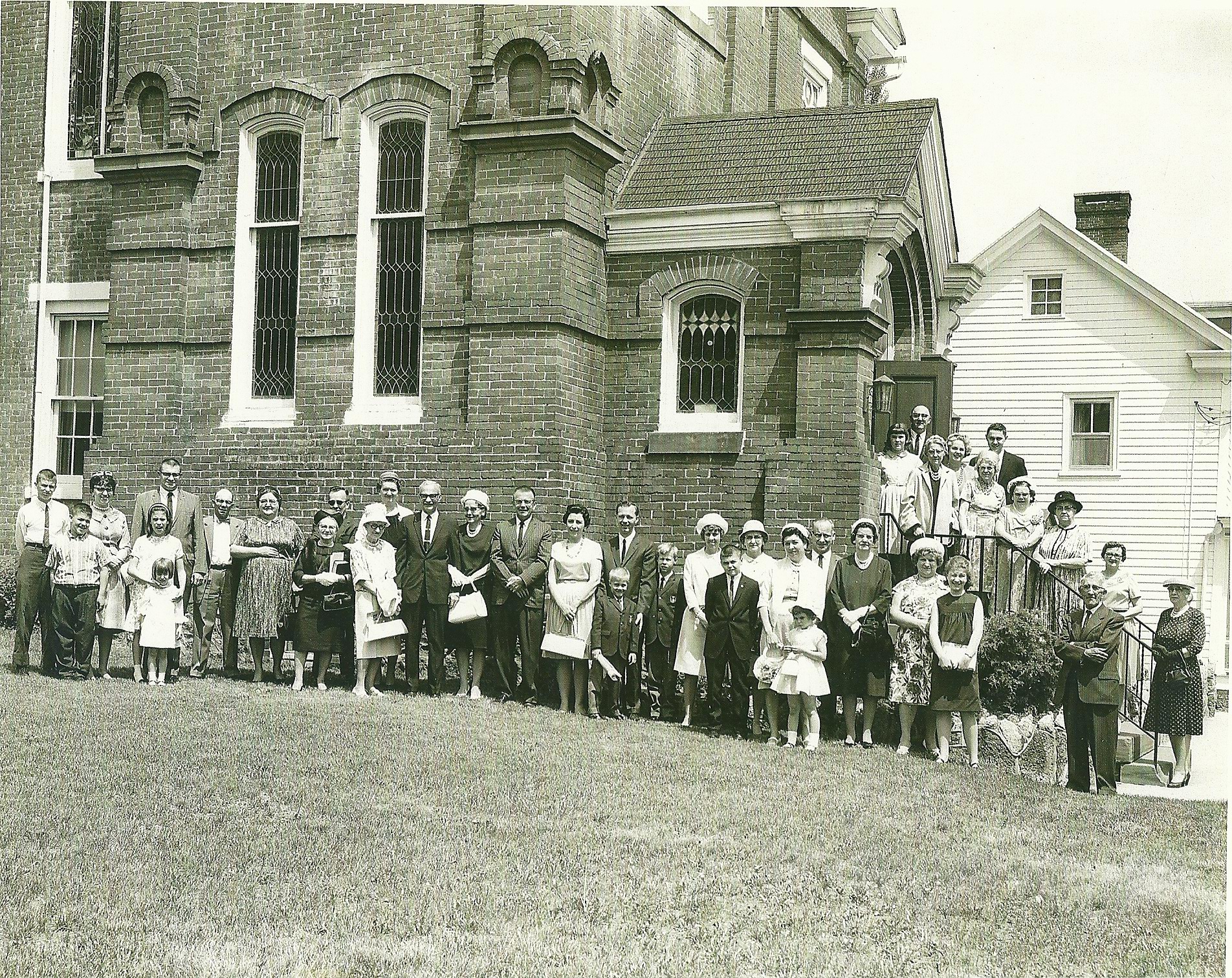
Nona (Snyder) Albert and her husband, Allen Albert, (directly below the brick area between the two long stained glass windows), St. Paul’s Evangelical Congregational Church, Pine Grove, Pennsylvania, 1965. (© Snyder Family Archives. All rights reserved.)
Shaped by the Temperance Movement, which increased in both membership size and power during her formative years, Nona Albert was temperate herself, abstaining even from caffeinated beverages throughout her life.
A member of the School of Methods club during the 1920s and early 1930s and of the Junior Christian Endeavor Society of the Christ Evangelical Congregational Church in Lavelle in the 1930s, she was also active in Bible classes and that church’s Sunday school. In 1938, the Pottsville Evening Republican reported that she directed that year’s Mother’s Day program for her church.
Following her marriage to Allen Albert, she joined St. Paul’s Evangelical Congregational Church in Pine Grove, and was a member of, and frequent attendee at, events sponosored by that church’s Women’s Missionary Society for the remainder of her life.
In 1963, she planned and overaw a society meeting at which Dr. Karl Becker, a medical missionary who had served in the Congo region of Africa for more than thirty years, presented a lecture about his work. The program attracted a large crowd from multiple cities within driving distance of Pine Grove. In November 1966, she planned and oversaw a program honoring missionaries who had been serving in Vietnam, which helped to raise funds in support of their ongoing work.
Three years later, she received word that her younger brother, John Sylvester Snyder, had been hospitalized after suffering a stroke. Following his death in Allentown, Lehigh County, Pennsylvania on 12 November 1969, he was laid to rest at that city’s Cedar Hill Memorial Park.
By the fall of 1972, she had been elected as the vice presdent of her church’s missionary society. Sadly, that same year, her youngest brother, Willard Emery Snyder, suffered a heart attack at work on 10 November and died later that morning. Following graveside funeral services on a cold, rainy 13 November, he was laid to rest at the Sinking Spring Cemetery in Sinking Spring, Berks County, Pennsylvania.
By the fall of 1977, Nona Albert was serving as president of her church’s missionary society. She and her husband also provided financial and in-kind support to the local schools and civic groups, and joined with members of their church in visiting elderly residents at area nursing homes.
Later Life, Death and Interment
Because Nona and Allen Albert married later in life, they had no children of their own, but they were active members of their church in Pine Grove throughout the remainder of their lives.
Opting for retirement in 1970, they closed their store in January of that year. The following month, they were honored by The Pine Grove Herald with a front-page feature story, “Allen and Nona Albert’s Retirement a Loss to Long-Time Customers,” which was continued on the second page of that 12 February edition, under the headline, “Allen and Nona.”
The closing last month of Albert’s Store, a 41 S. Tulpehocken St., Pine Grove fixture for many years, came as a shock to many residents, for it filled a special place among the town’s business establishments and will be missed.
All of Albert’s customers agree that Allen and Nona Albert have certainly earned the right to retire if they want to, and indeed, wish them the happiest of retirements. But that doesn’t alter the fact that they have left a real vacancy behind them.
Allen Albert’s father, Claude, went into business in September, 1901 — the same month in which he married the former Rebecca Fehr. The Alberts had a newspaper distribution and confectionary in the store now used [in 1970] by Clark Snyder as a store room, across Tulpehocken Street from the Funeral Home; then later in the property now occupied by the Automatic Laundry. Allen Albert remembers his father telling him that he started in business within two weeks of the assassination of President McKinley, as he remembered selling out of newspapers as a result of that shocking event.
Mr. Albert thinks his father moved his business to its present address, 41 S. Tulpehocken St., around the year 1910. At that time it was a general store, selling clothing, groceries and other merchandise. Allen Albert literally grew up with the business. After his graduation from high school, his father went out of the ‘general store’ trade and specialized in clothing, and in 1928 Allen began to take an active part in the business, which he continued until it closed in January this year [1970].
Both his parents worked in the store throughout the remainder of their lives. His father died in 1948; his mother followed him in 1953.
Allen Albert continued to run the store in which he had spent all of his adult life.
In September, 1953, Allen Albert and Nona Snyder were married in Lebanon, and the new Mrs. Albert became part of the business that was a fixture in Pine Grove. She brought with her an excellent background of experience in the retail trade. Born in Lavelle, she worked first in Ashland and then in Lebanon, always in the ready-to-wear business.
Both Mr. and Mrs. Albert said that in their years of work, they enjoyed the actual selling more than any other part of the business. Allen Albert said he liked the challenge of the business, and they both confessed they miss their daily contacts with customers, many of whom they have known for years.
They made buying trips to Philadelphia and New York, several times a year, and said they would like to visit both of these cities in the future, and enjoy them at a leisurely pace. ‘We were really working when we went to the city,’ Mr. Albert said, adding that they had little time to visit the sights and entertainments available in the great metropolitan centers.
Mrs. Albert looks forward to spending more time in her garden, which she loves; Mr. Albert plans to golf more, and perhaps to giving part of his time to business in some capacity which will not make the constant demands on time and energy that were made by the store. Both are active members of St. Paul’s Evangelical Congregational Church in Pine Grove….
Continuing to lead Sunday school lectures, plan missionary society programs and visit residents of area homes for the aged, they remained vibrant well into their final years–even as Nona recovered from multiple heart attacks. In March 1975, Nona Albert traveled to and through Florida on a Christian Tour road trip, during which she and other members of her group attended a Bible conference in Boca Raton, attended a church service in Ocala and visited both Cypress Gardens and Disney World. The tour group’s slogan was “Keys to Better Living.”
In 1983, she was preceded in death by her final surviving brother, Chester Hartranft Snyder, who passed away in Harrisburg, Pennsylvania on 22 July 1983, and was laid to rest at the Rolling Green Cemetery in Camp Hill, Cumberland County.
Nona Mae (Snyder) Albert died at the age of eighty-seven at the Pottsville Hospital in Pottsville, Schuylkill County, Pennsylvania on 6 May 1987. Following funeral services, she was laid to rest at the Saint John’s Lutheran Cemetery in Pine Grove, Schuylkill County.
Long after her passing, she was still remembered by her fellow church members and neighbors for her contributions to the church cookbook and community bake sales. She made a wicked sand tart.
Sources:
- “100 Years Ago–1911” (brief news recap of the 1911 fire which destroyed the Lavelle, Pennsylvania home of John Hartranft Snyder and his family). Pottsville, Pennsylvania: Republican-Herald, 17 March 2011.
- “Albert’s Store,” in “News and Events of Coming Week in Pine Grove Area.” Tremont, Pennsylvania: West Schuylkill Press and Pine Grove Herald, 24 January 1958.
- “Allen and Nona Albert’s Retirement a Loss to Long-Time Customers.” Tremont, Pennsylvania: The Press-Herald and The Pine Grove Herald, 12 February 1970.
- Attendance, Graduation and Employment Records of Lillian Estelle Snyder, Reading Hospital School of Nursing, 1927-1939 (Nona Snyder’s younger sister). West Reading, Pennsylvania: Office of the Registrar, School of Nursing, Reading Hospital.
- “Brief Items of Interest About People of Pine Grove and Vicinity” (mention of the start on construction by Nona and Allen Albert of a new home on Oak Grove Road in Pine Grove). Tremont, Pennsylvania: West Schuylkill Press and Pine Grove Herald, 5 July 1957.
- “Brief Items of Interest About People of Pine Grove and Vicinity” (mention of the move by Nona and Allen Albert into their new home on Oak Grove Road in Pine Grove and their planned expansion of Albert’s Store). Tremont, Pennsylvania: West Schuylkill Press and Pine Grove Herald, 24 January 1958.
- Catharine Snyder (paternal grandmother of Nona (Snyder) Albert), in Death Certificates (file no.: 91429, registered no.: 1242, date of death: 8 August 1918). Harrisburg, Pennsylvania: Commonwealth of Pennsylvania, Department of Health, Bureau of Vital Statistics.
- “Certificates Awarded” (notice of recognition for the “Allen Albert Store” by the Pine Grove Women’s Club and Pennsylvania Federation of Women’s Clubs). Lebanon, Pennsylvania: Lebanon Daily News, 20 September 1969.
- “Christmas Party for Missionaries and Children.” Tremont, Pennsylvania: Pine Grove Herald, 14 December 1972.
- “Church Unit Honors Viet Workers.” Tremont, Pennsylvania: West Schuylkill Press and Pine Grove Herald, 10 November 1966.
- “Died on Way to Hospital” (brief notice of Timothy P. Snyder’s fatal accident at work). Pottsville, Pennsylvania: Pottsville Republican, 23 April 1913.
- “Entertain Guests at Memorial Home in Myerstown.” Tremont, Pennsylvania: West Schuylkill Press and Pine Grove Herald, 23 September 1965.
- Gordon, Elizabeth Putnam. Women Torch-Bearers: The Story of the Woman’s Christian Temperance Union. Evanston, Illinois: National Woman’s Christian Temperance Union Publishing House, 1924.
- “Great Depression Facts.” Hyde Park, New York: FDR Library & Museum, retrieved online 16 February 2025.
- John H. Snyder (father of Nona M. Snyder), in Death Certificates (file no.: 73704, registered no.: 184, date of death: 5 August 1944). Harrisburg, Pennsylvania: Commonwealth of Pennsylvania, Department of Health, Bureau of Vital Statistics.
- “John H. Snyder, Lavelle, ‘Phone Official, Dies” (obituary of Nona M. Snyder’s father). Mount Carmel, Pennsylvania: Mount Carmel Item, 7 August 1944.
- “Miss Nona Snyder Is Married Today to Pine Grove Man” (article describing the wedding ceremony of Nona M. Snyder and Allen A. Albert). Lebanon, Pennsylvania: Lebanon Daily News, 23 September 1953.
- Snyder, Corrine and Catharine, in Reading City Directory, 1926. Reading, Pennsylvania: Boyd’s City Directories.
- Maurer, Russ. “Lavelle Telegraph Telephone Company Charted in 1908,” in “Memories of Russ Maurer.” Hegins, Pennsylvania: The Citizen-Standard, circa 1990s.
- Miss Nona Snyder, in “Lavelle.” Pottsville, Pennsylvania: Pottsville Evening Republican, 9 May 1938.
- “Missionary Tells of Experiences in South Africa.” Tremont, Pennsylvania: West Schuylkill Press and Pine Grove Herald, 18 April 1958.
- “Mrs. John H. Snyder” (obituary of Nona M. Snyder’s mother). Pottsville, Pennsylvania: Pottsville Republican, 29 April 1952.
- Nona, Corrine and “Kitty” Snyder, in “Personal Mentions.” Reading, Pennsylvania: The Reading Eagle, 26 August 1926.
- “Nona Albert” (obituary). Lebanon, Pennsylvania: The Daily News, 3 June 1960.
- Occupational Outlook Handbook, 1959 Edition, pp. 239-249, in Bulletin No. 1255. Washington, D.C.: United States Department of Labor, 1959.
- “Pine Grove B.P.W.C. Has 10th Anniversary Dinner.” Tremont, Pennsylvania: West Schuylkill Press and Pine Grove Herald, 24 January 1958.
- “Property Transfers” (purchase of Hikes’ estate land by Nona and Allen Albert). Tremont, Pennsylvania: West Schuylkill Press and Pine Grove Herald, 8 February 1957.
- “Returns from Bible Conference in Florida.” Tremont, Pennsylvania: Pine Grove Herald, 27 March 1975.
- “Roma Haas Was Married Last Evening” (news coverage of the wedding of Nona Snyder’s younger brother, Chester H. Snyder). Mount Carmel, Pennsylvania: Mount Carmel Item, 16 June 1933.
- Snyder, John H., Minnie R., Timothy P. and Nona M., in U.S. Census (Butler Township, Schuylkill County, Pennsylvania, 1900). Washington, D.C.: U.S. National Archives and Records Administration.
- Snyder, John H., Minnie R., Timothy P., Nona M., H. Corrine, John S., Catharine R., and Lillian E., in U.S. Census (Lavelle, Northwest Butler Township, Schuylkill County, Pennsylvania, 1910). Washington, D.C.: U.S. National Archives and Records Administration.
- Snyder, John H., Minnie, Nona M., John S., and Willard E. in U.S. Census (Butler Township, Schuylkill County, Pennsylvania, 1930). Washington, D.C.: U.S. National Archives and Records Administration.
- Snyder, John H., Minnie R., Nona, Corrine, John S., Catharine R., Lillian E., Chester H., and Willard E. in U.S. Census (Butler Township, Schuylkill County, Pennsylvania, 1920). Washington, D.C.: U.S. National Archives and Records Administration.
- Snyder, Nona M., in Polk’s Lebanon, Pa. City Directory, 1924. Boston, Massachusetts: R. L. Polk Co., Inc., 1942.
- Snyder, Nona M., in U.S. Census (Lebanon, Lebanon County, Pennsylvania, 1950). Washington, D.C.: U.S. National Archives and Records Administration.
- “Stock Market Crash of 1929,” in “The Great Depression,” in “Federal Reserve History.” Washington, D.C.: Federal Reserve, retrieved online 16 February 2025.
- “Tells of Mission Work in Congo.” Tremont, Pennsylvania: West Schuylkill Press and Pine Grove Herald, 24 October 1963.
- “The Young Crusader Woman’s Christian Temperance Union Magazine for Children, 1934,” in “Document Bank of Virginia.” Richmond, Virginia: Library of Virginia, retrieved online 15 February 2025.
- Timothy P. Snyder, in Death Certificates (file no.: 34710, date of death: 22 April 1913). Harrisburg, Pennsylvania: Commonwealth of Pennsylvania, Department of Health, Bureau of Vital Statistics.
- Wattenberg, Ben. “FMC Program Segments 1900-1930: Infant and Maternal Mortality,” in “The First Measured Century.” Washington, D.C.: PBS, 2000 (retrieved online 14 February 2025).
- “W.C.T.U. Convention,” in “Frackville News.” Shenandoah, Pennsylvania: Evening Herald, 30 September 1950.
- “Work in Africa Told by Missionaries at St. Paul’s E.C.” Tremont, Pennsylvania: Pine Grove Herald, 20 October 1977.
 47th Pennsylvania Volunteers
You must be logged in to post a comment.